How To Use Text-To-Speech on Google Docs



Key Takeaways
- Text-to-speech Google Docs makes voice typing, proofreading, accessibility, and multitasking significantly easier for busy professionals.
- Despite its usefulness, the Google Doc text to speech function is limited by regional availability, desktop-only access, and basic customization options.
- Users who need universal access or advanced voice controls must enable screen reader support and rely on add-ons or browser extensions.
- Chrome and Firefox extensions like Speechify, Read Aloud, NaturalReader, and Voice Reader offer richer features, broader language support, and higher-quality audio.
- Murf emerges as a strong alternative, offering highly natural voices, customizable narration, and MP3 export capabilities beyond Google Docs’ built-in tool.
Google Docs is one of the most popular text editors used by business teams across industries. Its ease of use and rich features make it the best choice for most, if not all, documenting applications.
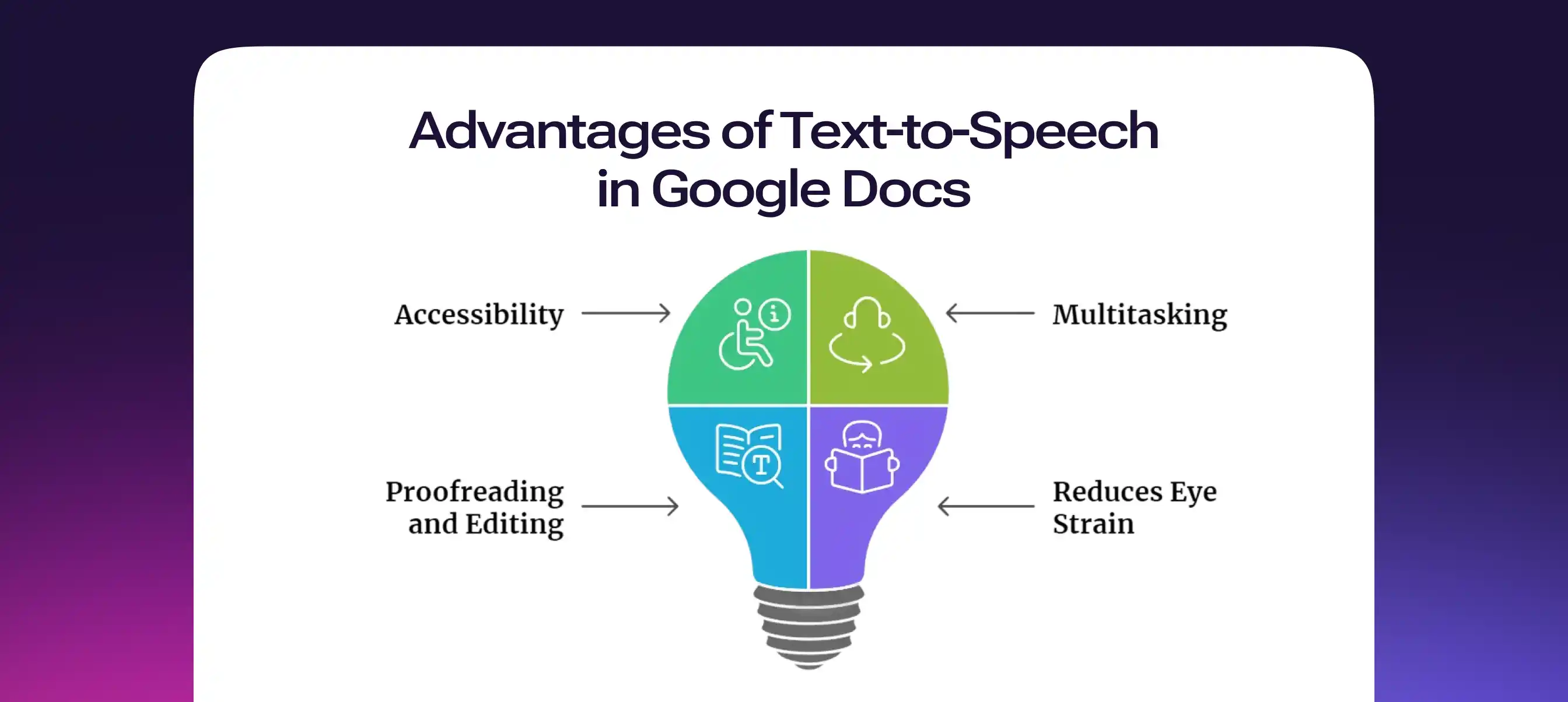
The platform has recently rolled out screen reader support as a native feature, which is beneficial for busy professionals for various reasons:
- Faster proofreading and document review
- Improved accessibility for visually impaired users
- Enables multitasking to boost productivity
- Reduces eye strain and cognitive fatigue
- Enhances comprehension by combining visual and auditory input
- Supports language learning and pronunciation
In this article, let’s look at how you can enable text-to-speech (TTS) in Google Docs to get the above benefits, and some potential challenges you might encounter.
How to Enable Text-to-Speech in Google Docs (2026)
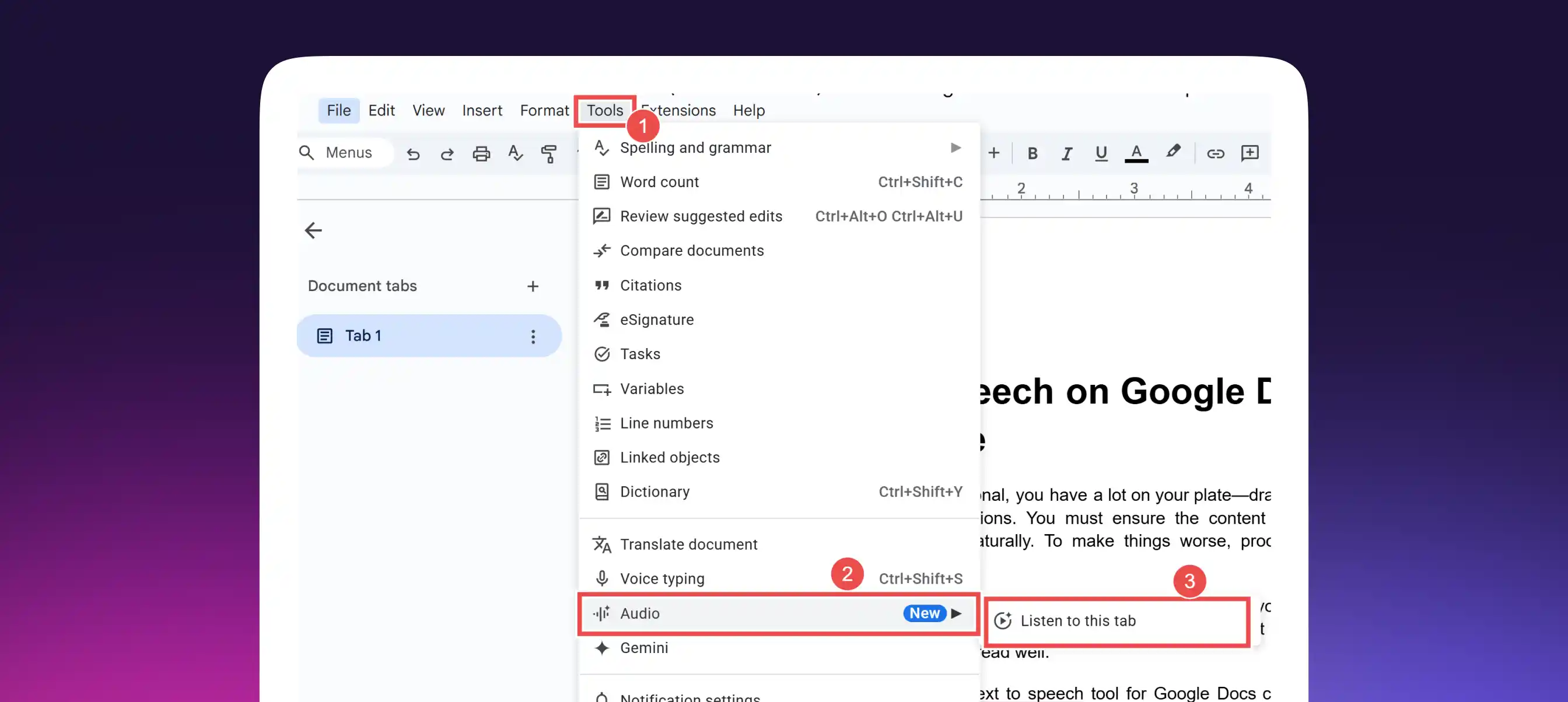
Google Docs now has a native “Listen to this tab” feature. Here’s how to use it in three steps:
- Click on the “Tools” option in the header menu.
- Scroll down to locate the “Audio” option and hover over it.
- Click on “Listen to this tab” to begin playback.
Customizing TTS in Google Docs
After you complete the above steps, you will see a movable audio player on the screen:

Here, you can click on the “1X” icon to change the playback speed, and the three-dot menu after that to modify the voice and provide feedback to Google about your experience.
Adjusting Speech Rate, Voice, and Language
You don’t really control the Google doc text to speech function itself but you can manage it with whatever you’re using alongside it. That could be a screen reader, your browser, or a speech extension. That’s where you tweak how the text actually sounds.
So whether you’re reviewing a document, going through written content, or just trying to listen to something in the same document, your experience depends more on your device and accessibility settings than anything built into the TTS feature of Google Docs.
Using Accessibility Features for Better Listening
With the help of accessibility options like a screen reader, you can have Google Docs text read aloud in a way that actually makes sense. This is essential for anyone who relies on screen reader support.
Once you set things up, select text, hit play, and start speaking through your chosen tools. You can use text to speech across multiple languages, turn content into audio, or even create audio files and audio recordings from a Google Docs file, if needed.
Limitations of Google Docs' Built-in TTS Capabilities
The feature has two huge limitations that prevent users from getting the full range of benefits.
1. Not Universally Available
The speech extension that creates audio files out of written text is only available in English in a select few regions of the world. Additionally, you must be using a desktop or a laptop computer to use this capability.
This makes it difficult for professionals to consume content on the go. When in transit, mobile devices such as smartphones and tablets are more convenient. In such a scenario, you’ll need to leverage browser extensions or add-ons instead.
2. Basic Customization Options
You can only change the reading speed and switch the voice character. Listeners can’t create audio files from their document in specific accents, tones, or styles. Moreover, for certain words and phrases in foreign languages or dialects, the pronunciation cannot be customized.
3. Dependence on Screen Reader Support for TTS
There’s no built-in TTS engine inside Google Docs. So if you want text to speech in Google Docs, you’ll need a screen reader like VoiceOver, NVDA, or ChromeVox. Basically, how the voice sounds, how fast it reads, and how smoothly it works all come down to your screen reader.
4. Restricted Audio Export Options
Even if you manage to use text to speech on a Google Docs file, you can’t directly turn that into an audio file. There’s no built-in way to export your document read as MP3 or WAV. That’s where dedicated voice generator platforms like Murf AI come in. They’re built to take text to speech a step further by turning it into polished, downloadable audio you can actually use outside the browser.
How to Use Text-to-Speech in Google Docs Universally?
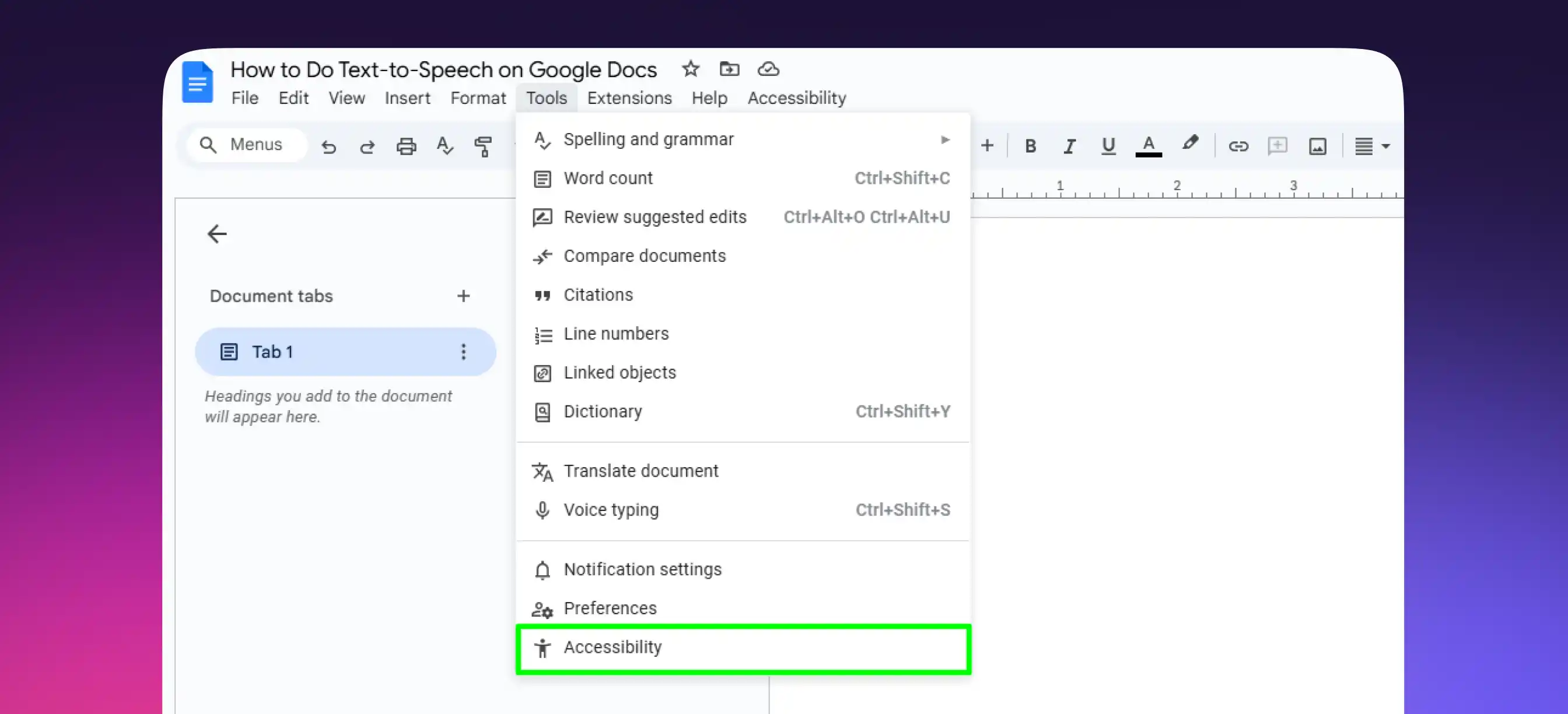
1. Give External Tools Permission to Access the Doc’s Content
Step 1: Open your document in Google Docs.
Step 2: Click the ‘Tools’ menu from the menu bar.

Step 3: From the drop-down menu, pick ‘Accessibility’.
Step 4: Check the box for ‘Turn on screen reader support’ and click ‘OK’.
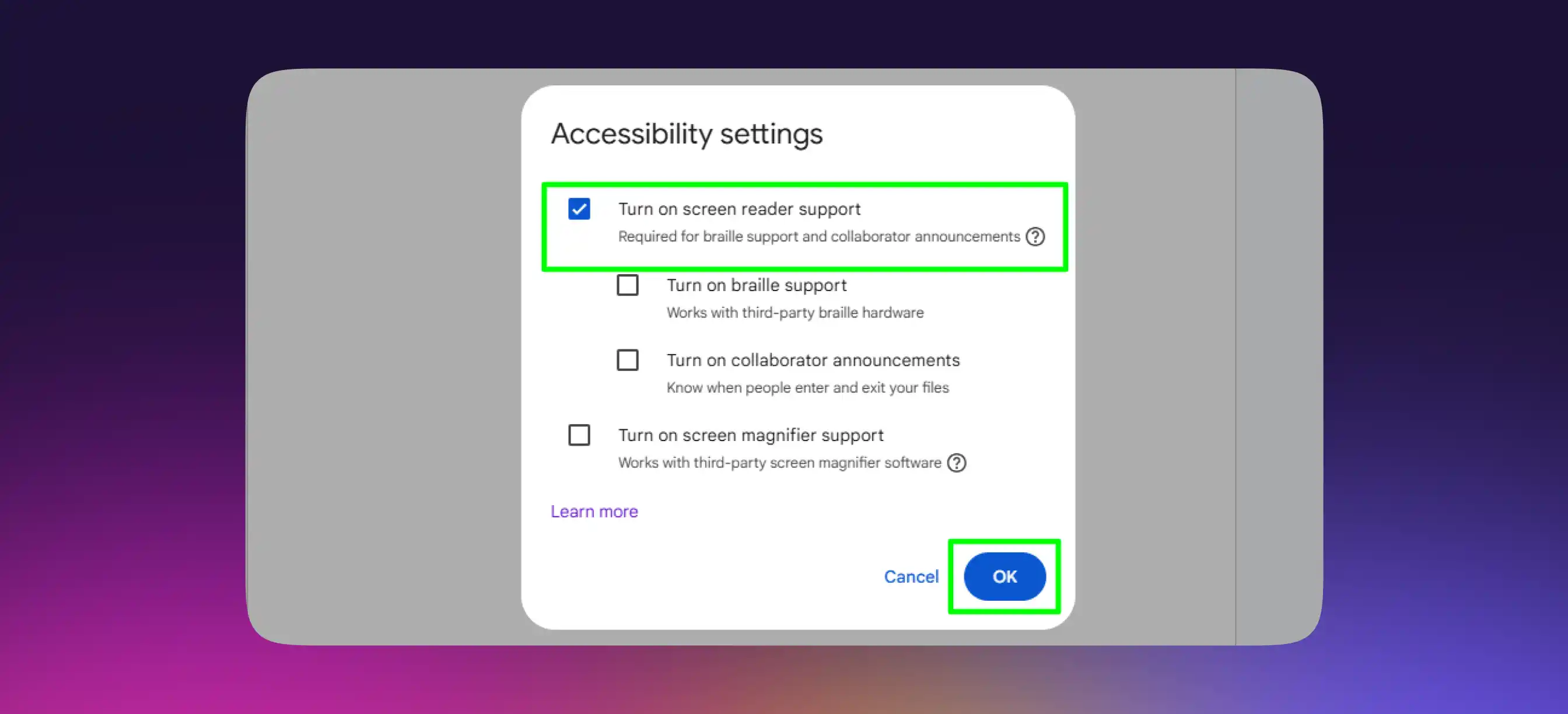
These changes will allow third-party extensions to access the text you want to listen to on the doc.
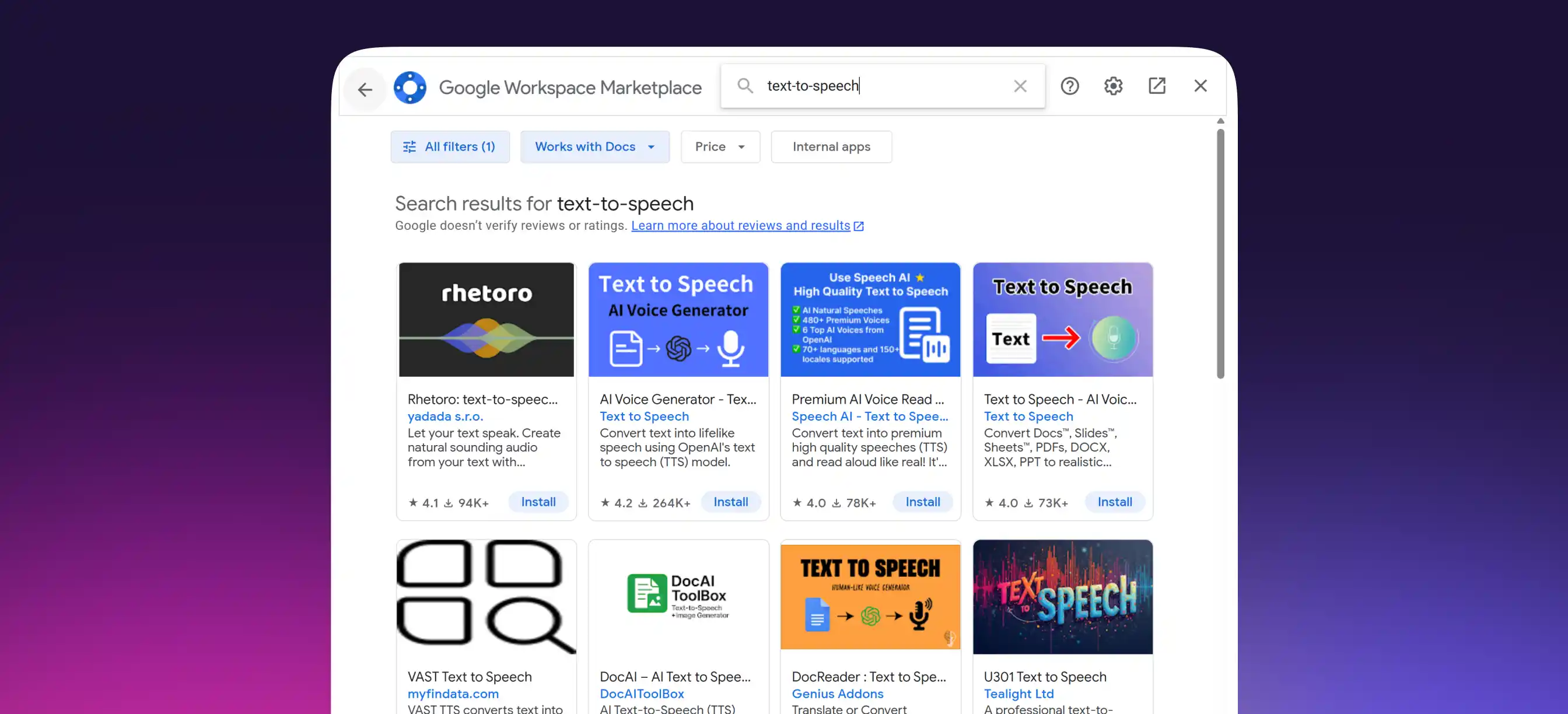
2. Use an Add-On
Add-ons offer a seamless, integrated experience within Google Docs. Here’s how to install one:
- Open your Google Docs document in Chrome.
- Navigate to the top menu and click on Extensions.
- In the dropdown menu, select Add-ons and then click Get Add-ons.

- Search “text-to-speech” and install the add-on whose features seem to meet your expectations.
3. Install Browser Extensions
Some of the best, most reliable TTS Chrome and Firefox extensions for Google Docs include:
1. Speechify Text to Speech Voice Reader
Pros
- The voice actually sounds human, not like a tired robot reading a script.
- Handles Google Docs, PDFs, and web pages without breaking the flow.
Cons
- The best features sit behind a paywall, and you’ll feel that pretty quickly.
- The free version is fine for testing, not for daily use.
Pricing
- Free plan available
- Premium starts at $29/month
2. Voice Reader: Read Aloud Text to Speech (TTS)
Pros
- Straight to the point. You open a document, hit play, and it just works.
- Lightweight, so it won’t slow down your browser.
Cons
- Don’t expect much control over voice or sound quality.
- Feels a bit dated compared to newer tools.
Pricing
- Free
3. Read Aloud: A Text-to-Speech Reader
Pros
- Great if you want flexibility. It supports plenty of languages and options.
- Easy to select text and listen without overthinking it.
Cons
- Voice quality can be hit or miss depending on what engine you’re using.
- Not always consistent across different devices.
Pricing
- Free
4. NaturalReader - AI Text to Speech
Pros
- The speech feels polished, yet natural and clean.
- Solid choice if you want to turn written content into proper audio.
Cons
- Free plan has limits, so you’ll hit a ceiling if you use it often.
- Full experience means paying up.
Pricing
- Free plan available
- Paid plans start around $20.90/month
Murf: Best Alternative to Google Docs’ TTS Voiceover
Murf brings 200+ human-sounding voices in over 35+ languages. Its TTS technology is developed with ethically sourced data trained on authentic linguistics and models. You can get highly natural-sounding voices for everything you write on Google Docs and read aloud from online or offline written content.
The latest Murf Speech Gen 2 model generates flawless, fluent, and flexible voices, ideal for listening to your document.
The best part is that Murf lets you control the voiceovers you want. Adjust the speed, pitch, pronunciation, voice palette, and other elements of the narration to create highly personalized and high-fidelity sounds.
Ready to elevate your Google Docs reading experience? Sign up for Murf today and get free ten voice generation minutes.
Conclusion
So, does Google Docs have a text to speech feature? Not really. It leans on screen reader support and external tools to read aloud Google Docs text, which works fine when you just want to listen and catch mistakes in your document.
But that’s where it stops. You can’t turn that into usable audio files or audio recordings directly. If you need something more polished or shareable, tools like Murf AI step in. They take your written content and turn it into clean, professional audio you can actually use beyond the browser.

Frequently Asked Questions
Does Google Docs Have a Text-to-Speech Feature?
.svg)
Short answer, no. Google Docs doesn’t come with a built-in text to speech feature. If you want it to read aloud your Google Docs document, you’ll need a screen reader or a speech extension running through your browser or device.
Can Google Docs Read Text Aloud Automatically?
Not by itself. Text to speech in Google Docs won’t just start reading your text out loud. But once you bring in screen reader support or Chrome extensions, you can select text, start speaking, and actually listen to your written content.
Can I Use Text-to-Speech on Google Docs for Free?
Yes, and that’s the good part. Most screen reader tools and basic speech extensions offer free text to speech. So as long as you use Google Docs in a supported browser, you can listen to your document without spending anything.
What Languages Are Supported by Text-to-Speech on Google Docs?
This depends entirely on your setup. Google Docs doesn’t control languages for text to speech. Your screen reader or tools do. Most of them support multiple languages, so you can read aloud content in different voices and accents.
Is There a Limit on the Length of Text for TTS on Google Docs?
Not officially. Google Docs won’t stop you from trying to read aloud a long document. But in reality, some screen reader tools or speech extensions may slow down or struggle with very large chunks of text.
Can I Use Text-to-Speech for Editing and Proofreading in Google Docs?
Yes, and honestly, you should. Using text to speech to listen to your written content is one of the easiest ways to catch mistakes. When you hear a document read out loud, awkward lines stand out instantly.
Does TTS Work with Images and Non-Text Elements in Google Docs?
Not really. Text to speech in Google Docs is built around Google Docs text. While screen reader support might describe some elements, images or visuals won’t be read aloud the way regular text is.
Can I Customize the Voice or Accent in Text-to-Speech on Google Docs?
You can, just not inside Google Docs. The control sits with your screen reader or speech extension. Most tools let you adjust the voice, accent, and speed through their own settings and accessibility options.
Can I Use Text-to-Speech Google Docs in Multiple Languages Within the Same Document?
Yes, but it takes a bit of setup. If your screen reader supports multiple languages, it can handle different sections within the same document. You might need to tweak settings so the speech switches correctly.