Conversational AI in Manufacturing: Automate Support
Conversational AI in manufacturing accelerates real-time decisions, preserves critical operational knowledge, and automates customer and supply chain support. Boost OEE, reduce MTTR, and keep production teams focused on output - not inquiries.

.svg)
.svg)
.svg)
.svg)
.svg)

Why Conversational AI in Manufacturing Matters

Driving Uptime and Operational Efficiency

Conversational AI in manufacturing reduces downtime and boosts OEE by embedding intelligence into frontline workflows. It delivers 20–70% lower unplanned downtime, up to 23% higher OEE, and 30–50% faster MTTR by enabling technicians to access diagnostics, alerts, and repair steps via chat or voice. Operators can ask “Why did Line 3 stop?” and receive real-time insights from sensor data, logs, and predictive maintenance systems.

Enhancing Workforce Productivity and Knowledge Access
Conversational AI improves shop-floor productivity and accelerates knowledge access by embedding assistance into daily tasks. It drives 10–30% higher frontline productivity, cuts documentation search time by 30–60%, and improves onboarding speed by 20–40%. Technicians can ask for setup parameters or SOPs and receive step-by-step guidance instantly. Plants using conversational copilots also reduce tribal-knowledge dependency and enable faster ramp-up through on-demand expertise via chat or voice.

Elevating Customer Support and Service Efficiency
Conversational AI enhances manufacturing customer service by automating interactions and accelerating response times. It enables 50–80% query automation, reduces response and handling time by 25–60%, and boosts CSAT by 20–30%. Chatbots handle order tracking, troubleshooting, and service scheduling using ERP and service data. In practice, manufacturers report 27% higher CSAT, 60% more sales-qualified leads, and up to 10× conversion through automated lead engagement.

Accelerating Sales and Forecast Accuracy
Conversational AI boosts manufacturing sales by improving lead qualification and forecasting insights. It drives 30–60% more sales-qualified leads and improves conversion rates by 10–30% through personalized, always-on engagement. AI assistants handle RFQs, configure products, and capture requirements before routing high-intent leads to sales. Manufacturers also gain more accurate forecasts by analyzing conversation data, including demand signals, pricing sensitivity, and buying intent across segments.

Enabling Data-Driven Decisions with Insights
Conversational AI improves decision-making by turning interactions into actionable intelligence. It achieves 70–90% first-contact resolution and 90–99% task-completion rates in focused use cases. For example, analyzing chat and voice transcripts reveals failure patterns, operator confusion points, and customer issues. Manufacturers leverage these insights to prioritize maintenance and product improvements, gaining continuous visibility into the voice of the customer and operator.
Key Conversational AI Manufacturing Use Cases
Predictive Maintenance Assistant (Shop Floor & Maintenance)
Expected benefits
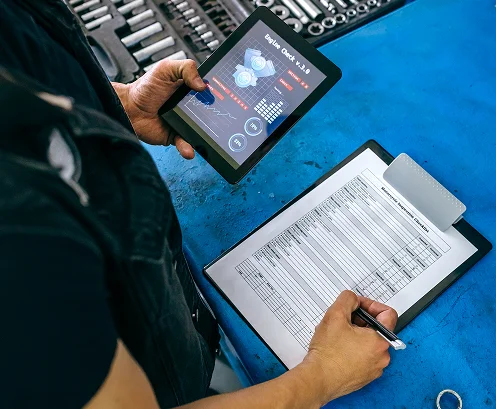
AI assistants guide technicians through diagnostics and repairs using natural language, reducing downtime and MTTR. They also surface sensor and CMMS data via chat/voice (e.g., “Why did Line 2 stop?”), improving first-time fix rates and asset lifespan.
Success metrics
30–50% reduction in unplanned downtime, improved MTTR and first-time fix rate, lower maintenance cost per asset, 10–15% increase in equipment lifespan, and higher assistant containment rate.
Risk scale
Medium
Digital Work Instructions & SOP Copilot
Expected benefits
AI copilots deliver step-by-step SOPs, torque specs, and setup guidance on demand, reducing manual search time and errors. They also support onboarding and cross-training by acting as a 24×7 assistant for operators and temporary workers.
Success metrics
30–50% reduction in training time, faster time-to-competency, fewer errors and rework, improved operator productivity, and higher task-completion and usage rates.
Risk scale
Medium

Quality Inspection & Non-Conformance Assistant
Expected benefits
AI assistants guide operators to log defects, retrieve defect codes, and access similar past issues, improving data consistency. They also surface corrective actions, control plans, and checklists quickly, reducing scrap, rework, and returns.
Success metrics
20–35% reduction in quality costs, lower defect rates, fewer returns and warranty claims, faster non-conformance resolution time, and improved inspection accuracy.
Risk scale
High

Production Planning & Scheduling Assistant
Expected benefits
AI assistants enable planners to query schedules conversationally (e.g., “What happens if order X moves to Line 3?”) and receive clear scenario insights. They also reduce planning cycle time and improve responsiveness to order changes and disruptions.
Success metrics
Faster planning cycle time, improved schedule adherence and on-time completion, reduced changeover effort, higher planner productivity, and increased adoption of conversational tools.
Risk scale
Medium

Internal Helpdesk for IT, HR, and Plant Policies
Expected benefits
AI assistants automate routine IT and HR queries (e.g., password resets, leave policies), reducing support load and email traffic. They also standardize responses across sites and shifts, improving employee experience and consistency.
Success metrics
Higher ticket deflection rate, faster resolution time, improved employee satisfaction, and reduced cost per ticket or interaction.
Risk scale
Low

Safety, EHS, and Compliance Q&A
Expected benefits
AI assistants answer real-time safety queries on PPE, lockout/tagout, and procedures, ensuring access to up-to-date guidelines. They also guide workers through incident reporting and audits conversationally, improving accuracy and reducing documentation effort.
Success metrics
50–70% reduction in incidents, faster safety form completion, fewer compliance gaps, improved audit outcomes, and higher usage of safety checklists and queries.
Risk scale
High

Customer and Distributor Support Chatbot
Expected benefits
AI chatbots handle FAQs on orders, deliveries, spare parts, and basic issues 24×7, reducing support workload. They also improve response speed and consistency for OEMs, distributors, and customers, enhancing satisfaction and loyalty.
Success metrics
50–80% automation rate, faster response and handling time, improved CSAT and first-contact resolution, and lower support cost per interaction.
Risk scale
Medium

How to Deploy Conversational AI in Manufacturing

Build and Test
Reduce operational inefficiencies by implementing conversational ai solutions to automate shop-floor support, maintenance interactions, and high-volume technician queries across channels. Define success metrics like containment rates (30–60%), MTTR reduction (20–50%), and test flows using real scenarios, natural language processing, system integrations, and escalation to human experts.
.svg)
Pilot and Validate
Launch pilots for automating tasks like SOP access, diagnostics queries, and service workflows. Track MTTR reduction, task completion (target 80–95%), and OEE improvement. Gather feedback from operators and technicians to refine conversational ai performance and improve efficiency, uptime, and operational outcomes.

Deploy and Govern
Roll out conversational ai systems across manufacturing environments while integrating with ERP, CMMS, knowledge bases, and plant systems. Maintain logs, QA coverage, compliance tracking, and access controls while ensuring seamless escalation to human experts and consistent uptime and production performance.
.svg)
Observe and Improve
Analyze interactions using machine learning and conversational analytics to identify gaps. Continuous improvement helps optimize conversational ai, enhance MTBF, reduce MTTR, and improve OEE, operational efficiency, and workforce productivity.
Security, Compliance, and Trust
Data Privacy and Consent
Conversational ai must protect operational and enterprise data while ensuring compliance across workflows and regulated manufacturing environments.
Encryption and Access Control
End-to-end encryption secures interactions while access controls protect sensitive operational, production, and asset performance data.
Oversight and Quality Assurance
AI systems and human experts ensure complex scenarios are escalated, enabling full QA coverage, reducing compliance risks, and improving operational accuracy.
Conversational AI in Manufacturing vs Traditional Systems
Availability
Limited to workforce availability and shift timings
Always-on, real-time assistance improving uptime and OEE
Consistency
Dependent on manual processes and individual expertise
Consistent, data-driven responses improving MTBF and process stability
Compliance Audit Trail
Sample-based QA and fragmented reporting
100% interaction analysis with unified insights across OEE, MTTR, and MTBF drivers
Cost Structure
High labor and operational inefficiencies
Optimized costs with scalable AI reducing downtime and maintenance overhead
Escalation
Manual routing and delayed interventions
Seamless AI-to-human handoff minimizing MTTR with full operational context
Why Murf AI is the Right Choice for Manufacturing
Lifelike, Multilingual Voice Quality
• 150+ voices across multiple languages and accents
• 99.38% accuracy for natural conversations
• Natural voice experiences for operator interactions
• Mid-session language switching support
Warm Handover to Human Agents
• Seamless escalation from AI to human experts
• Routes complex operational queries faster to reduce MTTR
• Supports expert intervention in critical uptime scenarios
Enterprise Security & Compliance
• Secure conversational ai solution protecting operational data
• Encrypted systems with compliance controls
• Aligned with enterprise and regulatory standards
Massive Scalability
• Handles thousands of interactions simultaneously
• Supports peak operational loads without performance drop
• Maintains efficiency while supporting OEE targets
Flexible Control & Optimization
• Configurable workflows for diverse manufacturing use cases
• Continuous improvement using machine learning to improve MTBF and reduce MTTR
• Integrates with ERP, CMMS, and enterprise tools
Ultra-Low Latency Performance
• Sub-second responses for real-time assistance
• Smooth shop-floor and omnichannel experiences
• Reduces delays, improving MTTR and overall equipment availability

FAQs
For any further questions,
send us a message at support@murf.ai

Manufacturers measure ROI by tracking performance metrics such as OEE improvement, MTTR reduction, MTBF improvement, and reduced operational costs. Additional key benefits include higher customer satisfaction, improved customer experience, faster resolution of routine tasks, and better service quality. Metrics like task completion rates (90–99%), first-contact resolution (70–90%), and efficiency gains from automating routine tasks demonstrate the impact of ai copilot and conversational ai systems. These insights, derived from real time data and analyzed using ai models, support better decision making and long-term value creation in ai in manufacturing.
Yes, embracing conversational ai enables manufacturing companies to scale ai adoption across multiple plants and geographies. These conversational ai technologies support multiple languages and standardize workflows while adapting to local requirements. This ensures consistent customer satisfaction, improves collaboration among manufacturing teams, and enhances efficiency across the global supply chain.
Yes, conversational ai systems are designed for the manufacturing environment, including noisy factory floors. With advanced natural language processing and multimodal capabilities, ai agents support both voice and text interactions, reducing dependency on phone calls. These ai solutions ensure instant responses and consistent service quality even in challenging conditions, while maintaining data security and enabling efficient communication across manufacturing operations.
Yes, integrating conversational ai with existing systems like ERP, MES, CMMS, and data storage platforms enables seamless access to valuable data such as order status, inventory management, customer data, and production data. Conversational ai solutions connect service teams, call centers, and manufacturing teams, ensuring personalized interactions and personalized support based on customer preferences. This integration enhances customer experience, streamlines manufacturing processes, and improves supply chain visibility while addressing key challenges in the manufacturing industry.
Yes, conversational ai technologies can handle real-time production and predictive maintenance queries by integrating with ai systems, sensor networks, and maintenance processes. Using natural language and human language understanding, ai agents and virtual agents deliver instant responses to customer inquiries and shop-floor issues. These ai tools leverage machine learning and generative ai models to analyze data, detect anomalies, and provide step-by-step guidance. This reduces reliance on human intervention and human agents, enabling round the clock support and improving operational efficiency in smart factories.
Conversational AI in manufacturing improves operational efficiency by reducing unplanned downtime (20–70%), accelerating MTTR (30–50%), and increasing OEE (up to 23%). By leveraging artificial intelligence, natural language processing, and machine learning algorithms, conversational ai systems provide real time insights into machine performance, equipment maintenance, and manufacturing processes. These ai driven solutions help manufacturing teams automate routine tasks, reduce material waste, and enhance decision making using data driven insights. By analyzing production data and supply chain data, conversational ai solutions optimize supply chain management, improve service quality, and support continuous improvement across manufacturing operations, helping manufacturers stay competitive in the manufacturing sector.
Explore Other Conversational AI Industries
Banking
Conversational AI in banking that handles account servicing, payments, and lending queries in real time...
Sales
Reduce friction, speed resolution, and scale 24/7 sales experiences. Run full workflows through...
Contact Center
Round the clock support with a human touch. Run full workflows through conversational ai technology...
Marketing
AI-powered conversational AI marketing chatbots and agents to deliver a more personalized customer experience...
Logistics
Streamlines logistics and supply chain operations with real time tracking, cost savings, multilingual support, and...
Education
Personalized learning, faster outcomes, higher engagement, scalable support, and measurable academic performance gains.
Finance
Improves efficiency, reduces costs, enhances CX, ensures compliance, and scales personalized...
Government
Transform government services through automation, improve efficiency, accessibility, citizen satisfaction, and...
BPO
Boosts BPO efficiency, scalability, and CX while reducing costs, improving resolution rates, and enhancing agent productivity.
Games
Drives retention, immersion, automation, and monetization through scalable, real-time, personalized player interactions...
Airlines
Reduces costs, accelerates support, boosts satisfaction, enables 24/7 multilingual service, along with...
Plumbers
Helps capture leads, automate bookings, reduce no-shows, improve response times, and increase overall efficiency.
Media
Boosts engagement, drives revenue, automates workflows, and delivers personalized, scalable audience...
Dealerships
Turn calls into booked appointments and qualified leads - delivering higher coverage, less workload, and...
Insurance
Conversational AI in insurance automates claims intake, personalizes policy support, and...
E-commerce
Automate order status, returns, and FAQs with natural-sounding AI voice agents. Faster answers...
Customer Support
Conversational AI for customer support handles queries across chat, voice, and messaging - 24/7, in natural language...
Telecom
Answer every call instantly, resolve billing and network issues, cut handle time, and turn interactions into advantages
Hotels
Boosts bookings, guest satisfaction, efficiency, personalization, multilingual support, and operational performance...
HR & Recruiting
Answer PTO and leave, benefits and payroll questions, policy FAQs, onboarding check-ins, employee...
Retail
Conversational AI in retail connects shoppers to your brand across every channel - from product discovery...
Healthcare
Conversational AI in healthcare automates scheduling, post-discharge follow-ups, and patient queries...


