Get in touch with us
Create voiceovers, build AI voice agents, and dub content into multiple languages. Powering 10 million+ developers and creators worldwide.
AI Glossary
Browse our AI glossary for clear definitions of artificial intelligence, machine learning, and large language model terms, complete with use cases and examples to understand each concept in practice.
A recurrent neural network (RNN) is a type of neural network designed to process sequences of data by remembering what came before. Unlike regular models, an RNN uses past information to influence current predictions.
Many people ask what is RNN and how it works. In simple terms, an RNN reads data step by step (like words in a sentence or frames in audio) and keeps track of previous inputs to understand context.
This makes recurrent neural networks especially useful for tasks where order matters, such as language, speech, and time-based data, particularly in artificial intelligence (AI) systems.
To understand how an RNN model works, think of it as a loop that carries information forward through an RNN cell.
At each step:
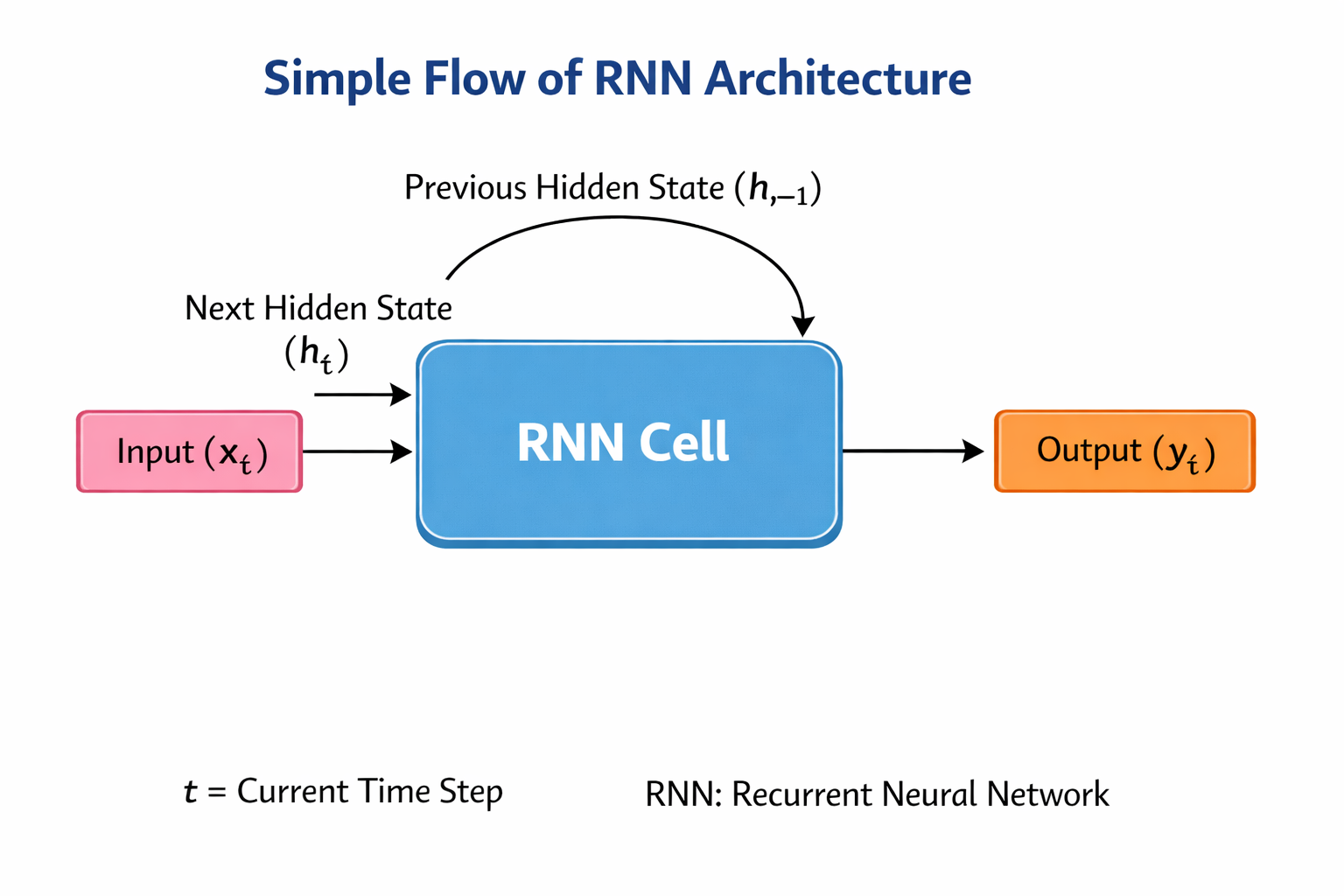
This looping structure is called RNN architecture, and it allows the model to learn patterns over time.
Unlike traditional models that treat each input independently, RNNs connect past and present data, which helps them understand sequences better using machine learning (ML) techniques.
Basic RNN neural networks can struggle to learn relationships across very long sequences. Training them on lengthy inputs can cause a problem known as the vanishing gradient, where the signal used to teach the network fades before it reaches earlier steps. Practitioners generally use gated variants to manage this.
Two widely used gated variants are:
Both LSTM and GRU are considered types of recurrent neural networks and appear across voice, language, and audio applications.
RNNs play an important role in AI systems that need to understand sequences.
They help systems:
Because of this, RNNs are widely used in natural language processing (NLP) and speech to text (STT) systems. They also support tasks handled by large language models (LLMs), although modern systems often use more advanced architectures like transformers.
RNNs are used in many real-world AI systems where data comes in sequences.
RNNs are used in speech recognition systems to process audio over time. They help models understand how sounds form words and sentences.
RNNs can generate text by predicting the next word based on previous words. This is useful in chatbots and tools powered by generative AI.
RNN models help translate languages by understanding sentence structure and context using natural language understanding (NLU).
In finance or weather forecasting, RNNs analyze past data to predict future outcomes using probabilistic methods.
In voice workflows, RNNs help process sequential audio data. Combined with technologies like text to speech (TTS) and vocoder, they contribute to natural voice generation pipelines.
On voice platforms like Murf, these sequence-based models govern how audio is processed and structured before the final output.
Here are simple, real-world examples of how RNNs work, especially in voice and language systems:
RNN-based language models power predictive text by analysing the sequence of words you’ve already typed. They use past context to suggest the next word, making typing faster and more accurate.
When you speak to a voice assistant, the system processes audio over time using speech to text. RNNs help interpret the sequence of sounds, ensuring the system understands your full command instead of isolated words.
In text to speech pipelines, RNNs help model how speech flows over time. They contribute to generating natural-sounding rhythm, pauses, and intonation by understanding sequence patterns in language and audio.
RNNs are widely used to generate sequences like music or speech waveforms. They predict the next note or sound based on previous ones, creating smooth and coherent audio outputs.
In conversational AI, RNNs help maintain context across multiple turns. This allows systems to respond more naturally instead of treating every message as a completely new input.
Although RNNs are powerful, they have some challenges:
Because of this, newer models like transformers are often preferred for large-scale tasks in artificial intelligence (AI).
Even though newer architectures exist, RNNs are still useful for many applications. They remain relevant in lightweight AI systems, real-time processing tasks, and voice and audio pipelines. As AI evolves, RNNs continue to support systems that require sequential understanding, especially in speech and time-based data, often working alongside deep learning (DL) and natural language processing (NLP).
Murf Falcon
The Fastest, Most Efficient TTS API for building Voice Agents
Discover how Murf Falcon helps build voice agents that are
ultra-fast, expressive, scalable and significantly cost-efficient, all at once.


Keeping your data safe


