Get in touch with us
Create voiceovers, build AI voice agents, and dub content into multiple languages. Powering 10 million+ developers and creators worldwide.
AI Glossary
Browse our AI glossary for clear definitions of artificial intelligence, machine learning, and large language model terms, complete with use cases and examples to understand each concept in practice.
Conversational AI is quickly changing how businesses operate and interact with their customers. According to Grand View Research, the conversational AI market is expected to be worth US$ 41.39 billion by 2030.
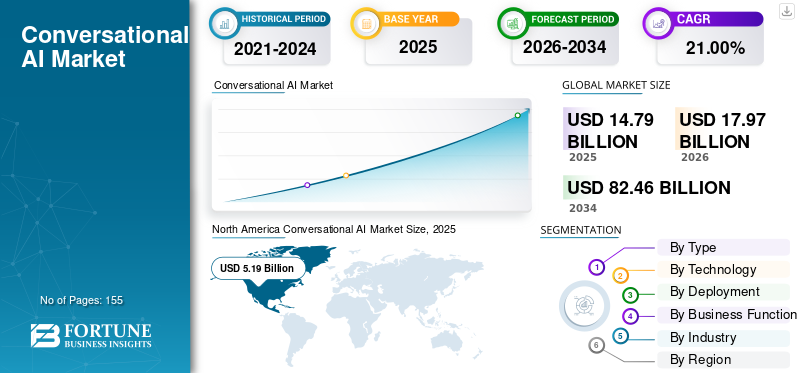
This shows that businesses are investing in implementing conversational AI systems to ensure human-like interactions for their customers.
But what is conversational AI really? Where can businesses use it? What are its benefits and limitations?
In this quick guide, we answer these questions to help you understand how you can utilize conversational AI for business growth.
Let's get started.
Conversational AI is a system that enables machines to understand and respond to human language in a natural way.
It goes beyond scripted replies. It listens, interprets meaning, remembers context, and responds intelligently across multiple exchanges.
It combines several technologies, including:
Unlike basic chatbots, conversational AI can manage multi-turn conversations and adjust responses in real time.
For example, a platform like Murf AI could power a voice agent for e-learning creators. A user might ask for a suitable voice for a teen-focused climate change course. The system understands the audience and tone, and suggests an appropriate voice.
AI conversational AI technology works by processing input, understanding intent, and generating a relevant response within seconds.
Here is a simple breakdown of how conversational artificial intelligence works:
All these steps happen quickly in microseconds. The speed and accuracy of conversational AI enable the system to deliver smooth, human-like conversations.
From customer service to content creation, conversational AI capabilities help businesses automate tasks, personalize responses, and deliver faster support at scale.
Here are some of the most popular use cases of conversational AI:
Businesses can use AI chatbots on websites and apps as the first touchpoint for online visitors. They help businesses answer frequently asked questions, guide users through products, and capture leads in real time.
These bots can:
With generative AI capabilities, modern systems can simulate human conversation rather than using static scripts.
AI Assistants, such as voice and virtual assistants, interact through text or speech. They rely on conversational systems, often powered by generative AI, to simulate human conversation and adapt responses based on context.
For example, a platform like Murf AI could power a voice assistant that helps creators select the right narration style and instantly suggest, adjust, and refine the voice.
This could be impossible at this speed and level of accuracy without advances in conversational AI.
Marketing AI assistants help brands interact with prospects across channels. These assistants can help businesses:
These systems also support campaigns by engaging users in real time and guiding them through the buyer journey.
Contact center AI assistants operate within support environments to help teams manage high volumes of customer communications. They help process human conversations across calls, chat, and messaging platforms.
They are commonly used to:
Conversational AI agents in customer support help human agents deliver faster responses, improving customer satisfaction.
Booking appointments is a challenge for most service-based businesses. With conversational AI assistants, scheduling becomes easier. It lets users state their availability in plain language rather than using forms.
The assistant checks calendars, confirms time slots, sends reminders, and automatically updates records.
It can also work 24x7, delivering updates to users whenever they need them. Teams can use their free time to focus on strategic roles such as revenue optimization.
Within organizations, conversational AI supports internal teams and operations. Employees can ask policy questions, check benefits, or raise IT requests without waiting for HR staff or human agents.
Some of the most common areas of application include:
Using HR support, AI assistants help businesses reduce repetitive workload and speed up internal communication.
While developments in machine learning and AI technologies have made conversational AI more efficient, not all conversational AI solutions are created equally. If you are looking to use conversational AI software for your business, ensure it matches your technical, business, budgetary, and growth requirements.
Murf Falcon
The Fastest, Most Efficient TTS API for building Voice Agents
Discover how Murf Falcon helps build voice agents that are
ultra-fast, expressive, scalable and significantly cost-efficient, all at once.


Keeping your data safe


