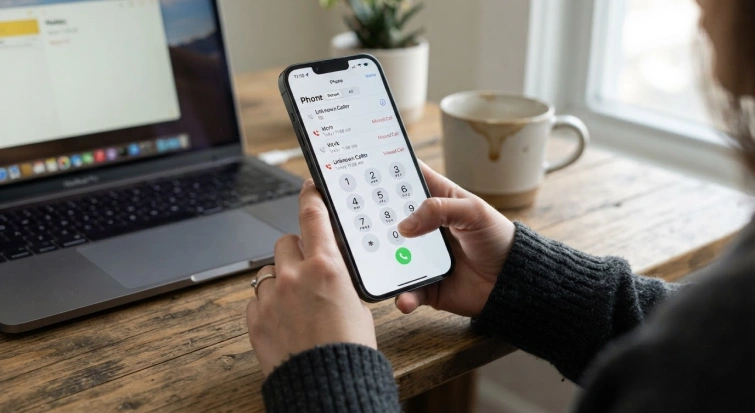
What is an AI voice agent?



Not long ago, calling a business after hours meant customers usually facing a blocker such as hitting a voicemail box, a phone tree that looped back on itself, or a ringing phone line that nobody picked up. In 2026, this has changed quickly as AI voice agents have been introduced that can pick up the phone, understand what a caller actually wants, and handle it in a real conversation rather than a menu.
For any business that runs on phone calls, it is turning into one of the more consequential decisions of the next few years, which is why it is worth understanding properly before a vendor demo does the explaining for you.
This guide walks through what an AI voice agent is, how it works underneath the marketing, what it costs, where businesses are using it, and the honest limitations that only show up once real customers are on the line.
TL;DR
- What are they: software or tools that hold a real spoken conversation over the phone and completes tasks on its own.
- How it works: it listens (speech-to-text), thinks (a language model), and speaks (text-to-speech), quick enough that the back-and-forth feels natural and human.
- What it does: it answers questions, books and reschedules appointments, qualifies leads, routes or transfers calls, and works 24/7.
- How it compares: it combines the natural language understanding of a chatbot, the spoken interface of a voice assistant, and the call-handling role of an old phone menu (IVR), but resolves the call instead of just routing it to human agents.
What are Voice AI agents?
An AI voice agent is an autonomous software system or a tool that uses artificial intelligence to conduct spoken conversations and completes tasks such as appointment booking and lead qualification calls. For example, a caller can say, "I need to check my order and ask about your return policy," and the AI voice agent platform handles both requests in one exchange with natural sounding speech.
What makes it an "agent" rather than a recording is that it decides what to do on its own. It understands the intent of a caller, remembers what was said earlier in the call, looks up or updates information in your existing systems, and responds in real time. The market is evolving in building voice agents as a result: one widely cited forecast puts the voice and speech recognition market on track to grow from about $14.8 billion in 2024 to more than $61 billion by 2033.
How are they different from chat agents and IVRs?
Businesses have automated phone and messaging interactions for decades. Customer interaction has been at the crux of AI automation, so the easiest way to place an AI voice agent is against the three tools it evolved from.
An IVR or interactive voice response is an automated menu that asks you to press one for sales or say a single word to move through a fixed tree. An IVR can only walk the paths that someone has programmed in advance - making it difficult for unexpected queries. It simply stalls or loops back. IVRs main task is to route and collect basic information.
A Chatbot is program that simulates human conversation through text or voice. It helps people get quick answers or complete tasks that do not require technical complexity. This was very common in service-based support queries such as food deliveries, internet connectivity diagnostics and other common questions.
The voice assistant, such as Siri or Alexa, are built for one person's short and general commands such as setting an alarm, or what the weather is like. Voice assistants were not entirely built for business conversations with a real customer.
An AI voice agent platform is what you get when these existing systems finally come together, running fast enough to feel like a natural phone conversation. We breakdown all the four enterprise systems here:
How does an AI voice agent work?
An AI voice agent works by bridging three pieces of technology together in real time.
- Speech-to-text: A speech recognition model transcribes spoken words into written text. AI voice agents also use speech recognition technology and generative AI.
- LLMs (The Brain): A large language model, such as ChatGPT, Gemini, or Claude reads that text, works out what you actually want, and decides how to respond. It can also pull in outside facts such as your account details or today's opening hours and trigger actions in other software rather than just talking, through integrations.
- Text-to-speech (The voice layer): The system then converts its written reply back into natural, spoken audio and plays it to you, closing the loop so the whole thing feels like a conversation rather than a transaction.
Around those three pieces sits an orchestration layer - which acts like a conversation manager. This layer decides when you have finished speaking, when the agent should reply, and what to do when you both talk at once. This layer is what makes an agent feel human or robotic.
What makes an AI voice agent good?
Speed
In a natural conversation, replies come back in well under a second. Research on AI phone calls suggest that if there is a sub-second delay, people start to feel that something is off, and they interrupt or talk over the agent. A slow voice AI agent feels broken even if every answer is correct. This is why a lot of the engineering effort goes into shaving milliseconds, and why a sub second latency text-to-speech voice is a core requirement to have.
Knowledge Base
On its own, the LLM only knows what it was trained on - and this does not include your prices, company policies or even this week's promotional activities. Therefore, most agents are connected to a live knowledge source, such as your help articles, a PDF, or a web page, and they look up the right answer on each turn of the call.
A good voice AI agent will often support human agents rather than just replacing them.
What are the benefits of AI voice agents?
The appeal comes down to handling routine, high-volume calls well, at a cost and scale that human teams cannot match on their own, and the individual benefits all follow from that.
1. 24/7 Availability
An AI voice agent can answer at any time of the day, weekends, and through a holiday rush without a queue forming, so that customers get support 24/7. During peak hours, human agents are usually stretched with multiple phone calls. Voice AI agents can answer concurrent calls with multi turn conversations, which means callers stop waiting on hold, and instant answers are provided for inbound calls.
2. Lower Cost Per Call
Automating routine live phone conversations costs a fraction of using human staff for the same call. McKinsey has estimated that generative AI could raise customer-care productivity by the equivalent of 30-45% of the function's current costs, which is the kind of shift that changes how a support budget is planned for contact centers with high call volumes with pricing transparency.
3. Scale Support without Hiring
Sudden spikes in call volume no longer requires a hiring round or extra-staffing efforts. The voice AI agent simply handles more calls at the same time through a seasonal rush, a product launch, or an unexpected outage. AI voice agents can handle 50% of a call center volume.
4. Consistent Answers
An agent brings a consistency that human teams genuinely struggle to guarantee, delivering the same correct answer to a routine question on every single call. Voice agents do not have 'off' days, similar to how a human agent would. Customer experience is standardised and call quality is ensured for a sales team.
5. Cleaner Records & Better Data
As an agent runs on software, it has the capability to log every call, note how the request was resolved, and update your CRM automatically. This ensures that your team has cleaner records and better follow-ups and over time provides you with valuable data insights that your business can optimise.
6. Multilingual Support
Most leading platforms such as Murf AI are able to provide international support in multiple languages. Code-switching is very common as humans tend to converse in different languages, which would otherwise need human agents to route calls to staff that can understand, for example - Spanish & English.
Taken together, the pattern of deploying AI voice agents are consistent: the voice agent handles routine tasks, so that human teams can handle more technical complexity queries - especially for industries such as healthcare & banking services.
What are AI voice agents used for?
Customer Support
Voice agent can answer FAQs, check order status, handle returns, and even walk a caller through basic troubleshooting. The agent gathers the relevant context up front and only routes to a human when a request is genuinely complex, so that context is transferred without asking the customer to repeat their issues again.
Lead Qualification
This works both for outbound and inbound calls, where the agent calls new leads, asks the qualifying questions a human agent would ask, books meetings for the sales team, and chases outstanding quotes. As it handles the repetitive top-of-funnel work at volume, it allows sales teams to spend their time on conversations that need more attention, than just dialling and screening.
Appointment scheduling
The agent books, confirms, and reschedules appointments across a calendar. It can also set reminder calls that can reduce no-show rates, that leads to a loss of revenue for businesses that depend on inbound and outbound calls.
Healthcare front desks & Receptionists
A medical practice puts a voice agent to work on scheduling, reminders, prescription refill requests, and routine pre-visit questions, which is precisely the workload a medical answering service is built to absorb. Taking those calls off the front desk allows healthcare staff to provide actual care for patients, rather than spending time on administrative tasks.
Financial services
In the BFSI sector, phone calls that are related to account queries and information requests can now be handled by AI voice agents. Loan servicing and debt collection are common uses. It is worth noting that before you deploy, deploying voice agents in BFSI carries compliance and verification requirements that a general-purpose setup could miss, and the cost of a wrong or vague answer can attract penalties.
Real Estate & Property Management
Businesses in these fields can adopt voice AI agents to answer listing and service inquiries around the clock, qualify leads, and book jobs or viewings even during non-working hours. When a prospect calls about a listing at 9PM, a voice agent can capture and book them, making the difference between winning and losing that customer.
SMBs & Growing Businesses
For a small business the value is usually simpler still, because the agent acts as an after-hours receptionist so that a missed call stops turning into a lost customer. That single job which is to attend the calls that used to go unanswered, is the entire premise behind an AI answering service for a small business.
How much does an AI voice agent cost?
Pricing is usually measured per minute of conversation, and it breaks into a few models. As a rough guide:
Automating a routine call typically costs a fraction of what it costs to have a person handle it. A few things move the price beyond the base rate. Real-time calls cost more than processing recordings after the fact. Higher-quality voices and more capable language models cost more than budget ones.
And integrations, connecting the agent to your CRM, telephony stack, calendar, existing phone systems, add setup effort. Phone numbers themselves are cheap, often a couple of dollars a month.
When you compare vendors, look at the all-in per-minute number, not just the voice or the software in isolation, and factor in setup and maintenance. For a fuller breakdown by call volume and use case, see this guide to how much AI voice agents cost.
Looking for the best AI voice agent? We've compared the top platforms to help you evaluate cost, performance, features, and integrations.
The demo-to-production gap: When deploying AI voice agents
Demos can look great, but the real cracks only show up when deployed to real customers. Murf's own teardown of why AI voice agents fail in production goes deeper, but the short version is five gaps:
- Real conversations are messy: People ramble, go quiet, talk over the agent, change the subject, or pack three requests into one breath. Background noise on a real call can push speech recognition errors up by 30% or more. An agent trained on clean, tidy inputs can often struggle when the caller does not hand in a clear request.
- The difficult 10% of queries: Agents handle common questions fine as they are provided with the right knowledge base. They can however fail on certain scenarios, like when a call asks two questions at once, between two categories. These edge cases are often exactly the calls that matter most to the customer.
- Latency: In a natural conversation, a reply comes back in well under a second. Once the delay stretches past roughly 800 milliseconds, callers feel something is off and start interrupting. If this goes beyond two seconds, the conversation breaks. Stitching together separate speech, language, and voice tools from different vendors quietly adds delay that never showed up in the demo. (For the technical version, see this breakdown of acceptable latency for VoIP.)
- A weak handoff: An agent is only as good as what happens after it hangs up. If it cannot check a real order or update your CRM, then the agent has failed. When it transfers a call, it should carry the full context with it, so the customer is not forced to repeat their name, and it should hand off cleanly to a human agent.
- Deployment time: When vendors promise - "Go live in minutes", this is usually only for a demo. A production-stable agent usually takes one to two weeks of focused work, and requires constant tweaking even after going live.
The gap between the two is where most projects quietly fail. Gartner research cited across the industry attributes 57% of failed AI initiatives to unrealistic expectations rather than a broken model.
None of this means voice agents do not work. It means the ones that succeed were scoped honestly and tested against reality, not shipped straight off the demo. Murf's own AI voice agent is built around this, with sub-800ms response times and end-to-end handling rather than a voice bolted onto someone else's stack.
Limitations and when not to use an AI voice agent
An AI voice agent is a strong fit for routine, high-volume calls. It is a poor fit in a few situations, and knowing the difference protects your customer relationships.
- Emotionally charged or sensitive calls: A grieving customer, a serious complaint, or a delicate negotiation calls for genuine human empathy, so these are the calls to route straight to a person rather than an agent.
- Highly complex, one-off problems: Callers will have unusual requests that cannot be handled through a knowledge base. Here, a human agent still handles it better than a voice agent. If not done, this could lead to frustration.
- Where wrong answers can get costly: Language models can occasionally state something incorrect with complete confidence, a failure often called a "hallucination," so in regulated or high-stakes contexts you need tight guardrails and a human kept firmly in the loop.
- Any attempt to deceive the caller: Deploying an agent that actively hides the fact that it is AI breaks down the very trust you are trying to build, and it increasingly collides with disclosure rules that require you to say so anyway.
How to evaluate an AI voice agent platform?
If you are considering one, this short checklist covers what actually separates a good deployment from a frustrating one. It is also crucial to test the prospect platform with real life calls, rather than just in demos.
- Latency: Does the back-and-forth feel natural, or is there a lag?
- Cost: Pricing models can differ from one platform to another. For ex: Retell has a usage-based pricing starting at $0.07 per minute, whereas Sierra's pricing is outcome-based. (Bland charges $0.09 per minute, Synthflow at $29 per month for 5000 minutes).
- Speech accuracy: Does it understand your customers' accents and vocabulary?
- Voice quality and range: Does it sound natural, and are there voices and languages that fit your audience?
- Multilingual Support: Can it serve the share of your customers who prefer another language or often mix languages in a single sentence?
- System Integrations: Can the AI voice agents integrate to your phone system, CRM, and calendar.
- Escalation design: How cleanly does it hand off to a human, and how easily can a caller reach one?
- Compliance: For automated calls, consent rules like the U.S. TCPA apply, and a 2024 FCC ruling confirmed AI-generated voices fall under them. For healthcare, check for HIPAA support; for data security and enterprise grade reliability, look for standards like SOC 2. Failure to do so can attract penalties - for every single call even.
Where Murf AI fits
Two of the failure points above, latency and how natural the voice sounds, come down to the voice layer, and that is Murf's core strength.
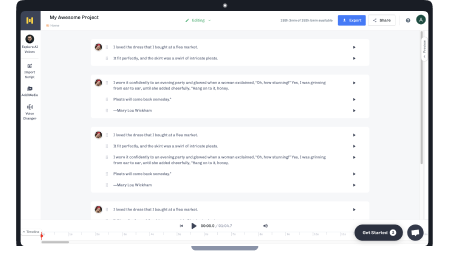
If you are looking for the whole voice infrastructure, Murf's AI voice agent handles the conversation end to end, with sub-800ms response times and multilingual support. If you are building your own stack and just need the voice layer, Murf Falcon 2 is a text-to-speech API built specifically for real-time voice agents. It is designed around the exact problems above:
- Speed & Latency: Falcon 2 delivers time-to-first-audio under-100ms, benchmarked as the fastest across every region tested, which leaves room in the sub-second budget for the rest of the pipeline. This is the difference between a call that flows and one where callers start talking over the agent.
- Natural, conversational delivery: Trained on real customer calls, support flows, and booking conversations rather than scripted narration, Falcon 2 was preferred 10x more often than the previous model in blind tests, with more human pacing and clearer emphasis. It also handles the details real calls trip on, like numbers, currency, addresses, and dates.
- Built for multiple languages: It covers 150+ voices across 35+ languages and handles code-mixing (for example, English & Hindi in one sentence), which is exactly where many agents fall apart on real calls.
- A custom brand voice, fast: Instant voice cloning technology creates a distinct brand voice from under a minute of recording, so your agent does not sound generic.
- Enterprise scale and cost: Up to 10,000 concurrent calls with stable latency, data residency across 11 geographies, on-premise deployment, at a custom pricing.
If you are mapping out a voice-agent project, it is worth hearing Falcon 2 on real call scenarios to judge whether the voice quality and latency hold up for the calls you actually handle.

Frequently Asked Questions
What is an AI voice agent?
.svg)
An AI voice agent is software that holds a real spoken conversation over the phone and completes tasks on its own, such as answering questions, booking appointments, or qualifying leads. It combines speech recognition, natural language processing, a language model, and text-to-speech to talk naturally and take action, replacing rigid phone menus with real dialogue.
How does an AI voice agent work?
It chains three steps in real time: speech-to-text turns your words into text, a language model works out what you want and how to respond, and text-to-speech speaks the reply back. An orchestration layer manages timing and turn-taking so the conversation feels natural, and the whole loop has to happen in under a second to feel right.
How is an AI voice agent different from an IVR?
An interactive voice response or IVR is a fixed phone menu that asks you to press buttons or say single words, and it breaks the moment you go off-script. An AI voice agent instead understands natural speech, handles follow-up questions and interruptions, takes real actions inside your systems, and routes to a human when it needs to, so callers simply talk through what they need rather than navigating a menu to get there.
How is an AI voice agent different from a chatbot?
A chatbot handles typed text one turn at a time, in a setting where a few seconds of delay while it composes a reply is perfectly acceptable to the person reading it. A voice agent has to handle live phone conversations and cope with people interrupting and talking over it, and manage the turn-taking of a real conversation, which is a considerably harder real-time problem.
How much does an AI voice agent cost?
A full-stack voice agent typically costs about $0.01 to $0.05 per minute if you assemble the parts yourself, or around $0.11 per minute all-in on a managed platform, compared with roughly $0.50 per minute for a human agent's loaded cost. Real-time processing, higher-quality voices, more capable language models, and integrations push the price up.
How can I tell if I'm talking to an AI voice?
Listen to the timing rather than the voice: a small, consistent pause before every reply or trouble handling interruptions is a common tell, as is delivery that is flawless but flat. You can also simply ask, since responsibly built systems, and increasingly the law, disclose when you are speaking with an AI.
Are AI voice agent calls legal?
Generally yes, but automated outbound calls are regulated. In the U.S., the Telephone Consumer Protection Act (TCPA) governs automated outreach, marketing calls usually require prior express written consent, and a 2024 FCC ruling confirmed that AI-generated voices count as an artificial or prerecorded voice under those rules. Please check specifics before adopting an AI voice agent.
What languages do AI voice agents support?
Production voice agents commonly support English plus a range of other languages such as Spanish, French, German, Portuguese, Hindi, and Mandarin. Murf AI provides AI voice agents in 35+ languages with code-switching capabilities.
Can an AI voice agent replace human agents?
No, and the businesses seeing the best results are not trying to. Voice agents absorb routine, high-volume calls, confirmations, status checks, FAQs, after-hours coverage, so human staff can focus on complex, sensitive, or high-value conversations where empathy and judgment matter.
What industries use AI voice agents?
Customer service contact centers, sales calls, healthcare, real estate, restaurants, financial services, logistics, and small businesses of every kind. The common usage is a high volume of repetitive phone calls, such as scheduling, status checks, lead qualification calls, and after-hours coverage, that an agent can handle so the team does not have to.