Why AI Voice Agents Fail in Production (and How to Fix Them)


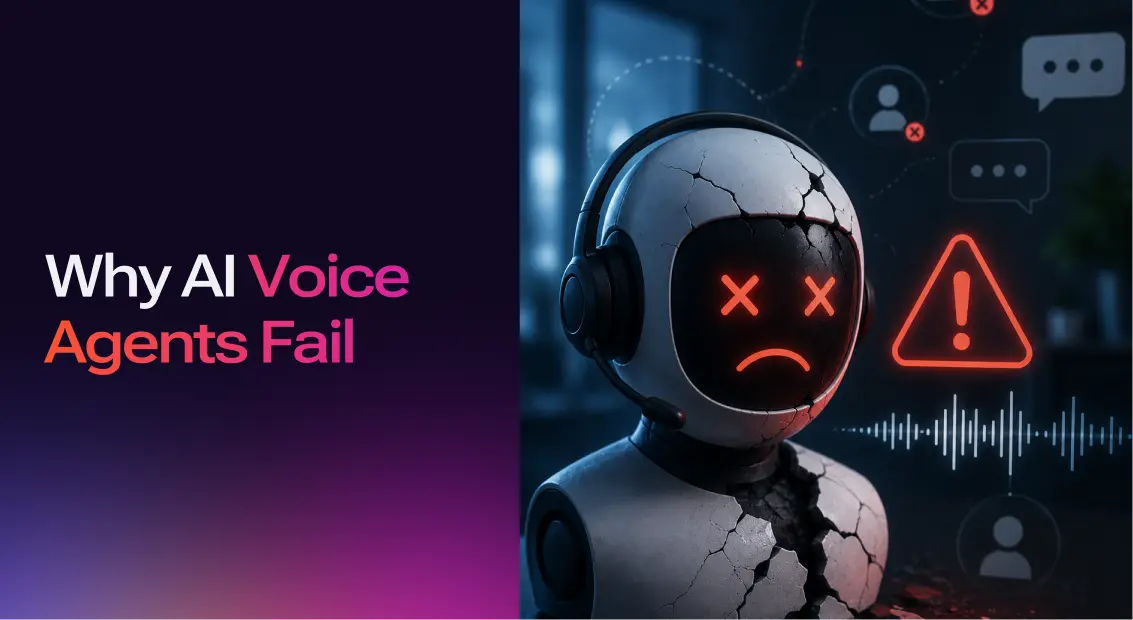

AI Voice agents have become remarkably good at impressing people during demos. They can answer questions naturally, book appointments, qualify leads and even sound human with natural conversations. Once you've gone past the demo stage and actually put them into production at scale, it tells a different story.
In this guide, we'll explore why AI voice agents fail in production, why companies still want to use voice agents and how to build better voice agents that doesn't break when you scale into thousands of calls.
Why AI voice agents fail
This happens more often than most teams admit. AI voice agents don't usually fail in production because the underlying AI is bad. They fail because of how they're built, deployed, and measured. The model that sounded flawless in a controlled demo is often the exact same model running in the field.
Gartner research cited across industry reports puts it plainly: 57% of failed AI initiatives trace back to unrealistic expectations, not a broken model. Here's why that gap shows up, and what the companies who get it right do differently. Here are some of the main reasons why Voice AI agents fail in production (not in any order):
1. Real-world conversations are messy
It is very common for people to ramble, backtrack, mumble, talk over the agent, or pack three requests into one breath. When talking to real humans in real environments in multi turn conversations, there is no one clear conversation flow that occurs. Other uncontrollable factors such as background noise can also further reduce the ASR by over 30%.
An AI voice agent is usually trained mostly on clean, structured input struggles the moment a real caller doesn't hand it a clean, structured request. Voice agents also tend to miss emotional cues from users such as anger, frustration and disgruntlement. Conversations that are too scripted - can show you a success in demos, but can fail in production.
2. AI struggles with edge cases
Most voice agent failures don't happen on the common, everyday questions. They show up in the rare ones: two questions asked at once, a name the system has never heard, a request that falls between two categories it knows. The agent handles the easy 90% fine and stumbles on the 10% that actually matters to the person calling. Voice agents that are built primarily on the LLM layer can handle these edge cases better.
3. Inconsistent Latency
Many teams tend to underestimate latency. Even half a second of dead air can feel painfully long on a real call with a customer. Between hearing a caller and replying, then listening, understanding and response generation can add milliseconds of delay, enough for a customer to get frustrated.Teams that don't budget for this end up with an agent that sounds hesitant or keeps getting talked over.
Hidden latency in the production stack - especially when using multiple vendors for different layers (ASR, LLM or TTS) - can add to these latency budgets, which can cause stilted or broken conversations. The sweet spot is to stay under 800 milliseconds, something that Murf AI does really well. Anything over 2 seconds causes a call to be broken.
4. Poor integration & Human Hand offs
Poor integration and human handoffs are two separate failure points that often show up on the same call. Integration comes first: a voice agent that can't check a real order status, pull an account balance, or update a CRM record isn't actually helping the caller, it's just a nicer-sounding hold message. Handoff comes later, when the agent hits something it can't resolve and has to pass the call to a person.
Too often that handoff drops everything the caller already said, so the human picking up starts from zero and the caller has to repeat their name, their issue, and whatever they already explained. A weak back-end integrations are often a major point of failure for AI voice agents.
For example: A customer calls to check on a late delivery. The voice agent can chat politely but can't actually look up the order, so it tells the customer to "check the app" and offers to transfer the call. The human agent picks up with zero context, so the customer has to explain the whole thing again from scratch.
5. Prompt stuffing
A stuffed prompt can still look good in a demo, because demos only test the handful of scenarios someone thought to try. The model has room to guess right when the input is predictable and the conversation stays short. In reality and production, this is a different test. When deployers try to fit more logic in one prompt, it becomes more unreliable. When more context is added - the model tends to start skipping steps, inventing policies (hallucinations).
Real callers can ask things in a different order, combine two requests, or even bring up something the prompt never anticipated or accounted for. The gap shows up as inconsistency: the agent can handle a compliance disclosure correctly nine times and skips it on the tenth, not because the model got worse, but because the tenth call hit a combination of instructions the prompt was never structured to prioritise. A demo audience never sees that failure, because a demo never runs long enough or wide enough to find it.
6. Multilingual conversations are much harder
An agent that works well in English can fall apart the moment a caller switches languages mid-call, speaks with a regional accent, or mixes two languages in the same sentence, which is completely normal in many parts of the world. The human speech is not defined by one single language every time.
Building multilingual voice agents isn't a translation problem, it's a whole new set of edge cases to test for. Outside of English, speech recognition (ASR) still struggles with accuracy. Additionally, code-switching (e.g., mixing Hindi and English) and the lack of authentic regional accents in TTS can lead to immediate user disengagement.
Apart from these, there are other reasons as well to why AI voice agents can fail in production:
- Response delays over 1.5 seconds can leave a user frustrated.
- Another reason entails poor data grounding and speech recognition errors, that can often lead to hallucinations where the agent can start making up information.
Why companies still want AI voice agents
This does not mean that the usage of voice agents are a bad idea. If deployed correctly, they can genuinely change how a business handles use cases such as phone support. Companies are still looking at voice AI agents for these benefits that they provide:
- Answer calls 24/7, with no wait for business hours
- Handle thousands of conversations at the same time
- Cut wait times for simple, repetitive requests
- Deliver the same answer every time, without a bad day affecting the call
- Reduce the small human errors that creep into repetitive work
- Free up human agents for the calls that need judgment
Building AI agents has some serious advantages. It's also why so many companies rush to deploy before the system is ready, and end up with a public failure instead of a quiet win. Murf's AI agents delivers for real world use cases - with high multilingual support and end-to-end implementation and a response latency of sub 800ms.
How to build better AI voice agents
If you're trying to build an AI voice agent that survives contact with real customers, the teams that get this right, follow the following: let the AI handle the conversation, and let your business rules and data stay firmly in your own hands.
Here is how you can build better voice AI agents that don't fail when scaling to thousands of calls:
Start with resolution, not automation
The goal isn't "how many calls can this handle." It's "how many calls does this actually resolve, the way a good human agent would." Pick use cases where a resolved call is easy to define, and prove the agent there first instead of directly automating the agent to handle thousands of calls.
Design the whole conversation flow
Designing a conversation is a different job from writing a script. A script only covers the path where the caller says exactly what you expect, in the order you expect it. A real conversation flow has to hold up when the caller interrupts mid-sentence, changes their mind halfway through, or stacks two or three requests into one turn, like asking to reschedule an appointment and update their phone number in the same breath.
That means the agent needs to track multiple steps at once without losing its place, let the caller jump in and talk over it without breaking the flow, and pick the conversation back up after a detour instead of starting over.
It also needs a way to recover when something falls outside what it was built for: ask a clarifying question instead of guessing, admit when it's unsure instead of bluffing. And when a request goes past what the agent can safely handle, intelligent call routing should send it to the right human agent with context so the person picking up can move the conversation forward instead of starting it over.
Integrate systems before going live
Before the voice AI agents have gone live, connect the systems before you go live. If the agent can't see or change real data, it can't really help. Connect your CRM systems, billing or scheduling tools early in the process so that your agent can complete actions, not just respond. This is what turns a voice agent from a fancy answering machine into something that solves a real problem for your business.
Make the handoff to a human feel smooth with context retention
When the agent passes a call along, it should pass the full context with it. Say what the caller already said, what's been tried, and how urgent it feels. Nobody should have to repeat themselves after being transferred.
Test beyond demos
It is important to retrain continuously, through every layer and every change in prompt. A demo only proves the agent can handle the handful of real life scenarios someone thought to try. Agents can often struggle with scenarios that is not usually covered when training. Real testing means two things: synthetic testing, where you simulate a wide range of customer conversations before launch, and real-world batch testing, where you run the agent against actual call patterns at scale. If you've only tested the happy path, you don't know what your agent does yet.
Measure customer outcomes
Measuring customer outcomes means looking past the numbers that make a voice agent look efficient and checking whether it actually helped anyone. Containment rate and cost per call are easy to track, but they don't tell you if the caller's problem got solved or if they hung up frustrated and called back an hour later on a different line. By observing real data around post-calls, latency and tool call execution times can also be captured.
A voice agent can post a great containment rate simply by ending calls quickly, which looks like success on a dashboard and feels like a brush-off to a caller. This lack of empathy can lead to user frustration. The metrics that matter more are: did the issue actually get resolved, did the caller need to reach out again for the same problem, and how did they feel about the interaction afterward. Repeat contact rate is good tell that the agent didn't handle the issue, since a caller who comes back for the same issue within a day or two is a sign the first call didn't really fix anything.
Ask questions like - is the agent able to handle interruptions by itself? Did it go off script when a user asks for a specific solution to a problem?
Key takeaways
The biggest reason AI voice agents fail isn't that the technology or the AI model used is bad. It's that companies expect them to do too much before they're ready. You cannot build a successful voice agent that is perfect on Day 1.
Start with a resolvable problem, connect it to your real systems, give it a real way to hand off, and measure what customers experience. Do that, and the same technology that failed in someone else’s headline can quietly work as one of the reliable voice agents for call centers. If you’re exploring whether an AI voice agent is right for your team, start with the narrow use case, call flow, and the right AI phone numbers setup, not the hardest automation problem first.
The AI should handle the conversation itself, while your business rules, data, and workflow logic stay firmly in your control. When the AI is left to improvise business logic on its own, that's usually where things go wrong. Treat the voice layer and the decision layer as two separate jobs, and each one gets easier to test, fix, and trust.

Frequently Asked Questions
Why AI voice agents fail in production?
.svg)
Most failures come from the gap between a scripted demo and a real, messy conversation. Rigid dialogue design, weak integration with business systems, no real handoff to humans, and the wrong success metrics all show up only once real callers are on the line - this is a failure to handle unexpected requests.
What's the difference between a voice agent demo and one that works in production?
A demo is tested against a small, predictable set of conversations. A production-ready agent has been tested against real interruptions, off-topic questions, and edge cases, and has a plan for what happens when it doesn't know the answer.
Do customers actually trust AI agents?
Not by default. Years of frustrating phone menus have made people skeptical of anything automated on a call. A voice agent has to prove itself quickly, usually by resolving something fast and handing off cleanly when it can't. It is important to note that a word error rate (WER) above 10-15% can lead to users being frustrated with a conversation, causing them to drop off.
What industries struggle most when building AI agent failures?
Any industry where calls involve emotional stakes or regulatory detail, like fintech, healthcare, and insurance, tends to see failures show up faster. The margin for a wrong or vague answer is much smaller there than in simple order tracking.
How much does an AI voice agent cost?
Costs vary widely based on call volume, integration complexity, and how many languages or use cases you need. For a detailed breakdown, see how much AI voice agents cost.
Can AI voice agents integrate with existing business systems?
Yes, and they need to. An agent that can't read or write to your CRM, scheduling tool, or order system can only answer generic questions. Real usefulness depends on that integration being solid before launch.
What does a good handoff to a human look like?
The human agent should receive the caller's intent, what's already been discussed, and any relevant account details, without asking the customer to start over. A handoff without context is barely better than no handoff at all.
How long does it take to get an AI voice agent production-ready?
It depends on the use case, but a narrow, well-scoped task can go live in weeks. A broad, multi-department rollout with deep integrations takes months. Rushing this timeline is one of the most common causes of a public failure.
What metrics should companies use to measure success?
Containment rate and cost per call matter, but only alongside customer satisfaction and resolution rate. A voice agent that ends calls fast but doesn't solve anything is optimizing for the wrong outcome.
Are AI voice agents worth it despite the failure rate?
For the right use case, yes. The failures that make headlines almost always trace back to scope, integration, or expectations, not to the technology being fundamentally incapable. Starting narrow and expanding based on real results avoids most of the common traps.