What is Multi-Turn Conversation?


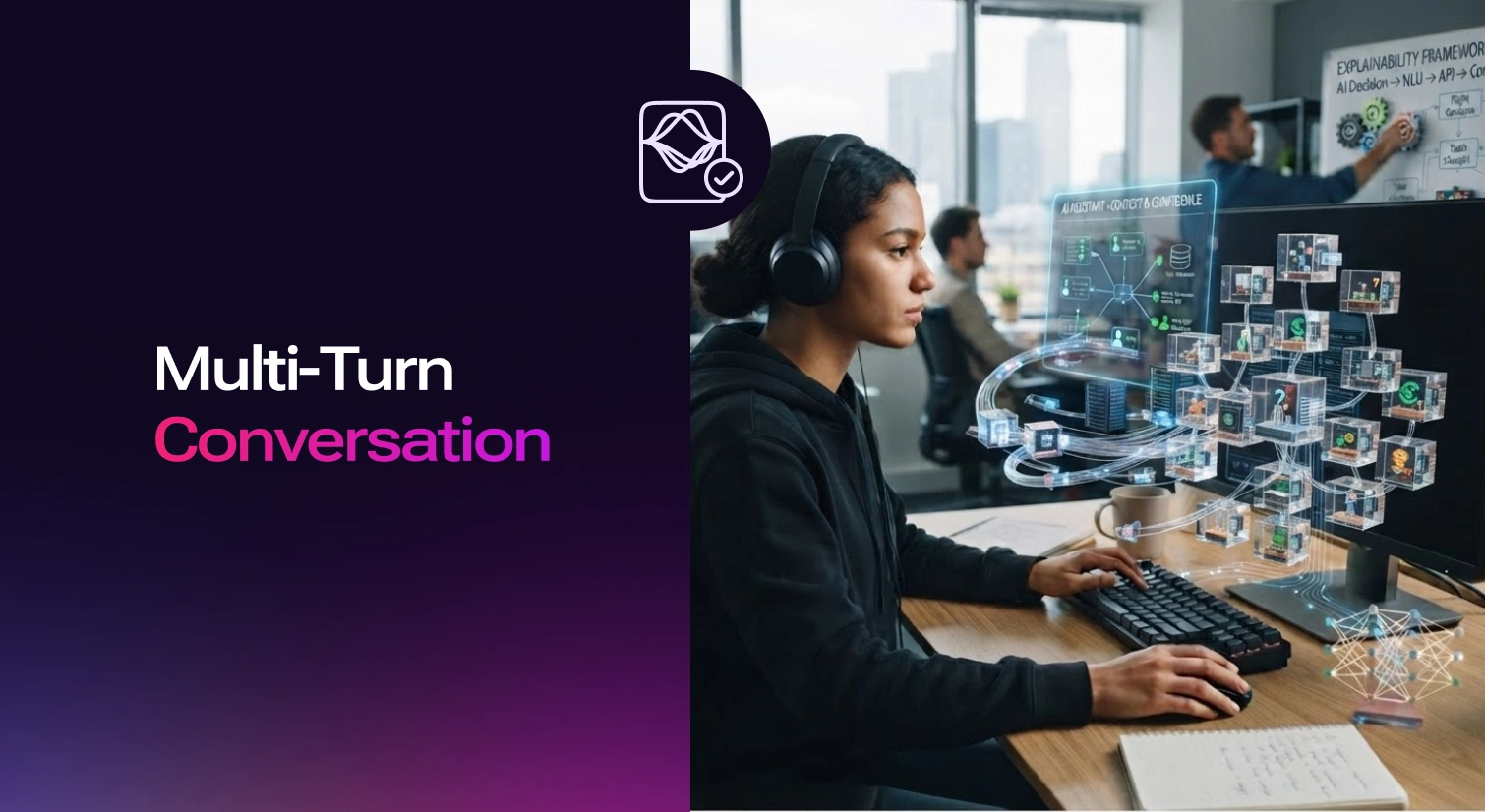

A multi-turn conversation is an exchange between a person and an AI system that spans more than one back-and-forth, where each new response depends on what was said earlier. A customer says "I need to reschedule my delivery." The agent asks for the order ID and the customer answers. The agent provides the options for a new date and then the customer confirms a new date. Three to four turns, one thread, no repeated context. The system understood that the date of delivery is being changed for the very same order and not any pervious order made by the customer.
That's multi-turn conversation, and it's the difference between a voice agent that feels like talking to someone paying attention and not the one that resets with every sentence so the caller has to repeat every thing again to provide the right context.
Single-turn systems handle isolated commands fine such as "set a timer for 10 minutes" needs no memory of anything before or after it. Most people run into this dozens of times a day, "Hey Siri, remind me to call the dentist" doesn't need to remember anything from an hour ago. But most real conversations, especially on a phone call, aren't isolated commands. They're threads that build, branch, and sometimes double back on themselves, and creating a system that can follow one all the way through rather than answering a single question well.
This blog explains what multi-turn conversation actually means, how it is important for AI systems track context across a call, and why it's the difference between a voice agent that holds a real conversation and one that forgets what the caller just said. If you're building, buying, or evaluating an AI voice agent for beyond single-question lookups, this is the concept to understand first.
Single-Turn vs. Multi-Turn Conversation
A single-turn interaction is stateless. The user asks one question, the system answers, and nothing carries forward. "What are your store hours?" needs no context beyond the question itself.
A multi-turn conversation is stateful. Each exchange builds on the ones before it, and the system has to maintain context this includes, hold onto details, unresolved threads, and the user's actual goal, not just the literal words of the last message. When a customer says "cancel my order" without specifying which one, a single-turn system has nowhere to go. A multi-turn system asks a clarifying question, gets the answer, and keeps the original intent alive while it does.
Single-turn systems also shift work onto the caller. Without memory across exchanges, the caller has to anticipate everything the system might need and say it all up front, which is its own kind of cognitive burden, and not how anyone would rather talk to a business on the phone.
The practical dividing line is that, if a system can complete the interaction correctly without remembering anything said before the current message, it's single-turn. If it needs the complete conversation history, it's multi-turn, whether that's two exchanges or twenty.
Design complexity follows the same split, on the builder's side this time instead of the caller's. A single-turn system that answers "what are your store hours" needs one intent, one response, and no memory architecture behind it. Deploy it, and it either gets the answer right or it doesn't; there's no state to track where the last conversation left and not much that can go wrong in between.
A multi-turn system handling "move my 7pm reservation to 8, actually make it Friday instead" has to do a lot more before it can even respond such as, identify which reservation, recognize "actually" as a correction rather than a new request, hold the original intent (reschedule) through that correction, and only then confirm back.
That's a different category of work which involves dialogue state tracking, context window management, and testing across the dozens of ways a caller might phrase that same correction, instead of one clean input-output pair.
Single-turn conversations are often used in voice assistants or voicebots, but multi-turn conversations are an integral part of AI voice agents where the agent not only needs to remember everything, but also record it and execute an action based on that conversation. For a broader look at how this fits alongside chatbots and other automation formats, see voicebot vs. chatbot vs. AI agent.
How Multi-Turn Conversation Works
An AI voice agent isn't one program doing everything. It's a pipeline of distinct components, each handling one job, that together produce something that feels like a continuous conversation. This is the same core problem dialogue systems have had to solve since long before voice AI existed. None of the individual components, on its own, remembers the entire conversation. Here's what each one actually does:
Hearing and understanding
Automatic Speech Recognition (ASR) converts the caller's spoken words into text. Natural Language Understanding (NLU) then reads that new message and pulls out two things, the user intent (what the caller wants to do) and the slots (specific details inside that intent, like a date, a name, an order number, or a party size).
Intent detection doesn't stop at one goal either, it tracks a primary goal and any secondary ones that come up alongside it, since a caller often has both ("book a table" plus "and ask about parking" isn't unusual).
The memory layer
The Dialogue State Tracker (DST) is the system's running clipboard. As the call progresses, it updates a list of what's been filled in (party_size: 2, time: 7pm) and what's still missing (name), and it has to keep the primary goal from the first turn alive across every one of the subsequent turns that follow, even after a detour. Part of this job is coreference resolution which is mapping a pronoun or shorthand ("it," "the other one," "that account") back to the correct entity from earlier in the conversation, not just the most recent noun mentioned.
The DST doesn't just store a raw transcript of the entire conversation, that gets noisy fast and eats into how much the model can actually hold onto. Instead, it extracts key facts and discards the rest, which is what makes context retention possible without dragging every word along.
This is also where a length limit shows up in practice where every model can only take in so much relevant context in a single call (its called context window and is measured in tokens), so even a large context window has a ceiling, and the DST's job is partly about deciding what's worth keeping once early turns start falling out of reach. There are a few different options for handling this once a call runs long, and all of them come back to the same idea, keep what matters, compress or drop the rest.
The decision maker
The Dialogue Manager (DM) is the stateful brain of the operation. It looks at what the DST currently has on its clipboard and decides the next move, ask for the missing detail, look something up in a database, or confirm and move forward. Unlike a stateless function that only sees the current message, the DM has the ability to know where the conversation currently stands and act on maintaining state across the whole call, not just the last exchange.
Speaking back
Once the DM decides what to do, Natural Language Generation (NLG) turns that decision into an actual sentence, and Text-to-Speech (TTS) turns that sentence into spoken audio which becomes the response of the AI system to the caller.
What Makes it a Human-like Conversation
A voice agent that just marches through a fixed checklist breaks the moment a real caller does anything slightly unexpected, which is most calls. A few specific techniques are what keep it from feeling like that.
Intelligent slot filling
If a caller volunteers several details at once, "I'd like a table for two at 7pm tonight", a well-built agent captures all of those slots immediately rather than asking for them one at a time regardless. It updates its state and only prompts for whatever's still missing, instead of working through a rigid script from the top.
Managing tangents and topic shifts
Callers don't stay on script. Someone updating a shipping address might ask an unrelated question mid-flow, "wait, what's my subscription fee again?" A stateful agent can pause the main task, answer the tangent, and pick the original task back up exactly where it left off, instead of losing the thread or forcing the caller to start over.
Graceful error recovery
Voice channels pick up background noise and mishear words constantly. Rather than forcing a full restart every time something's unclear, the system checks its own confidence in what it heard. If it's fairly confident, it confirms implicitly ("Sure, booking for 7pm, which restaurant?"). If it's genuinely unsure, it asks explicitly ("Did you say Tuesday or Thursday?"). Either way, it resolves the ambiguity without throwing away everything that came before it.
Conversational pacing
This one is about feel more than logic: a short pause followed by "let me check that" signals the system is working on something, matching the rhythm of how a person would actually respond, rather than an instant, robotic reply that makes clear nothing real is happening behind it.
Without this kind of structure, state, and memory, a language model has nothing to anchor it turn to turn. The models left to track long conversations on their own start making premature assumptions and compounding earlier mistakes instead of catching them.
Where Multi-Turn Conversations Get Lost
Multi-turn isn't automatically better just because it's longer. A 2025 research paper, LLMs Get Lost In Multi-Turn Conversation, tested a range of leading language models across multi-turn settings and generation tasks and found a consistent pattern where performance degradation shows up as conversations get longer and messier. Not because the models can't understand any single message, but because they lose track of earlier commitments and start contradicting themselves or drifting off the original request. The failure isn't random. It shows up in a few specific ways:
- The system forgets a constraint the user gave several turns earlier
- It agrees with something that contradicts what it said two turns back
- It keeps re-asking for information already provided.
Each of these comes down to the same core issue. The system is generating a fluent next message without a solid enough grip on the thread that led up to it, and without good error recovery, one missed detail early in a long conversation can throw off everything that follows.
Multi-turn is harder to get right than single-turn, not easier, and any system claiming otherwise hasn't been tested on long conversations. There's no single fix. It takes memory management that prioritizes what's relevant over what's merely recent, explicit tracking of open commitments, and enough real-world testing to catch drift before a customer does.
The real test isn't a scripted demo, it's what happens in edge case where forty turns take place in a live call. See why voice agents fail in production for more on how this plays out once an agent is live.
Why Multi-Turn Conversation Matters
On a phone call, there's no chat window to scroll back through. If a voice assistant loses something the caller said three turns ago, the only fix is asking the caller to repeat themselves out loud, which is exactly the friction automation multi-turn conversations are supposed to remove.
Most real customer interactions aren't one-shot. Sendbird's research puts it at 70% of customer service interactions require multiple exchanges to resolve, and a billing question is a good example why. It routinely starts with "why did my bill go up" and needs one or two follow-ups (which account, does this charge look right) before the caller gets a real answer. Every follow-up depends on persistent memory of what came before it, not a fresh start each time the customer asks something new.
This shows up directly in AI call center deployments, where businesses use voice agents to reach customers and handle routine calls at a volume human agents can't match. The agent verifies a caller, pulls up an account, handles a request, and confirms the outcome, all without asking the caller to restate information they already gave. An agent that can't do this just feels worse as it escalates more, takes longer per call, and trains callers to distrust it before the conversation is even over.
How to Design AI Voice Agents for Multi-Turn Conversations
Knowing what a system needs to do (track state, fill slots, recover from errors) is different from knowing how to build it well at scale. The design decisions below are what separate a system that works in a demo from one that holds up over thousands of real calls.
Build a layered memory system, not one long transcript
Feeding raw chat history straight into the model's context window feels like it should work, and briefly does, but it creates what's sometimes called an illusion of continuity. The system looks like it's tracking everything right up until the transcript gets noisy enough to bury the details that actually matter. Production systems generally split memory into layers instead of one undifferentiated log:
- Short-term memory for the current task, active goals, where the caller is in a workflow, and resets once that task is done.
- Long-term memory for facts and decisions that should persist across sessions, so a returning caller doesn't have to re-explain who they are.
- Episodic memory that stores a compact summary of what happened last time (what was tried, what worked) rather than the full transcript.
- Procedural memory for the agent's own reusable know-how: workflows and tool-use patterns it's learned to fall back on.
- User preferences, kept separate and explicit, for things like tone or preferred contact method.
Track state with candidate sets, not a fixed value list
Older trackers matched a slot (like "city") against a pre-loaded list, one exact hit or nothing. Say "Portland" with unclear audio, and a system like that either forces a wrong match or fails outright. A candidate-set approach instead holds a short, ranked list of guesses (Portland, Oregon or Portland, Maine; capped around seven), then re-ranks as the caller adds detail ("the one in Oregon") until one candidate wins, rather than needing a perfect match on the first try.
Let the dialogue manager support mixed initiative, not just a script
A rigid form-filling flow assumes the caller answers exactly one question at a time, in order. Real callers barge in, answer three slots at once, or jump to a different topic mid-task. A more resilient design tracks topics on a stack. When a caller detours, the system pushes the new topic on top, resolves it, and pops back to resume exactly where it left off, an approach with roots in older dialogue-management research that still holds up for voice specifically, where there's no screen to show the caller where they are across multiple turns during the conversation.
Every context strategy has trade-offs, pick deliberately
A 40-turn call generates a lot of transcript. Here's what a system can actually do with all of it, once it's too much to just keep re-sending in full:
- Feed the full history: Send every single turn, every time. On a 5-turn call, this is fine. On a 40-turn call, the system is now re-sending 39 previous exchanges with every new message, which gets slow and expensive fast, and eventually just won't fit in the model's token limit at all.
- Sliding window: Only send the last "X" turns (say, the last 10) and drop everything older. Cheap and predictable, but if the caller mentioned an important constraint in turn 3 ("I'm allergic to shellfish") and the call is now on turn 15, that detail is gone, it fell outside the context window.
- Summarize older turns: Instead of dropping old turns entirely, compress them into a short note ("caller is allergic to shellfish, wants a table for 4, already declined the patio"). The system keeps sending that note plus the last few real turns, so old facts survive without the full transcript weighing things down.
- Retrieve relevant context dynamically: Rather than deciding in advance what to keep, pull in whatever's actually relevant to the current question, on demand. If the caller suddenly asks "what did I order last time," the system looks that up right then instead of carrying it in every single turn just in case.
Most production systems land on summarization as the default, with dynamic retrieval layered on top for anything that needs external data (an order lookup, an account record) mid-call.
Design around the specific ways AI systems fail
Left unmanaged, these systems tend to fail in three specific patterns:
- Premature answering (guessing at a solution before the caller has given all the constraints)
- Answer bloat (leaning on an earlier, wrong attempt instead of correcting it)
- Losing details from the middle of a long call (catching what was said first and last, but dropping what came in between).
Each has a specific fix:
Against premature answering: Keep the first turn focused on establishing the high-level goal and let later turns fill in specifics, rather than letting the system guess at a full answer before the caller's finished specifying what they want.
Against answer bloat: When a caller finishes providing scattered details across several turns, consolidate them into one clean instruction before generating a final action, rather than building on top of an earlier, possibly wrong, attempt.
Against losing details from the middle: Keep the system's own responses concise, since longer generated turns bury the specific detail that matters inside a lot of restated context, making it easier for a detail to get missed on either side.
Add oversight for anything high-stakes
For enterprise or safety-critical deployments, some teams layer monitoring on top of the raw conversation to catch contradictions a dialogue manager might miss on its own, treating the call as a structured record where the system can flag when something said in turn 12 doesn't line up with turn 3. This is a heavier layer than most voice deployments need, but worth knowing exists if the use case is regulated or high-risk.
Murf AI Voice Agents
Multi-turn handling is table stakes for any AI voice agent worth deploying. It's also the specific line Murf draws between itself and older call automation: in Murf's own comparison of IVR, intent-based IVA, chatbots, and AI voice agents, "free-form, multi-turn" conversation and the ability to handle edge cases are listed as what separates an AI voice agent from the rest, not an added feature, but the defining one.
In practice, that means a Murf voice agent tracks context across a full call, not just the most recent sentence, so a caller who circles back to something they mentioned three turns ago doesn't have to repeat it. It also means the agent can act mid-call on what it's tracked such as, pulling a customer record, updating a CRM field, or booking an appointment through Murf's real-time function calling, all triggered by context gathered earlier in the same conversation, not a separate step afterward.
Teams running Murf report a 40% reduction in cost-to-serve and a 30% increase in CSAT scores, alongside sub-600ms response latency on live calls, figures Murf publishes across its production deployments rather than a single case study.
You can hear what a multi-turn exchange like this actually sounds like rather than take the claim on faith: Murf's appointment scheduling demo walks through a booking call end to end, name, date, time, and confirmation gathered across several turns without the caller repeating anything, and the customer service demo shows the same context-holding behavior in a support scenario available on Murf AI Voice Agents.
If you're evaluating voice AI for anything beyond a single-question lookup, whether that's building an AI voice agent from scratch or replacing one that keeps dropping context, multi-turn handling is the first thing worth testing.

Frequently Asked Questions
What is a multi-turn conversation?
.svg)
A multi-turn conversation is a dialogue between a person and an AI system that spans two or more connected exchanges, where each new turn depends on context from the ones before it, rather than being answered in isolation.
What's the difference between single-turn and multi-turn conversations?
Single-turn conversations are stateless: one question, one self-contained answer, nothing carried forward. Multi-turn conversations are stateful: each exchange can reference and build on everything said earlier in the same interaction.
Why do LLMs lose context in long, multi-turn conversations?
Research on leading language models has found accuracy drops as conversations get longer, largely because the model loses track of earlier commitments or starts contradicting itself as turns accumulate. This is documented in "LLMs Get Lost In Multi-Turn Conversation" (arXiv:2505.06120).
How many turns does a typical customer support conversation take?
It varies by issue type. Simple lookups often resolve in one or two turns, while anything involving a change, a transaction, or a real decision, a refund, a reschedule, an account update, commonly takes five or more. Multi-turn design improves customer satisfaction scores significantly.
How does an AI voice agent remember what was said earlier in a call?
It carries the conversation history forward and hands the relevant details back to the large language model at each new turn. On a long call, that history usually gets compressed into short summaries as it grows, so the system keeps the facts that matter (account details, stated issue, what's already been tried) without dragging the full transcript along word for word, letting callers speak naturally instead of repeating themselves.
What happens if two AI systems talk to each other?
They can exchange multi-turn dialogue the same way a person and a system would, but without a human anchoring the conversation's actual goal, the exchange can drift or loop, since neither side is necessarily tracking the same intent a human caller would.
How do you evaluate or test multi-turn conversations?
Testing has to go beyond checking whether a single task got completed. It means simulating realistic multi-turn scenarios, interruptions, topic changes, corrections, and checking whether context carries forward correctly across the whole interaction, not within one exchange. See how to test AI voice agents for a fuller breakdown.
Can multi-turn conversations work in languages other than English?
Yes. The underlying context-tracking problem is the same regardless of language, though systems need language-specific handling for things like pronoun resolution and phrasing. Murf's voice AI Agents support 35+ languages, which matters for teams handling multi-turn calls outside English-only markets.
What is dialogue state tracking?
Dialogue state tracking is how a conversational AI system keeps track of what's been established, confirmed, or is still pending in an ongoing conversation, such as which order a customer is asking about or which fields in a form are already filled.
Does Murf's voice AI support multi-turn conversations?
Yes. Murf's voice AI Agents are built to retain context across a full call rather than treating each turn in isolation. See the special mention below for specifics.

.webp)
.webp)


