What is Conversational AI Lead Scoring?


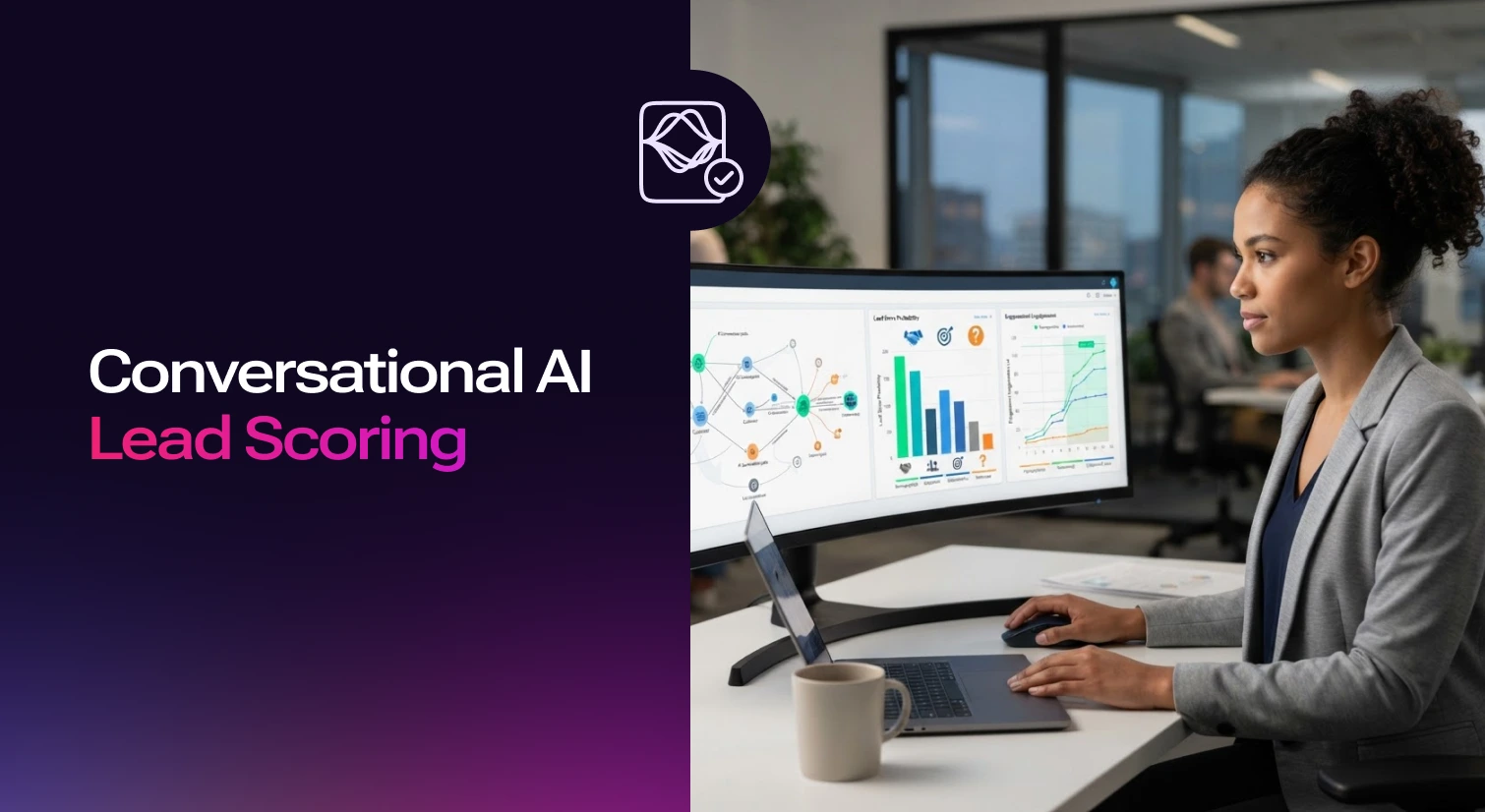

Most lead scoring systems reward the wrong signals. A prospect who downloads three whitepapers gets the same score as one who spends eight minutes reading your pricing page, even though only one is close to buying. That's backward, and it happens because most scoring still runs on what a lead clicked, not what a lead actually said. Gleanster Research has put the cost of this at roughly 27% of B2B leads being sales-ready when marketing hands them off, meaning the other 73% sit in the pipeline wasting rep time for both sales and marketing teams.
Conversational AI lead scoring fixes the click-vs-said problem by scoring leads on what they say, not just what they click. It ranks prospects in real time using signals pulled from a live chat or voice conversation, so sales and marketing teams know who's ready to talk before the conversation even ends.
Chat and voice aren't two flavors of the same signal. A chat-based tool reads word choice, punctuation, and response speed. A voice-based one reads all of that plus something text can't carry at all including pace, pitch, pauses, and whether someone talks over the agent to get to the point faster. That's not a richer version of the same information. It's a different signal set, and which one your scoring tool reads determines what it can and can't see.
Conversational AI lead scoring ranks leads using data captured during a live conversation, chat or voice, instead of relying only on form fills, page visits, or demographic data. A chatbot or AI voice agent asks qualifying questions, listens for buying signals like urgency or budget mentions, and updates a score based on how the conversation unfolds. In practice, this is what real time lead scoring looks like and the system doesn't wait for a batch of calls or form fills to score leads based on stale form data, and it matters most for teams running high-volume lead generation where no rep could review every conversation manually.
Traditional scoring waits for a form submission, then runs a batch update overnight. Conversational AI lead scoring system scores the lead while they're still on the call or in the chat window.
Traditional Lead Scoring vs. AI-powered Scoring
Manual lead scoring asks a rep or an analyst to review each lead by hand and assign points against a checklist. It works at small volume. It breaks down once the pipeline grows past what one or two people can review in a day.
Static scoring models, the point-value rules most teams set up in a spreadsheet or CRM, have a structural problem, not just a maintenance one. A static model assigns its points at the moment of the form submission and never revisits them. If a lead states real urgency five minutes into a live call, the model has no channel to register that signal until the next scheduled batch update, if it ever re-scores the lead at all. That's not a tuning problem you fix with better point-value rules. It's a property of scoring at a fixed point in time instead of continuously. Traditional lead scoring methods built this way treat all engagement as equally meaningful, which is exactly backward for example, a CFO spending eight minutes on your pricing page and a student downloading a whitepaper for a class project can end up with the same score.
AI-powered scoring, sometimes called AI-driven lead scoring or just AI scoring, replaces the fixed checklist with a model that learns. Instead of a human manually reviewing each lead, an AI system evaluates the lead scoring process continuously, working through the same lead qualification process a rep would, minus the manual effort and the human error that creeps in after the twentieth call of the day. The scoring process itself doesn't change in principle, you're still trying to answer "is this lead worth a rep's time," but automated lead scoring answers it faster and more consistently than a person working through a spreadsheet, and unlike a static model, it can answer that question again the moment new signal shows up.
Where Lead Scoring Fits on the AI Maturity Curve
Conversational AI systems don't jump straight from "basic bot" to "does everything." They move through recognizable stages, from a system that can only follow a fixed script, to one that can hold a real conversation, to one that acts on what it hears. That progression is called AI maturity curve. It refers to a way of describing how capable an AI system actually is, not just whether it's labeled "AI."
Conversational AI lead scoring isn't really a separate category sitting next to traditional scoring. It's a marker of how far along that curve a team's automation has actually progressed. A useful way to place it:
Traditional and manual lead scoring don't sit on this curve at all. They're a pre-conversational paradigm, static rules bolted onto a form, not a stage a system passes through on the way to something more capable. Conversational AI lead scoring is specifically what a task-executing agent does with a conversational assistant's understanding. It doesn't just hold the exchange, it draws a score from it and acts.
In practice, here's what changes stage to stage:
The Data Behind the Score
Most lead scoring data falls into three familiar buckets, and they don't all carry the same kind of information. An AI lead scoring system pulls from more than one of them:
- Demographic and firmographic data (job title, company size, industry) describes who a lead is on paper, but it says nothing about timing, whether this happens to be the week their budget got approved, or whether a competitor's contract just came up for renewal.
- Behavioral data and behavioral signals (website visits, email opens, engagement patterns across channels) show what a lead has actually done, which is closer to timing but still indirect.
- Intent data adds another layer of search behavior, content topics, and competitor research that hint at where someone is in their buying journey.
Conversational AI adds a fourth bucket most scoring tools don't have access to at all. A signal generated live, inside the conversation itself is the only one of the four that captures timing directly, because it's generated at the moment intent is expressed instead of collected in advance.
Traditional lead scoring often relies on 5 to 10 superficial attributes such as job title, company size, maybe one or two behavioral flags. A conversational AI model can weigh far more at once, cross-referencing customer data already sitting in your CRM against new data captured mid-conversation.
The underlying AI model is trained on historical data, past conversations, and their outcomes, so it can identify patterns that predict which combinations of demographic and firmographic data, behavioral signals, and stated intent actually lead to a closed deal. This is the same lead evaluation a human rep would do manually, just applied consistently across every conversation instead of once in a while. As the model processes more data, it gets better at telling a real buyer from someone doing early research, and it keeps adjusting instead of running on the same fixed rules for months.
This is also where conversational AI overlaps with, but isn't identical to, predictive lead scoring. Predictive lead scoring and predictive scoring models typically run entirely on historical data and firmographic/behavioral patterns, no live conversation involved, to forecast which accounts are likeliest to convert. Predictive lead scoring models are useful for prioritizing outbound targets before any contact happens. Conversational AI lead scoring picks up once a conversation starts, adding real-time signal on top of whatever predictive score a lead already has.
How Conversational AI Lead Scoring Works
Three things do the actual work:
- Natural language processing (NLP) reads what a lead types or says and pulls out meaning, not just keywords. It's how the system knows "I need this live by next quarter" signals urgency, while "just browsing for now" doesn't. On a voice call, the same NLP layer also has pace and pitch to work with, not just word choice, since urgency spoken in a rushed tone and urgency typed in a calm one aren't the same signal even when the words match.
- Machine learning algorithms compare each conversation against patterns from past leads who did or didn't convert. Over time, by analyzing vast amounts of conversational data, the model gets better at telling a serious buyer from someone doing early research.
- Real-time signal capture is what separates this from older automation. Instead of waiting for a nightly batch job, the score updates the moment a lead mentions a budget, a timeline, or a pain point. Walk through one example: a lead opens with "just looking into options for now," which keeps the score low. Two minutes later they ask "what would this cost for 50 seats by next month," a specific volume and a specific deadline in the same sentence, and the score jumps immediately, before the call even ends. A static model would have scored this lead once, at the point of form submission, and never revisited it.
Together, these three pieces let a bot ask the right question, read the answer for intent, and route a hot lead to a rep in seconds instead of hours.
Voice vs. Chat-based Lead Scoring
Most examples of conversational AI lead scoring online focus on text such as, chat widgets, WhatsApp, Messenger. Voice isn't just chat with an extra channel bolted on. It carries prosody, the pace, pitch, pauses, and interruptions in how something gets said, and none of that survives being reduced to a transcript.
A prospect who types "we need this running by Friday" and one who says the same sentence in a rushed tone, cutting off the agent to get to the point, are not sending the same signal, even though the words match exactly. A chat-only tool reads the words and a voice-capable one reads the words and the urgency underneath them. That's the core distinction worth sitting with: voice scoring isn't a better version of chat scoring. Chat only ever receives typed text, and text doesn't carry pace, pitch, or pauses, so there's no tone signal for a chat-only tool to miss. It was never there to read. Voice carries all of that, which is why it matters most in industries where the phone, not chat, is still where urgency actually shows up such as real estate, dealerships, and healthcare scheduling among them.
If your sales motion runs through phone calls as much as web chat, a chat-only scoring tool isn't giving you a lighter version of the picture. It's missing a channel of information entirely.
Benefits of Conversational AI Lead Scoring
The benefits of AI lead scoring show up in more than just faster follow-up. Scoring leads through conversation changes timing, accuracy, and where a rep spends their day.
Prioritize leads automatically
Instead of a rep scanning a spreadsheet to guess who to call first, the system surfaces the most promising leads on its own. High scoring leads get a rep's attention first; unqualified leads get nurtured or filtered out instead of clogging the pipeline.
Real-time scoring that doesn't decay
The real advantage of scoring a lead the moment intent is expressed isn't speed for its own sake. It's that the score is more accurate right then than it will be later, because urgency decays. A lead who was ready to buy this morning and hasn't heard back by afternoon is, by the time a batch job would have scored them, already a different lead than the one the static score was measuring. Public research on AI-driven lead scoring reports conversion rates improving anywhere from roughly 25% to as high as 50%, alongside a reported 30% increase in decision accuracy and a 30% reduction in scoring processing time.
Shorter sales cycles
Qualified prospects reach sales representatives sooner and with richer context, since the AI has already captured intent data and stated timelines during the conversation instead of leaving a rep to piece it together on a first call. That richer handoff can shorten sales cycle length in practice, not just in theory.
Revenue growth from better lead quality
Sales teams focus their time on leads that are more likely to close, which compounds into revenue growth over a quarter, not just a cleaner-looking dashboard. Better lead quality upstream means fewer wasted meetings downstream.
Runs continuously, and applies the same criteria every time
A tired rep on their twentieth call of the day scores leads differently than the same rep on their first call, and no rep is available at 2 a.m. The system doesn't sleep, doesn't get inconsistent under load, and applies the same criteria whether it's scoring individual leads or used to score accounts in an account-based motion, at whatever volume the pipeline demands.
How to Implement an AI Lead Scoring System
This takes more than flipping a switch:
- Place yourself on the maturity curve first: If your current bot only holds scripted menu options, adding scoring on top of it won't work, there's no real exchange yet to score. Confirm you're at least at the conversational-assistant stage before picking a scoring tool.
- Pick a scoring tool that fits your channels: Mostly phone conversations? You need a voice-capable AI lead scoring solution that reads tone and pacing, not a chat-only one that would miss that signal by construction.
- Define your lead scoring criteria: Company size, job title, stated budget, timeline, specific pain points. Feed these in as the rules your scoring models will apply, and for voice, include tone or urgency thresholds explicitly. Teams that carry over chat-only criteria unchanged tend to underweight vocal urgency simply because their rules were never written with it in mind.
- Connect it to your CRM: A score that never leaves the chat tool is useless to sales. Push scored leads and conversation summaries straight into the CRM record alongside your existing lead data.
- Test before launch: Run simulated conversations and check whether the scoring matches what a human would conclude, using historical data from leads you've already closed or lost as a benchmark.
- Launch and compare: Score real leads for a few weeks against how your team would have scored the same leads manually.
- Route and hand off deliberately: A high score should trigger intelligent call routing to the right rep, with a clean handoff from AI to human so the lead doesn't repeat themselves.
- Keep it updated: Scoring criteria go stale as your product, market, and lead behavior shift. Revisit on a schedule, not just when something breaks.
Most teams that implement AI lead scoring for the first time start with one channel and one scoring model, then expand once the results hold up against manual review.
Where Murf AI Agents fit in
Murf AI Agents hold live voice conversations with inbound leads, ask qualifying questions, and score them on tone and pacing as well as words, the signal set a chat-only tool never has access to. Murf's own comparison of channel types makes the chat limitation explicit.
A chatbot understands text only and needs a separate workflow to act on anything it learns, while a voice agent can take actions inside the same call it's scoring, updating CRM records in Salesforce, HubSpot, Zoho, or Pipedrive, booking a meeting, or triggering a follow-up, through real-time function calling mid-conversation. Calls run at sub-600ms response latency and are built to handle interruptions and natural turn-taking, so the scoring conversation reads as a real exchange, not a script working through a decision tree.
This picks up where voice bots handle lead qualification leaves off, with scoring as the natural next step. A conversational assistant that also acts as a task-executing agent on what it hears. The best results still come from balancing artificial and human intelligence, and Murf's handoff rules make that concrete rather than aspirational.
An escalation can trigger on intent, urgency, sentiment, account type, workflow stage, or specific phrases, and when a call transfers, the receiving rep gets the full conversation context and summary instead of starting cold. Every call also generates a transcript, summary, and sentiment read, so teams can track how quickly leads are contacted and converted, and refine scoring criteria against real conversations instead of guesswork.
Murf is used by 1,000+ teams across industries including healthcare, finance, retail, and real estate, and reports a 40% reduction in cost-to-serve and a 30% increase in CSAT scores across its AI voice agent deployments.
Ready to score leads through conversation?
Murf AI Agents hold real-time voice conversations with your inbound leads, score them as the conversation happens, and route qualified leads straight to your sales team. Explore Murf's conversational AI agents to see how it fits your call volume.

Frequently Asked Questions
What is conversational AI lead scoring?
.svg)
Ranking leads using signals captured during a live chat or voice conversation, rather than relying only on form fills or page visit history. The score reflects what a lead actually says, and on voice calls, how they say it, about their intent, budget, and timeline.
How does it work?
It combines natural language processing to interpret what a lead says, machine learning algorithms to compare that against patterns from past conversions, and real-time signal capture so the score updates during the conversation, not overnight.
What's the difference between traditional and conversational AI lead scoring?
Traditional scoring assigns fixed point values to actions like downloads or page visits, usually updated in a batch overnight, and often relies on just a handful of demographic and firmographic data points. This method reads the actual language in a live conversation and updates the score immediately, drawing on far more data points at once.
Is voice-based lead scoring just chat scoring with extra steps?
No. Voice carries pace, pitch, pauses, and interruptions that a chat transcript doesn't preserve. A voice-capable system reads a different, wider signal set than a chat-only one, not a richer version of the same signal.
What is predictive lead scoring, and how is it different?
Predictive lead scoring models forecast which accounts are likely to convert using historical data, firmographic data, and past buyer behavior, without any live conversation involved. Conversational AI lead scoring builds on top of that: it adds real-time signal from an actual chat or voice conversation once contact happens.
What data does it use to score a lead?
The conversation itself: questions asked, urgency and sentiment in the responses, budget or timeline mentions, plus demographic and firmographic data, prior website visits, and engagement patterns the lead shares directly or has already generated.
Can this work over voice calls, not just chat?
Yes. Voice-based scoring reads the same intent signals as chat, urgency, budget mentions, stated timelines, and can also pick up on tone in actual speech, which text-based chat can't capture.
How do you implement it?
Pick a scoring tool that matches your primary channel, define clear lead scoring criteria based on your ideal customer profile, connect it to your CRM, test it against real conversations and historical data, then launch and compare results to manual scoring before fully automating routing.
Does it replace human sales reps?
No. It handles the qualifying conversation and scoring, then routes ready leads to a rep. The AI does the initial triage; a person still closes the deal, and the best setups keep a human reviewing edge cases the model gets wrong.
How accurate is it compared to manual methods?
It depends on how well the system is trained on your specific ideal customer profile and lead scoring criteria. A generic, untrained model misses signals that matter in your market. One trained on your actual closed deals, and reviewed periodically, tracks closer to how a human would score the same lead, and keeps improving as it sees more data.
Can it integrate with my CRM?
Most platforms integrate with common CRM, email, and calendar tools, so a scored lead and its conversation summary land in the CRM record instead of staying siloed in a separate dashboard, giving marketing and sales teams the same view of every lead.


.webp)
.webp)


