Legally Recording Phone Calls in the US: Is It Legal, and When?



Under federal law (18 U.S.C. § 2511), recording a US phone call is legal as long as one party consents — usually you. But 11 states require every participant to consent before you can press record, and when callers are in different states, the stricter rule applies. So the answer to "is it illegal to record a phone call?" depends on three things:
- Where you are? i.e. which state?
- Where the other person is?
- Is anyone on the line in an all-party-consent state?
Please Note: This article is for general information and is not legal advice. Recording law varies by state, situation, and evolving case law. Consult a licensed attorney before relying on this article for any specific recording decision.
The federal baseline: 18 U.S.C. § 2511 and the Wiretap Act
The federal Wiretap Act, codified at 18 U.S.C. § 2511 and amended by the Electronic Communications Privacy Act of 1986, sets the minimum standard for call recording in the United States. The rule is one-party consent. If you are part of the conversation, your own consent is enough. You can record without telling the other person.
Two limits apply if you are not a party to the call, you cannot record it unless at least one party knows and agrees. Recording a conversation you are not part of is wiretapping and is a federal crime. And even with one-party consent, recordings made with criminal or tortious intent (to blackmail, defraud, commit another offense) are illegal regardless.
States can be stricter than the federal rule, and 11 of them are. They cannot be more permissive. If you are in an all-party-consent state, that state's law controls, not the federal floor.
One-party vs all-party consent: The core split
State law splits into two groups:
One-party consent
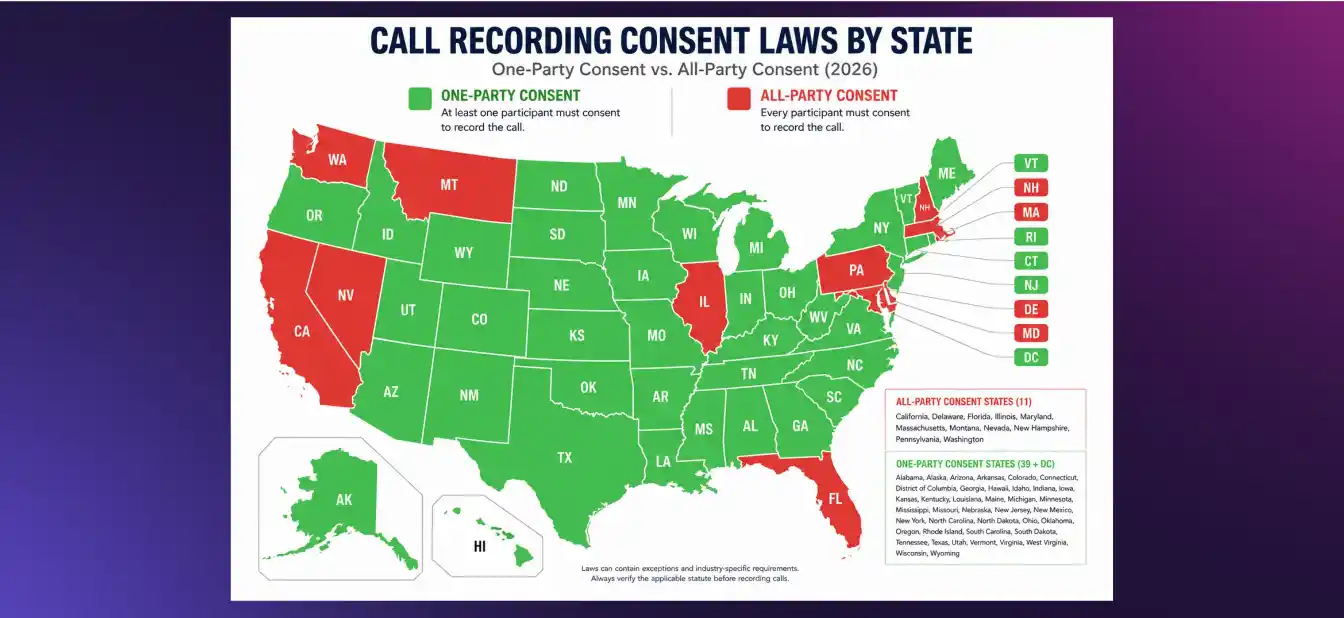
This means a recording is legal as long as one person on the call agrees. If you are part of the call, you are that person. Thirty-eight states plus the District of Columbia follow this rule, the same as federal law. Vermont has no recording statute and defaults to federal one-party consent by gap.
All-party consent
Sometimes called "two-party consent" means every participant has to know about and agree to the recording. The term "two-party" is misleading. If five people are on a conference call, all five must consent. Eleven states use this rule: California, Delaware, Florida, Illinois, Maryland, Massachusetts, Montana, Nevada, New Hampshire, Pennsylvania, and Washington.
The all-party rule catches people off-guard. That's why "can you legally record a phone call" has no national answer.
All-party consent states at a glance
One-party Consent States (the majority rule)
The remaining 38 states, along with the District of Columbia, generally follow the federal one-party consent rule for call recording.
These states include Alabama, Alaska, Arizona, Arkansas, Colorado, Connecticut, Georgia, Hawaii, Idaho, Indiana, Iowa, Kansas, Kentucky, Louisiana, Maine, Michigan, Minnesota, Mississippi, Missouri, Nebraska, New Jersey, New Mexico, New York, North Carolina, North Dakota, Ohio, Oklahoma, Oregon, Rhode Island, South Carolina, South Dakota, Tennessee, Texas, Utah, Virginia, West Virginia, Wisconsin, and Wyoming.
Vermont has no specific state recording statute and follows one-party consent by default.
However, Connecticut, Michigan, Oregon, and New Jersey have situational exceptions where certain in-person conversations or workplace recordings may require all-party consent, so it is important to check the applicable state law if the recording involves more than a typical phone call.
Cross-state calls: Which law applies?
This is the question the leading articles rarely answer cleanly. If you are in a one-party state and the person on the other end is in an all-party state, you do not automatically inherit the easier rule. Courts in the strictest states have ruled the other way.
Use this four-step decision flow:
- Where are you physically located when you press record? Identify the state.
- Where is every other person on the call located? Identify each state. If anyone is in California, Delaware, Florida, Illinois, Maryland, Massachusetts, Montana, Nevada, New Hampshire, Pennsylvania, or Washington, mark the call as cross-jurisdictional.
- Does any state on the call require all-party consent? If yes, apply the all-party rule. Get consent from every person before recording, even if your own state would let you record without it.
- If only one-party states are involved, federal one-party consent controls. You can record without notifying the other party as long as you are a participant.
The leading case is Kearney v. Salomon Smith Barney (Cal. 2006), where the California Supreme Court held that California's all-party rule applies when one participant is in California, even if the other participant is calling from a one-party state. The safe default for any cross-state call is to get consent from everyone.
Call Recording Laws in Key U.S. States
Call recording laws vary significantly across the United States. Some states follow a one-party consent rule, allowing a participant to record a conversation without notifying others, while others require consent from everyone involved. The consequences for getting it wrong can include civil liability, fines, and criminal penalties. Understanding state-specific requirements is essential for individuals and businesses that record calls for customer service, compliance, training, or documentation purposes.
Is it illegal to record a phone call in California?
California is the most aggressive all-party state. Cal. Penal Code § 632 covers confidential communications; § 632.7 covers any call involving a cordless or cellular phone. Civil damages run $5,000 per violation or three times actual damages, whichever is greater. Recording without consent is a misdemeanor by default and can rise to a felony depending on intent.
Is it illegal to record a phone call in Florida?
Fla. Stat. 934.03 makes intentional interception of a wire or oral communication a third-degree felony. Florida applies the reasonable-expectation-of-privacy test, so a recording made in a public setting where no privacy was expected may be defensible. For any normal phone call, assume all-party consent is required.
Is it illegal to record a phone call in Texas?
Texas is one-party under Tex. Penal Code § 16.02. If you are part of the conversation, you can record it without telling the other party. Recording a conversation you are not part of, without anyone's consent, is a felony.
Is it illegal to record a phone call in New York?
New York is one-party under N.Y. Penal Law § 250.00–250.05. You can record any call you are participating in. Recording a conversation you are not on is eavesdropping and is a Class E felony.
Is it illegal to record a phone call in Virginia?
Virginia is one-party under Va. Code § 19.2-62. Recording a conversation you are not party to is a Class 6 felony, even with one party's consent under some readings.
Is it illegal to record a phone call in Pennsylvania?
Pennsylvania is all-party under 18 Pa.C.S. § 5703. Recording any wire or oral communication without all parties' consent is a third-degree felony. The Wiretap Act applies broadly, including to most business call-recording setups.
Is it illegal to record a phone call in Michigan?
Michigan's statute (MCL § 750.539c) was historically ambiguous. The Sixth Circuit resolved it in AFT Michigan v. Project Veritas (2021), confirming that a participant can record a conversation without the other party's knowledge. Michigan is one-party for participants.
Is it illegal to record a phone call in Ohio?
Ohio is one-party under Ohio Rev. Code § 2933.52. A participant in a call can record without notifying others.
Exceptions to consent laws
The consent rules are not absolute. A few exceptions matter.
Law enforcement. Police and federal agencies can intercept calls under a court-issued warrant, as authorized by the Wiretap Act and the Foreign Intelligence Surveillance Act. Without a warrant, the same one-party or all-party rule that applies to civilians applies to them, with narrow emergency exceptions.
Public meetings and proceedings. Many states exempt recordings of public hearings, council meetings, and judicial proceedings from consent rules. Open-meetings laws often require recordings, not just permit them.
Workplace and business use. Companies that record customer-service calls usually rely on disclosure plus implied consent. The standard "this call may be recorded for quality assurance" pre-roll followed by the customer staying on the line is generally treated as consent in both one-party and all-party states. Internal calls between employees are stickier; talk to counsel before recording employee-to-employee conversations.
Reasonable expectation of privacy. Massachusetts and Florida only require consent when the parties had a reasonable expectation of privacy. A conversation in a loud public space may not qualify. A private phone call from someone's home almost always does.
Emergencies. Some statutes allow recording without consent when it is necessary to document a crime in progress or to protect life.
Recording disclosure and ready-to-use scripts
Even where one-party consent is legally enough, disclosure is often required by company policy, customer-service regulation, or international rules. A clear notice plus continued participation counts as consent in most jurisdictions.
Three scripts cover most situations:
Consumer service (inbound or outbound): "This call is being recorded for quality and training purposes. By continuing the call, you consent to the recording."
B2B sales or support: "Before we get started, please note that this call is being recorded so we can review the conversation and follow up accurately. Is that all right with you?"
Legal, journalism, or research (all-party state): "I'd like to record this conversation for accuracy. Do I have your permission to do so?" Wait for an audible "yes" and continue recording with that confirmation captured.
Disclosure can also be an audible beep tone (the old California Public Utilities Commission standard) or an automated pre-roll message. The point is fair notice before any sensitive content begins.
AI, automation, and modern recording tools
AI voice agents, IVR systems, and AI notetaker tools have outpaced the statutes. The law was written for a person pressing a button on a tape recorder. It does not directly answer "does the AI on the call count as a party?" or "who consents when the recorder is software?"
The working answer most counsel will give: the AI is not a legal "party" — the human or business deploying the AI is. If you deploy an AI voice agent that records and transcribes a customer call in an all-party state, you (the deployer) must obtain consent the same way a human agent would. Most AI voice platforms, including AI voice agents, now include automatic consent prompts at the start of each call. If yours doesn't, add one.
AI notetakers (the kind that join Zoom or Google Meet calls) generally rely on the platform's built-in recording notice and the participants' continued presence as consent. That's workable in one-party states. In all-party states, the safer practice is to announce the notetaker at the top of the meeting and confirm consent on the record. The same logic applies if you use AI voice cloning tools that take recorded audio as input — the underlying recording still needs to be lawful.
Unsettled questions like whether silent passive recording by an AI bot is "secret" under Massachusetts law are likely to be tested in court over the next few years. Until they are, treat AI-assisted recording the same as a human recording it.
Penalties: What happens if you break the law
Penalties vary by state and by whether the case is civil or criminal.
Criminal range: from a misdemeanor (Colorado's Class 2 misdemeanor under § 18-9-303, up to 120 days in jail) to serious felonies (Connecticut's Class D felony under § 53a-189, up to five years; Pennsylvania's third-degree felony under § 5703, up to seven years; New Hampshire's Class B felony, up to seven years).
Civil: several all-party states give the recorded party a private right of action. California allows $5,000 per violation or three times actual damages. Washington allows actual damages plus attorney fees. Even when criminal prosecution is unlikely, civil exposure stacks fast across multiple recorded calls.
A recording made in violation of state law is often inadmissible as evidence in that state's courts. That undercuts the most common reason people record calls in the first place.
Closing
US call recording law is workable once you know the two-question test: who consents in your state, and is anyone on the call in a stricter state? When in doubt, ask. A short verbal disclosure costs nothing and removes most of the legal exposure.
If your work involves voice, audio, or AI agents on phone calls - building a voice changer for phone calls, deploying an AI voice agent, or working with synthesized speech - the same rules apply to whatever you record or generate from those calls. Murf builds AI voice tools that work with the disclosure-and-consent flow above; if your use case involves real call recording, build the consent prompt into your workflow before the call connects.

Frequently Asked Questions
Is it illegal to record a phone call in the US?
.svg)
It depends on state laws. Federal law under the Electronic Communications Privacy Act follows one party consent, meaning at least one party must agree. However, some all party consent states require parties consent from everyone involved before recording phone calls.
Can you legally record a phone call without telling the other person?
Yes, in a one party consent state, if you are the recording party and an active participant. In a two party consent state or all party consent state, you must obtain consent from the other party and all parties involved before recording calls.
What is the federal Wiretap Act?
The federal Wiretap Act, part of the Electronic Communications Privacy Act, regulates recording conversations and electronic communication. It permits call recording when at least one party consents, but prohibits intercepting telephone conversations when the person recording is not a participant.
What are the 11 all-party consent states?
The all party consent states are California, Delaware, Florida, Illinois, Maryland, Massachusetts, Montana, Nevada, New Hampshire, Pennsylvania, and Washington. These call recording laws generally require explicit consent from all parties before recording phone calls.
What law applies when I'm in a one-party state but the other person is in an all-party state?
When recording calls across state lines, the stricter recording consent rule usually applies. Legal experts generally recommend obtaining prior consent from everyone involved, especially when one participant is in a two party consent state.
Can a recording made without consent be used as evidence in court?
Usually not. A recording obtained without proper consent may violate recording laws and be excluded from court proceedings. It can also expose the person recording to criminal charges, civil penalties, or a civil lawsuit depending on the specific law.
Is it legal for my employer to record my work calls?
Generally yes. Employers often record inbound calls and outbound calls for quality assurance, compliance, and training. However, consent laws still apply, and employers may need to notify participants or obtain consent in all party consent states.
Do I have to play a "this call may be recorded" beep?
No. Most call recording laws do not specifically require a beep. A verbal notice that notifies participants of call recording is usually sufficient to establish recording consent and demonstrate that parties involved were informed.
Does an AI voice agent or notetaker need separate consent?
AI systems must follow the same recording rules as human participants. In an all party consent state, the AI should obtain consent before recording phone calls or video meetings. Disclosure is especially important when recording private conversations or sensitive discussions.
What's the penalty for recording a phone call illegally?
Penalties vary by state. Violations can lead to criminal law consequences, criminal charges, civil penalties, or a civil lawsuit. In some states, illegally recording telephone calls may result in fines, damages, or imprisonment depending on the circumstances.