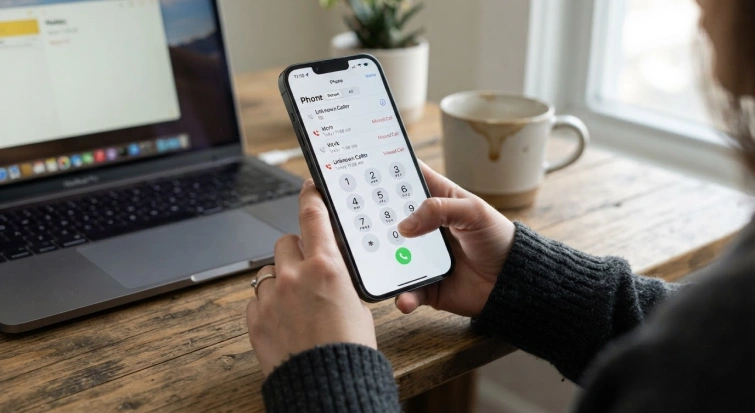
What is an AI phone agent?



Every missed call is a missed opportunity and for most businesses, phones ring during meetings, after hours, and faster than any team can reliably answer. An analysis of over 130,000 calls across 45 contractor businesses found that 74% went unanswered during normal business hours, not after hours.
An AI phone agent is a software that picks up the phone, holds a full conversation, and completes a task, without a human on your end. Not a voicemail prompt, not a touchtone menu. A live, responsive call that understands what the caller says and responds the way a trained employee would.
In this guide, we will cover how AI phone agents work, what they are capable of, which platforms lead in 2026 for building AI voice agents, and how to adopt one without breaking what's already working.
AI Phone Agents: Definition & How They Differ From Traditional Agents
An AI phone agent is a form of voice agent is an autonomous software system that handles phone calls using speech recognition, a large language model, and text-to-speech voice synthesis. It answers inbound calls, makes outbound calls, and completes real tasks such as booking appointments, qualifying leads, answering FAQs and updating CRMs.
A traditional IVR routes callers through a menu: "Press 1 for billing, press 2 for support." It just waits for the user to enter a keypad input and doesn't understand context and language. Then, we have the chatbot that handles only text, not voice. And finally, a human receptionist can handle voice well but costs $40,000 to $60,000 per year and clocks out at 5 PM.
An AI phone agent does what none of these above mentioned traditional agents do: hold an open-ended spoken conversation, understand intent from natural language, take action on that intent, and do it at any hour, at any call volume.
How does an AI phone agent work?
Every AI phone call runs through four steps, and the speed at which those steps complete determines whether the conversation feels natural or robotic. The best platforms today target end-to-end latency under 600 milliseconds, fast enough that the pause between a caller's question and the agent's answer is shorter than a human would take.
The four main steps of an AI voice agent orchestration include:
- Speech recognition (ASR): The moment a caller speaks, the audio stream goes through an automatic speech recognition model that converts spoken words to text. Modern ASRs such as Murf AI are now able to handle regional accents, background noise, and overlapping speech accurately.
- Large Language Model (LLM): This is referred to as the brain. The converted text goes into a large language model, the same type of reasoning engine behind tools like ChatGPT. Here, natural language processing (NLP) is used. The LLM reads the caller's intent, checks it against a knowledge base or set of instructions, and decides what to do next: answer a question, ask a follow-up, or trigger an action like scheduling a calendar event.
- Action execution: If the call requires a task such as booking an appointment, pulling an account status from a CRM, sending a confirmation text, the voice agent calls the relevant integration in real time. This is where the agent moves from conversation into actual work.
- Voice response (TTS): The reply converts from text back to speech using a text-to-speech engine. High-quality TTS models like those powering Murf's text-to-speech API produces voices that are human like phone conversations. The caller then hears a response and the loop repeats until the call is done or escalated.
The full cycle - listen, reason, act and respond takes under a second. That's what makes a modern AI phone agent feel like a customer conversation rather than an automated attendant. This is how AI voice agents work.
Key capabilities of AI Voice Agents
The core capability of an AI phone agent is natural conversation and not just a guided menu navigation. In real time phone conversations, a caller can say "I need to reschedule my appointment from Thursday to next Monday morning" and the voice AI agent handles it, without the caller pressing any buttons or repeating themselves to a confused IVR.
Beyond that, a production-ready AI phone agent handles:
- 24/7 availability, no hold time. The conversational agent picks up every call on the first ring. There's no queue, no after-hours voicemail. A caller at 2 AM gets the same experience as one at 2 PM. For businesses losing leads because calls go unanswered outside business hours, this alone justifies the switch on what an AI voice agent handles.
- CRM and calendar integration. When a customer call ends, the contact centre records are updated, the appointment is logged, and the follow-up task is created. Most platforms connect directly to HubSpot, Salesforce, Google Calendar, and Calendly via webhooks or native connectors in their own infrastructure.
- Multilingual support. Leading voice AI agent platforms can support 20 to 40+ languages, including regional accent variants. A multilingual AI phone agent handles inbound and outbound calls in their preferred language, that sound human without a separate staffing hire per market.
- Call recording and transcription. Every call is logged, transcribed, and searchable. Managers can audit conversations, spot patterns, and track resolution rates, customer data that a human receptionist doesn't generate automatically.
- Voice cloning for brand consistency. Some platforms even let businesses deploy a cloned voice, so that every caller hears the same consistent persona, not a generic synthetic one.
- Smart escalation. A well-configured AI phone agent knows what it can't handle. When a call goes outside its knowledge base or a caller asks for a human, it transfers with full context no caller has to repeat themselves.
Also, we've compiled a list of the best AI voice agents to help you compare features, pricing, and capabilities. Check it out.
Use Cases that AI Voice Agents Handle
Any business with high call volume and a meaningful portion of routine calls is a candidate. The voice AI agent use case list is wider than most people expect. Whether it's just for basic customer interactions that answers instantly or an autonomous task execution for your sales team, AI voice agents can handle these following use cases.
- Inbound customer support. Order status, return policies, billing questions , the calls that consume 70 to 80% of a support team's time but require minimal human intervention. An AI phone agent handles these at scale, 24/7, with no queue.
- Outbound sales and cold calling. An AI cold caller dials hundreds of prospect calls simultaneously, delivers a consistent pitch, qualifies interest, and hands off warm leads to a human rep. The SDR still closes. The grunt work of top-of-funnel dialling moves to the agent.
- Appointment booking and reminders. Custom voices for healthcare clinics, law firms, real estate agencies, and service businesses run on scheduled time. An AI phone agent books, reschedules, and sends automated reminder calls without consuming staff hours. One dental practice reduced no-show rates by 22% through automated reminder calls alone.
- Healthcare patient intake. Collecting symptoms, insurance details, and pre-visit information over the phone is slow for patients and time-consuming for staff. A HIPAA-compliant AI phone agent handles intake calls, reducing check-in time and freeing clinical staff for the actual care.
- Real estate lead qualification. A real estate AI phone agent handles first contact with inbound leads such as asking about budgets, timelines, and location preferences and routes calls that are qualified prospects to an agent. The hours spent on tire-kickers drop with this effective conversation flow.
- Restaurant and retail order lines. Taking phone orders, confirming reservations, WISMO or handling "what time do you close" calls doesn't need a human employee. The agent covers the line and feeds order data directly to the POS with human like phone conversations in their own phone number.
These are just the tip of the iceberg on what AI phone agents can accomplish. With virtual agents that can communicate in multiple languages, customer conversations
Benefits of using AI phone agents
Using AI phone agents provides a range of benefits when adopting for various use cases.
- Cost per call drops by 90% or more. A routine 4-minute call costs $3 to $7 handled by a US-based human agent, and $0.28 to $0.60 handled by an AI agent, which is a 90 to 95% reduction per interaction. At 10,000 calls per month, that's a $230,000 to $864,000 annual difference. The Ai voice agents costs can be cheaper with custom pricing for your specific use case.
- Zero hold time, every call answered. Every caller is picked up on the first ring. No queue, no music, no abandoned calls. For businesses where a missed call is a missed sale, the revenue retention is as important as the cost reduction. 62% of inbound SMB calls go unanswered during peak hours industry-wide. Businesses that deploy an AI phone agent commonly report the opposite problem solved outright. One SMB found 54% of its total call volume is now handled by its AI agent alone, calls that would previously have gone to voicemail or a competitor. This can be achieved through the use of AI assistants that can handle multi turn conversations.
- Consistent handling, every time. A human agent has a bad day. A new hire doesn't know the script, causing a breaking flow to your customer interactions. An AI phone agent delivers identical handling quality on call 1 and call 10,000 with a steady conversation flow that is defined by you. Compliance teams in regulated industries rely on this, every caller hears the required disclosures, every time.
- Scale without headcount. A single AI phone agent deployment handles hundreds of simultaneous calls. Adding call volume doesn't mean adding staff. During seasonal spikes, that elasticity is a real operational advantage using AI calls reliably. It is estimated that 80% of buyers purchase from the first vendor that responds to them.
- Every call becomes data. Transcripts, sentiment signals, resolution rates, escalation frequency with all captured automatically. This gives operations teams visibility that a human-staffed phone line never provided.
- ROI in months, not years. A Forrester Consulting study found organisations deploying AI voice agents achieved 3-year ROI between 331% and 391%. Most businesses hit payback within three to six months of deployment.
Best AI phone agent platforms in 2026
The market has matured quickly. A handful of platforms now handle serious call volume in production with enterprise grade security.
Choose a platform based on what matters most for your use case. Retell AI powers the largest production deployments and is built for developers who need granular control at enterprise scale. Vapi is the go-to for builders who want full API flexibility such as custom LLMs, custom telephony, the works.
Synthflow gets non-technical SMB teams live fast through its no-code builder, backed by a 99.99% uptime SLA. Bland AI is built for volume outbound campaigns, with pricing starting at $0.14 per minute and no platform fee on its entry tier. It is also important to note that Vapi and Retell languages are based on the provider you choose, rather than their own natively available languages.
Murf's edge is voice quality and language reach: 35+ supported languages, voice cloning for brand consistency, and end-to-end implementation support, built for teams where the voice itself is the product experience, not a background utility.
Best practices when adopting an AI phone agent
Getting an AI phone agent live is the easy part. Getting it to perform takes a few deliberate choices.
- Start with one call type. Don't automate everything on day one. Pick the highest-volume, lowest-complexity call type such as appointment reminders, FAQ calls, lead qualification and get that working before expanding, especially on customer interactions. A focused first deployment gives you clean data to optimise from.
- Build the escalation path before you build the agent. Every AI phone agent hits calls it can't handle. Define the escalation trigger (caller requests a human, confidence drops below a threshold, a specific topic comes up) and the handoff behaviour (warm transfer with context, or callback scheduling) before the agent goes live. An agent without a reliable escalation path erodes trust faster than having no agent at all.
- Customers are wary, and that's the point. Gartner's research found 64% of customers would rather companies skip AI in customer service altogether, and over half said they'd consider switching providers if they found out AI was handling their calls. That's not a reason to avoid AI phone agents, it's a reason to build the escalation path first, not last. The businesses getting this right aren't hiding that an agent is AI; they're making the handoff to a human so seamless that the caller never has to ask twice.
- Test on real call recordings. Don't write a call script from first principles. Pull your last 100 call recordings, identify the 10 to 15 most common caller intents, and build the agent's responses from actual caller language, not just what you think callers say. Define escalation rules and set your knowledge base to test your calls.
- Monitor transcripts weekly in the first month. The first 30 days surface every edge case your script didn't cover. Read transcripts, note where the agent stumbled, update the prompts. Most of the optimisation work happens in the first four weeks. Monitor agent behaviour with every change you make to transcripts.
- Know where structured conversation ends. Even well-reviewed platforms can struggle when a caller changes topics mid-call rather than following the expected flow. One independent test found an agent looping back to its starting script instead of adapting. This isn't a dealbreaker for structured use cases like appointment booking or FAQ handling, but it's exactly why testing on real call recordings matters more than reading a spec sheet.
- Get the voice right before you scale. The text-to-speech voice your agent uses affects caller trust more than most teams expect. A voice that sounds robotic or flat increases escalation rates. Test with a small call group before rolling out broadly and build your own voice agent with a voice that fits your brand, not a default one.
AI phone agents in 2026
The category is moving fast, and a few shifts define where it's heading.
Proactive outbound is growing. Inbound automation came first. Outbound proactive callbacks, appointment reminders, collections, re-engagement campaigns is now the growth frontier. Voice agent usage grew 9x in 2025, driven largely by outbound deployments.
Multimodal agents are here and Gartner's own research backs why this matters. Gartner predicts agentic AI will autonomously resolve 80% of common customer service issues by 2029, but specifies that the organisations getting there are the ones with unified context across phone, chat, and web, not separate bots per channel. A phone agent that can't pass context to your chat or SMS layer is optimising for the wrong metric.The line between a phone agent and a web agent is blurring. Platforms are building agents that follow a single conversation across phone, SMS, and web chat - one context thread, multiple channels, no information lost.
Emotion detection is becoming standard. Newer platforms analyze tone, speech pace, and word choice to detect caller frustration or urgency in real time, triggering proactive escalation before the caller asks for a human. This closes the trust gap that slowed early adoption.
Regulation is tightening. The FTC updated its rules on AI-generated voice calls in 2024 and 2025. TCPA compliance for AI outbound calls, required consent language, and opt-out handling are now table stakes for any outbound deployment. Any platform you choose needs explicit compliance tooling.
80% of businesses plan to integrate AI-driven voice technology into customer service by 2026 (Nextiva). The question is no longer whether to adopt, it's how well you implement for high volume calls.
If you're building a voice experience where quality matters, where the voice is part of the product rather than a utility layer behind it, Murf's voice AI platform and TTS API give you the voice engine to build it right.

Frequently Asked Questions
What is an AI phone agent?
.svg)
An AI phone agent is software that handles phone calls autonomously using speech recognition, a large language model, and text-to-speech technology. It understands spoken language from callers, determines the right response, executes tasks like booking appointments or updating a CRM, and speaks back all without a human on the other end.
How is an AI phone agent different from an IVR?
An IVR routes callers through menus: "Press 1 for billing." It doesn't understand language, it just waits for keypad input. An AI phone agent understands spoken sentences, handles open-ended questions, and takes action based on intent. The caller doesn't navigate a menu, they just talk.
Can an AI phone agent integrate with my CRM?
Yes. Most production platforms integrate with HubSpot, Salesforce, Zoho, and other CRMs via native connectors or webhooks. After each call, the agent updates contact records, logs call summaries, and creates follow-up tasks automatically.
How much does an AI phone agent cost?
In 2026, AI phone agent platforms typically charge $0.05 to $1.00 per minute, with most deployments landing around $0.10 to $0.25 per minute all-in. A routine 4-minute call costs $0.28 to $0.60 via AI — versus $3 to $7 for a US-based human agent. Monthly costs for moderate-volume deployments typically run $400 to $1,200, depending on call volume and platform.
Can I attach a phone number to my AI agent?
Yes. Most platforms provision a dedicated phone number or allow you to port an existing one. All inbound calls to that number go to the AI agent. Outbound campaigns also originate from an assigned number.
What languages do AI phone agents support?
Leading platforms support 20 to 40+ languages, including regional accent variants. Some platforms — including Murf-powered deployments — let you configure a distinct voice persona per language, rather than using a single generic multilingual voice.
Is an AI phone agent HIPAA compliant?
Some platforms offer HIPAA-compliant configurations — encrypted call storage, audit logs, BAA agreements, and restricted data handling. This is not universal. If you're deploying in healthcare, confirm HIPAA compliance before selecting a vendor. HIPAA-compliant AI phone agents work for patient intake, appointment scheduling, and prescription refill calls.
How long does it take to set up an AI phone agent?
A focused single-use-case deployment — appointment booking, FAQ handling — takes one to two weeks for most businesses. More complex deployments with multi-intent routing, deep CRM integration, or custom voice cloning typically take three to six weeks. Starting with real call recordings compresses setup time compared to writing scripts from scratch.
What happens when the AI can't answer a question?
A well-configured AI phone agent detects when it's outside its scope — the caller's question doesn't match any known intent, or the caller asks for a human. It executes a predefined escalation: a warm transfer to a live agent with call context passed along, or an offer to schedule a callback. The caller doesn't hit a dead end.