What is Intelligent Call Routing? Key Benefits & How to Set it Up


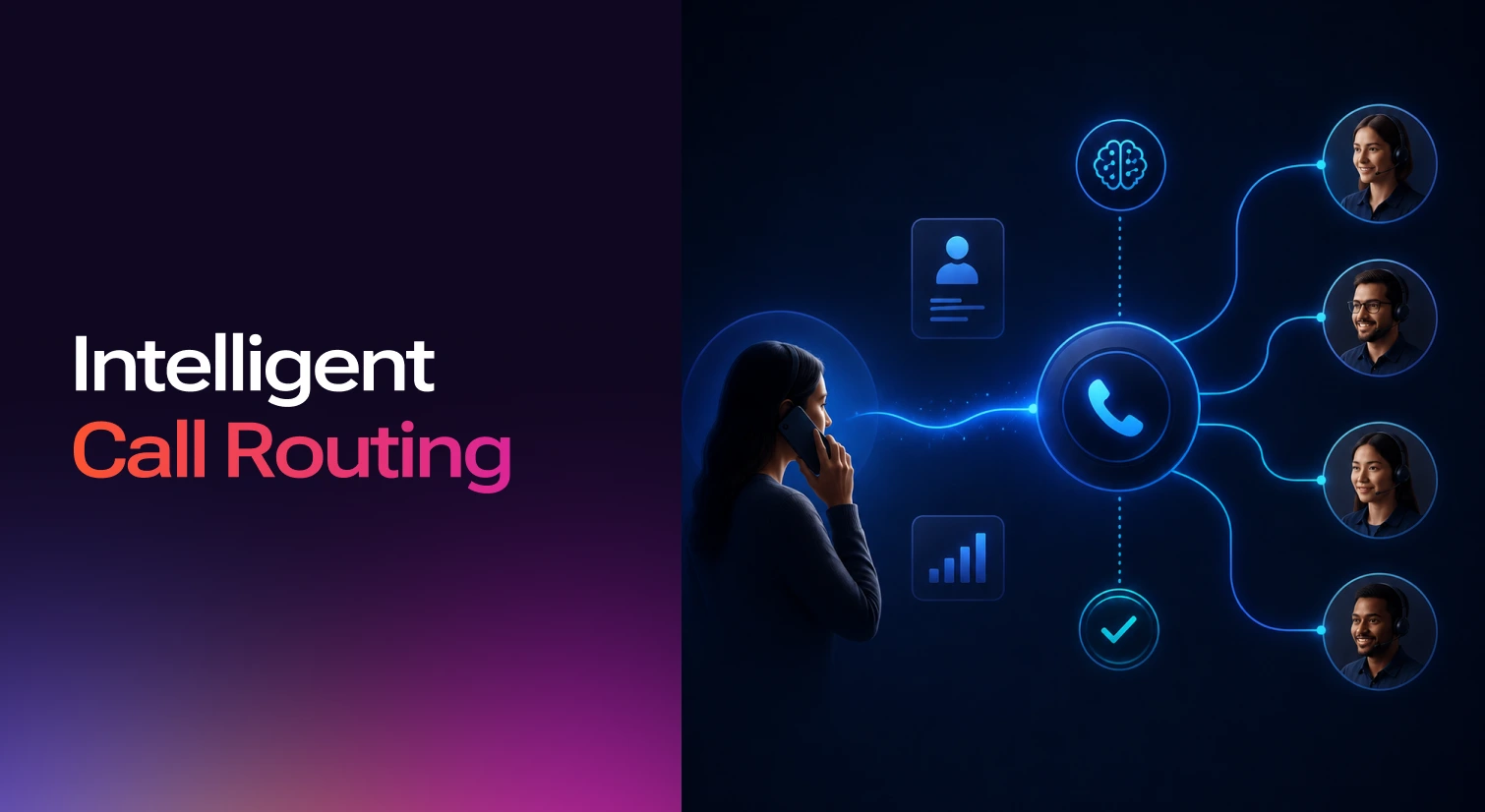

Intelligent call routing (ICR) sends each incoming call to the most qualified agent, using AI, real-time call data analysis, and CRM context, instead of just transferring it to the next person in the phone line. It replaces predefined routing rules and static first-come-first-served distribution with a decision layer that reads who's calling, why, and who on your team can actually solve their problem.
Plain phone tress treat direct incoming calls with wait times, multiple transfers, and frustrated customers. Getting intelligent call routing systems right isn't a nice-to-have feature for customer service operations, but a difference between a customer experience that builds loyalty and one that drives customers to a competitor.
Picture this, Sarah's Wi-Fi goes out on a Tuesday morning, so she calls her internet provider hoping for a quick fix.
Without the intelligent call routing system that call turns into a slog. Sarah dials in, gets a long menu, and presses 1 for "billing" when her issue falls under "internet's down" category. She waits ten minutes to reach a billing agent, who tells her, "Sorry, I can't help with Wi-Fi, let me transfer you to our tech department." Back on hold for another ten minutes. When a technical agent finally picks up, Sarah has to explain the whole problem again from scratch, because nothing from her first call was carried over. Twenty-five minutes in, she still doesn't have an answer, and she hangs up more frustrated than when she started.
With intelligent call routing, the same call looks nothing like that. The system recognizes Sarah's number the moment she dials, checks her account, and sees her modem has been offline since 8am. It skips the menu entirely and sends her straight to a technical agent who handles Wi-Fi issues all day. She's connected in under two minutes, and the agent already knows why she's calling: "I see your modem's been offline since this morning, let's get that fixed." No transfer, no repeating herself, no wasted time. The problem gets solved on the first call, and Sarah hangs up glad she called instead of dreading it.
That's the entire value of intelligent call routing in one phone call: the same customer, the same problem, but one version wastes her time and the other respects it.
Intelligent routing vs. Traditional ACD/IVR
Traditional call routing runs on automatic call distribution (ACD) and a fixed set of predefined routing rules. If an agent is open, the customer calls go there. If not, the caller waits. The logic doesn't know or care what the call is about.
An interactive voice response (IVR) menu adds a layer on top: Press 1 for sales, press 2 for support and so on. It narrows the destination slightly, but the caller is guessing which button fits their actual problem, and the system still has no memory of who they are or their interaction history.
Intelligent call routing removes the guesswork on both sides. It pulls the caller's account number, recent account activity, open tickets, and the reason for the call, then matches all of that against agent expertise, availability, and current workload before the call connects. The caller doesn't need to know your org chart. The system has already worked out where they belong.
Rather than replacing your existing phone stack, ICR integrates with IVR and ACD systems already in place, layering AI-driven decision-making on top of the call handling processes you already run. The difference shows up in three places: fewer transfers, because the first agent is usually the right one; shorter calls, because the agent isn't starting from zero; and fewer repeated explanations, because the context arrived with the call.
How intelligent call routing works
Most intelligent call routing software runs through five steps.
1. Caller identification
The moment a call comes in, the system reads two pieces of information: Automatic Number Identification (ANI), the number the caller is dialing from, and Dialed Number Identification Service (DNIS), the number they dialed. Together these tell the system who's likely calling and which line or department they came in on, which matters if a business runs several phone numbers for different products or regions.
The system then matches the ANI against its CRM database. If the number belongs to an existing customer, it pulls up their profile in real time: account status, recent orders, open support tickets, and past call history. This happens before the call ever reaches a human, so by the time anyone picks up, the system already knows whether it's talking to a first-time caller, a long-standing customer, or someone with an unresolved issue already on file.
If the number isn't recognized, the system flags the caller as new and routes accordingly, usually to a general queue or a short verification step.
2. Intent detection
Knowing who's calling only answers half the question. The system still needs to know why. This is where Interactive Voice Response (IVR) selections and natural language processing work together. If the business uses a traditional keypad menu, the caller's button press ("press 2 for technical support") gives a rough signal.
More advanced systems skip the keypad and let the caller say what they need out loud, then use natural language processing to parse the actual words for intent.
This distinction matters more than it looks. Two callers can both press "2" for the same menu option, but one means "my Wi-Fi is down" and the other means "I want to check my equipment return status." A basic IVR treats them identically because it only sees the button. Real intent detection listens past the button to the actual words, distinguishing "I want a refund" from "I want to check my balance" even when the caller's initial keypad choice was the same for both.
3. Agent and skill matching
Once the system knows who's calling and why, it needs to find the right person to take the call, not just any available person. This step checks the caller's need against a live, constantly updated map of every agent's skills: language fluency, certifications, product specialties, and historical handle-time performance on similar issues.
This is where the "intelligent" in intelligent call routing earns its name. A traditional system asks "who's free?" This step asks "who's free and actually good at solving this specific problem?" It's how ICR maximizes agent expertise for example, a skilled technical specialist doesn't spend their day on billing questions just because they happened to be the next name in a rotation, and a caller with a complex technical issue doesn't land with a generalist who has to escalate anyway. The system is matching capability to need, not just clearing a queue.
4. Real-time prioritization
Even with the right agent identified, timing still matters. This step layers in live operational data: how deep the current queue is, what Service Level Agreement (SLA) commitments are at risk of being missed, and, where sentiment analysis is available, how frustrated or urgent the caller sounds based on tone and word choice.
These signals can override the normal order of the queue. A high-value account with a fraud flag on their file, for instance, can jump ahead of a routine billing question, because the cost of delay is higher.
Businesses that have designated high-value customers can also route them to dedicated queues automatically, so those callers never wait behind standard-tier traffic in the first place. This step is what keeps intelligent call routing responsive to what's happening right now, not just what a static rule said should happen.
5. Context handoff
By the time the call actually connects to an agent, four steps' worth of information already exist: who the caller is, why they're calling, which agent is best suited, and how urgent the situation is. This final step makes sure none of that gets lost in the handoff. Account details, the specific issue (a disputed charge, a service outage, a billing question), and any sentiment flags appear on the agent's screen the instant the call rings through.
The result is a caller who doesn't have to repeat themselves. The agent opens the call already knowing the situation, which is often the single biggest difference customers notice between a frustrating call and an easy one.
Skipping any one of these five steps doesn't just weaken the system, it usually collapses it back toward traditional routing with extra machinery bolted on.
The most common failure is running intent detection without CRM integration. The system correctly figures out what the caller wants but has no idea who they are, so even though intent was detected accurately, the agent still starts the call cold, asking for an account number and re-explaining basics that a connected system would have already known.
Three Tiers of Call Routing Maturity
Call routing maturity is a way of measuring how much real intelligence sits behind the label "intelligent call routing," not just whether a system has the label at all. Vendors use the term loosely, so it helps to sort routing into three tiers, since most vendors tend to blur the last two tiers together.
Tier 1: Static or rule-based routing
Classic ACD plus a basic IVR tree and a short list of predefined routing rules. Rules are fixed, if caller presses 2, send to queue B, and no data informs the decision beyond the button pressed. This is what most small call centers still run.
Tier 2: ML-scored skills-based routing
A model scores each call against historical resolution data, agent performance, and CRM signals, then routes to the best statistical match. This is where routing starts factoring in more than just the button pressed. It further classifies them as follows:
- Time-based rules: that shift calls to a different queue or region once business hours end
- Priority scoring: that moves high-value customers or urgent issues ahead of the standard queue,
- Location-based logic: that sends a call to the nearest or most relevant regional team for language or compliance reasons.
This is what most intelligent call routing software describes today. It's smarter than tier 1, but the caller is still navigating a menu or answering IVR prompts before the system has anything to score.
Tier 3: Conversational AI-agent routing
An AI voice agent has the first conversation itself. Instead of "press 1 for billing," the caller says what they need in their own words, the agent asks a clarifying question if it needs one, and the routing decision comes from an actual conversation rather than a keypad guess. There's no menu to misread and no caller intent to infer from limited button presses, because the system already gathered intent by talking to the caller.
Most of what gets marketed as "intelligent call routing" today is tier 2. Murf AI Agents operates at tier 3. The AI voice agent handles the initial conversation, understands the reason for the call, and either resolves it directly or routes it with full context to the right human agent or department.
Key Benefits of Intelligent Call Routing Systems
Higher first call resolution
When the most qualified agent a caller reaches has the right skills and the right context, fewer calls need a second attempt or a transfer. AI-driven intelligent call routing has been associated with first call resolution rate improvements of around 25%, since callers land with someone equipped to solve the issue on the first attempt instead of being redirected after the fact.
Lower call handling time
Agents spend less time on verification and context-gathering when that work already happened before the call connected. Across analyst summaries and case studies on AI-powered call routing deployments it is reported that, ICR reduces average call handling time by up to 30%, since routing removes the manual steps that used to happen live on the call.
Fewer transfers
Accurate upfront matching means fewer "let me transfer you" moments, often the single biggest driver of caller frustration. Take a caller with a defective product who first reaches a general support line under traditional routing, that call might bounce from general support to billing (to check the return policy) to a technical specialist (to confirm the defect) before anyone actually resolves it, three separate holds and three separate explanations for one issue. Intelligent call routing eliminates that into a single handoff, because the system identifies "defective product, needs return and replacement" upfront and sends the caller directly to whichever team owns that end-to-end. whether that's a technical specialist with return authority or a dedicated returns desk.
Better agent utilization
Routing that accounts for real-time workload and skill, not just next-available, keeps distribution balanced instead of overloading a subset of agents while others sit idle, which directly supports contact center performance during high call volumes.
Lower operational costs
By cutting repeat contacts and unnecessary transfers, ICR can reduce operational costs by up to 20% in reported deployments, largely from reclaimed agent hours rather than headcount cuts. These savings tend to show up in a few concrete ways rather than one lump figure. Fewer transfers mean fewer agent-minutes spent per resolved issue, which lowers the effective cost per call even without changing headcount. And because routing absorbs volume spikes more predictably, businesses can avoid some of the overtime and temporary staffing costs that used to be the default response to a busy season or an unplanned surge in calls.
Improved customer experience
Faster resolution and fewer repeated explanations show up directly in CSAT and NPS over time, and connect customers to the business in a way that feels less like navigating a system and more like being understood. Companies using ICR report improved customer satisfaction metrics.
Pros and Cons of Intelligent Call Routing
Intelligent call routing isn't a universal upgrade with no tradeoffs. Weighing both sides is part of deciding whether it's worth the setup work.
Pros
- Reduces transfers and repeat contacts by matching callers to the right agent on the first attempt
- Cuts call handling time by removing manual verification from the call itself
- Gives agents context before they answer, instead of building it live on the call
- Scales more predictably than adding headcount during high call volumes, since routing logic absorbs spikes that would otherwise mean overtime or temp staff
- Provides data on call patterns, agent performance, and friction points that a static ACD never captured, feeding directly into key performance indicators like FCR and average handle time
Cons
- Needs clean, current customer data. A routing engine making decisions on stale CRM records will misroute confidently, which is worse than routing randomly.
- Caller interpretation isn't perfect. Someone who describes their issue vaguely can get natural language detection to guess wrong, so you need a human-override path.
- Change management takes real work. Agents who don't understand why a call landed on their desk will distrust the system and route around it manually.
- Setup takes time upfront. Connecting CRM, IVR, and workforce management into one decision layer isn't a same-day project.
How to Set up Intelligent Call Routing
Step 1: Start with a week of call-level logging
Before changing anything, capture IVR choices, disposition codes, transfer chains, and hold times for a representative week. That tells you where the current system actually breaks, not where you assume it breaks.
Step 2: Write routing rules as business outcomes, not just call flows
When you write "If the caller has an unresolved billing dispute over $500, route to a recovery specialist and surface the ticket before the agent answers", it solves a specific problem. "Route billing calls to the billing queue" doesn't improve on what you already have.
Step 3: Connect the systems that actually inform a decision
At minimum: CRM for customer data and ticket history, workforce management for real agent availability, and IVR (or a conversational AI agent) for the reason someone is calling. Skip any one of these and the routing software is guessing on that dimension.
Step 4: Pilot before you cut over
Run the new logic in parallel with your existing system on one high-value call flow for four to six weeks. Track first call resolution rates, transfers per call, call handling time, and how often agents override the routing decision. The override log tells you where the model is wrong.
Step 5: Train agents on the why, not just the what
Agents need to know what signals drive a routing decision and how to flag a misroute with a reason, not just be told the system changed. Skip this step and agents quietly work around the routing logic within weeks.
Step 6: Monitor key performance indicators, then retrain
Set real-time alerts for SLA breaches, daily dashboards for queue health, and a monthly cadence to retrain the model using the override log and updated ticket outcomes. Routing accuracy that isn't revisited drifts as call patterns change.
Where Murf AI Agents Fits
Everything above describes routing logic that still assumes a human, an IVR menu, or a keypad sits between the caller and the decision. Murf AI Agents removes that layer for calls that don't need a human from the start.
Instead of navigating "press 1 for sales, press 2 for support," a caller talks to an AI voice agent that understands the request in natural language, in 35+ languages, and either resolves it on the spot or hands it off to the right human agent with full conversational context attached. That's tier 3 from the framework above: the routing decision comes out of an actual conversation, not a set of scored guesses about what a button press probably meant.
For a sense of scale, Murf AI Agents is instrumental in a 34% goal success rate with 7-8 AI Agents deployed for various tasks such as, appointment booking, debt collection, and warm call transfer or human handoff with complete context and customer information. These agents were able to trigger 10,000 calls per hour and have the ability to scale up as per the client requirement.
Murf's AI Voice agents not only supports with inbound and outbound calls, but is a part of the workflow where the agent are working 24/7/365 to get the customer where they need to be. Multilinugal and international support is where most platforms quietly fail. With Murf AI Agents' seamless language switching, from English to Spanish has helped thousands of customers feel heard and understood (a primary criteria for any good NPS).
Whether call routing needs a full AI voice agent layer or tier 2 skills-based routing covers your case depends on volume and how much of your incoming phone calls could be resolved without a human at all. High-volume, repetitive call types, appointment scheduling, lead qualification, basic account questions, are usually where a tier 3 AI agent pays for itself fastest.
Intelligent call routing solves the matching problem. Murf AI Agents goes a step further and removes the menu-and-guesswork step entirely, letting callers describe what they need in their own words and get routed, or resolved, from that conversation alone.
Explore Murf AI Agents to see how it handles inbound calls for teams already running it at scale.

Frequently Asked Questions
What is intelligent call routing (ICR)?
.svg)
A system that uses AI, real-time caller data, and CRM context to direct each incoming call to the agent, department, or self-service flow best suited to resolve it, rather than routing calls in a fixed order regardless of what they're about.
How does intelligent call routing differ from a regular IVR or ACD system?
An ACD system routes calls based on availability alone, with no knowledge of who's calling or why. An interactive voice response menu adds a layer on top, but the caller is still guessing which option fits. Intelligent call routing pulls in actual customer data and intent before making a decision, so the match reflects the real reason for the call, not a button press.
What is an intelligent routing system?
The combination of CRM integration, intent detection (via IVR, NLP, or a conversational AI agent), and a skills-based matching engine that together decide where an inbound call should go. It's less a single piece of software and more a decision layer sitting across your existing call center software and phone systems.
How does intelligent contact routing work in a call center?
As calls arrive, the system identifies the caller, checks CRM records and open tickets, determines intent, then matches the call to an available agent with the right skills before connecting, passing that context along so the agent doesn't start cold.
What data does intelligent call routing use to make decisions?
Account number and caller ID, CRM account history and recent tickets, IVR selections or natural language caller intent, agent skill profiles and current workload, and in more advanced setups, real-time sentiment analysis and SLA status.
Can intelligent call routing work without a human IVR menu?
Yes. In a conversational AI-agent setup, the caller talks to an AI voice agent instead of navigating a keypad menu. The agent gathers intent through natural conversation and either resolves the request itself or routes it to a human with full context, removing the menu-guessing step entirely.
What are the benefits of intelligent call routing?
Higher first call resolution rates, lower call handling time, fewer transfers, better agent utilization, lower operational costs, and improved customer experience, because callers reach someone equipped to help them on the first attempt.
What are the downsides or risks of intelligent call routing?
It depends on clean, current customer data, since decisions made on stale records will misroute confidently. Natural language detection can also misread ambiguous requests, so you need a human-override path. Rollout requires real change management, since agents who don't understand the logic tend to work around it.
How long does it take to set up intelligent call routing?
It varies by how many systems need to connect. A pilot on one high-value call flow, run in parallel with existing routing, typically takes four to six weeks to validate. Full integration across CRM, workforce management, and IVR or a conversational AI layer takes longer, depending on how centralized that customer data already is.
Is intelligent call routing the same as skills-based routing?
Skills-based routing is one component of intelligent call routing, the step that matches a call to a qualified agent's abilities rather than just their availability. Intelligent call routing is the broader system that also includes intent detection, customer data, and real-time prioritization around that skills match.