Call Center Voice Analytics: How it works and why it matters



Two agents are handling calls with an Average Handle Time of 4 to 6 minutes, well within what most industry benchmarks call good. But the CSAT score for both is sitting below 75%, and the contact center team can't figure out why. On closer review of the recordings, one call stands out: a customer was distressed and confused after a roadside emergency, but the agent missed it entirely and handed the call off to another department without acknowledging what the customer was actually going through. The call looked fine on paper. AHT was within range, the transfer was procedurally correct, nothing would have flagged it in a standard report. The problem was invisible to every metric except the one nobody was tracking: how the customer actually felt on that call.
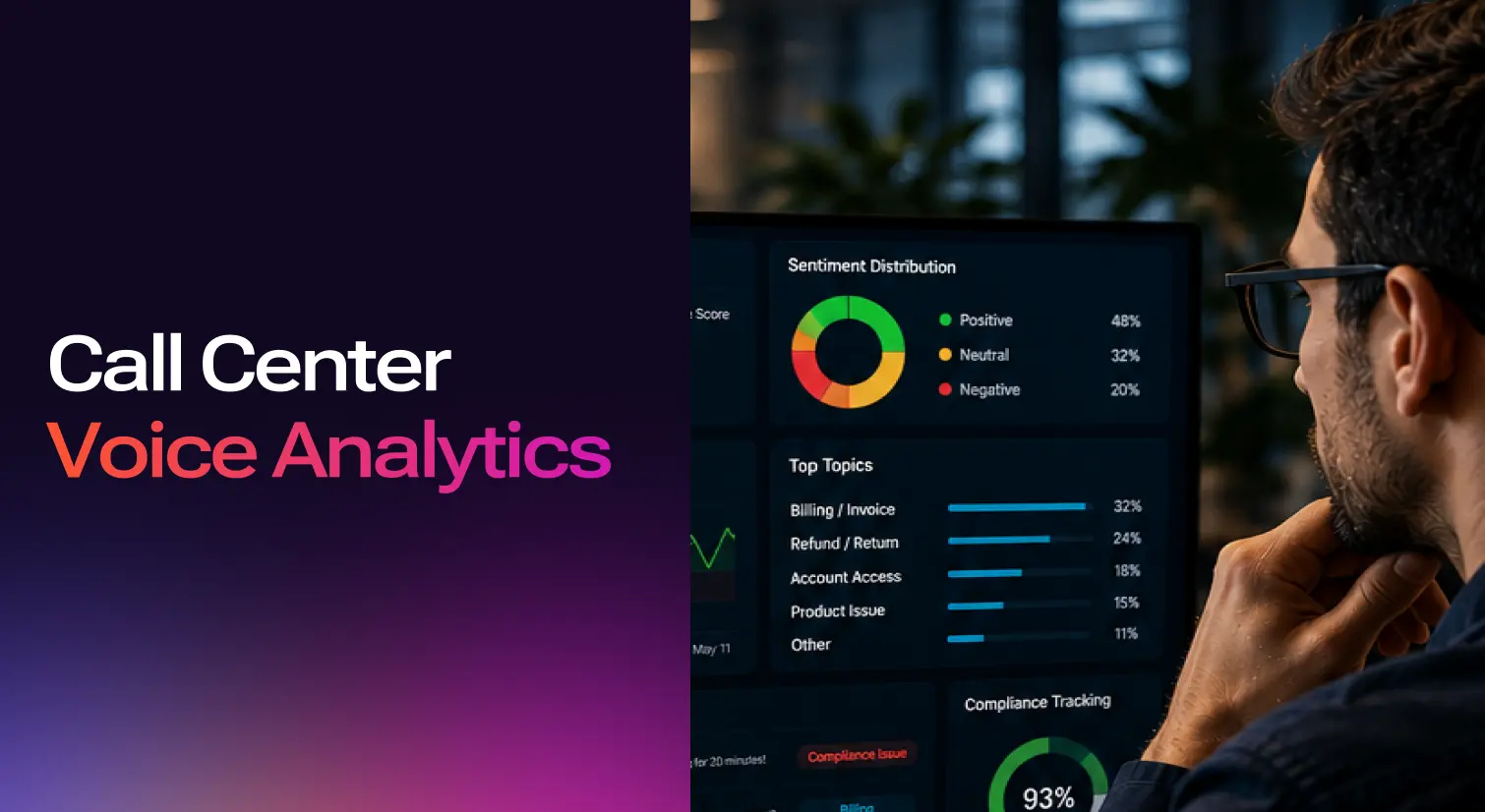
That's the gap call center voice analytics is built to close. Call center voice analytics an AI-powered process that records, transcribes, and analyzes customer conversations to surface exactly the kind of moment that AHT and call logs miss. It evaluates both what customers say (speech analytics) and how they say it (voice analytics), examining language, tone, pitch, pace, and emotion, so a distressed customer gets flagged as a distressed customer, not just a call that hit its target handle time.
This is what helps businesses detect customer sentiment, assess agent performance, identify trends, ensure compliance, and generate actionable insights, either in real time or after the fact.
In practice, that means the software listens to recorded or live phone calls, converts speech to text, then analyzes customer interactions for sentiment, keywords, compliance gaps, and behavioral patterns across agents and customers.
Instead of a QA team sampling a handful of conversations a week, the software processes every interaction and turns customer conversations into structured, searchable data, the exact kind of data that would have caught the roadside emergency call before it became a CSAT problem instead of after. Done well, this improves customer satisfaction, not just reporting: one study estimate puts the improvement at around 10%, simply from catching issues that manual review misses.
Speech Analytics vs. Voice Analytics
The two terms get used interchangeably, and in most vendor material they mean the same thing. Technically, speech analytics is the linguistic layer: what was said, which words and phrases came up, what topics dominated the call. Voice analytics focuses on that same conversation data but sometimes extends it to vocal characteristics, tone, pace, pitch, which can carry emotional cues that word choice alone misses.
Most conversation analytics platforms bundle both under one product name. If a vendor says "contact center speech analytics" and another says "voice analytics solutions," ask what's actually being measured before assuming there's a real difference.
Set clear business goals before implementing speech analytics. Compliance monitoring, agent coaching, and customer experience tracking each need different alert thresholds, different scorecards, and often different teams reviewing the output.
Configure the software for all three on day one and you typically end up with loose compliance alerts that miss real violations, coaching scorecards too generic to help supervisors, and a sentiment dashboard nobody actually owns. Pick one goal, usually compliance, since it carries the most immediate risk, get it working properly, then layer on coaching or CX tracking once the first one is actually delivering.
How Call Center Voice Analytics Works
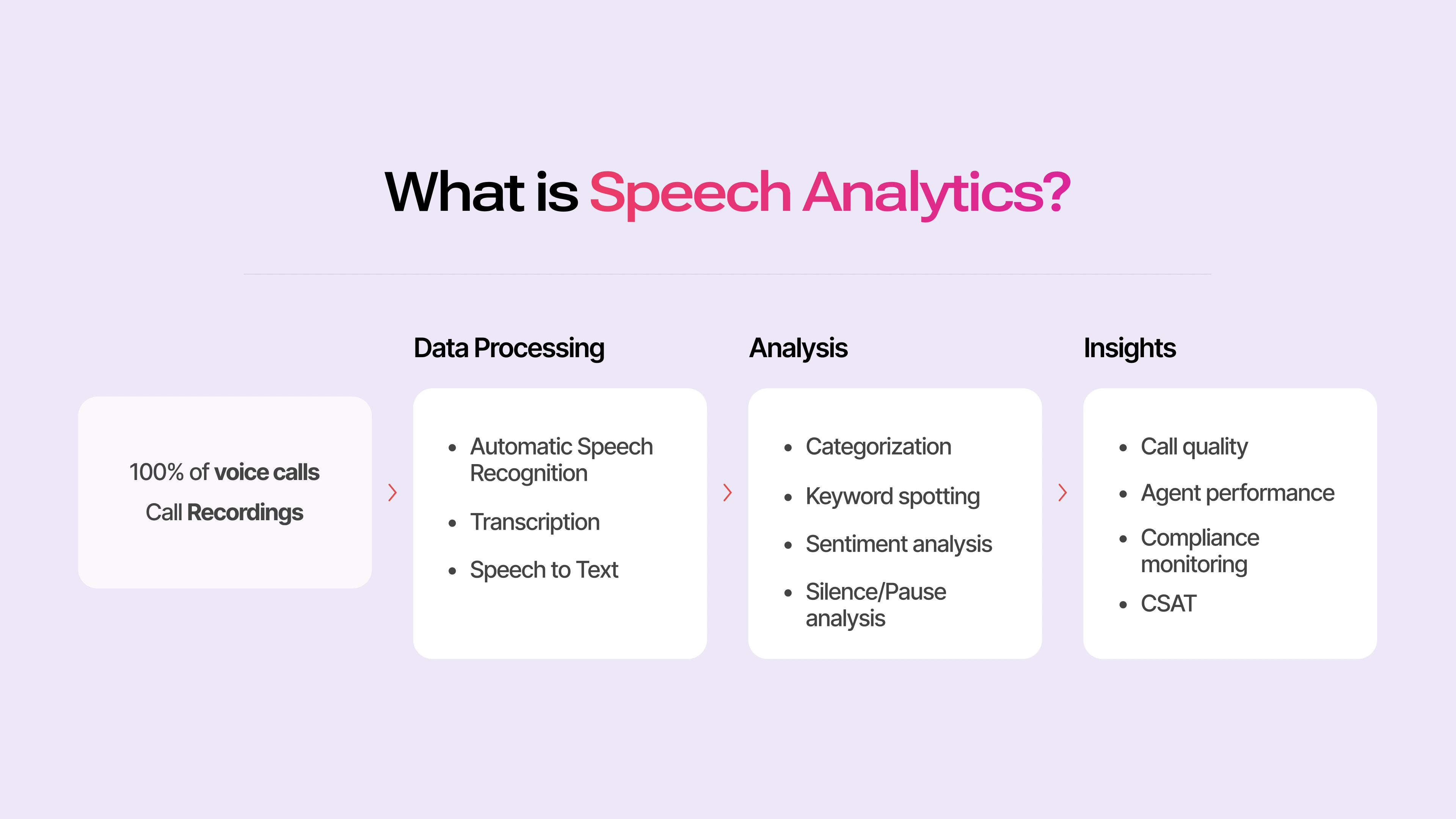
The pipeline behind call center voice analytics runs in four stages, and if any stage falls short or fails, it undermines everything in the process.
1. The call gets captured - through your phone system's recording layer
Modern call centers run on VoIP (voice over internet), so calls aren't just "recorded," they're pulled as digital audio streams. When you hear "this call will be recorded for quality and training purposes", it is because most modern systems tap the call (legally) using something called SIP trunking or RTP mirroring. This is just a fancy way of saying: while the call is happening, a copy of the audio stream gets sent to the analytics software in parallel, without interrupting the live call. Ideally, the agent's voice and the customer's voice get captured on two separate tracks (called dual-channel or stereo recording) instead of blended into one. That separation matters a lot in step 3, because it's much easier to tell who said what if they were never mixed together in the first place.
2. The audio gets turned into text - through (ASR)
This isn't a transcriptionist typing what they hear, its automatic speech recognition (ASR) and it's a two-part process:
- An acoustic model breaks the sound wave into tiny chunks and matches each chunk to a phoneme, the smallest unit of sound in speech (like the "k" in "cat" or the "sh" in "she"). English has about 44 of these.
- A language model then strings those phonemes into the most probable sequence of real words, based on patterns it's learned from huge amounts of speech data. This is why it can usually tell the difference between "I scream" and "ice cream," even though they sound almost identical: it's not just hearing sounds, it's predicting which combination of words actually makes sense.
Handling accents and speaking speed comes down to how much varied audio the model was trained on. A model trained mostly on clean, single-accent audio will struggle on a noisy call with a strong regional accent, which is why transcription accuracy is the single biggest quality bottleneck in the entire pipeline; a bad transcript poisons everything built on top of it.
Word spotting (catching "cancel" or "refund" the moment they're said) works differently from full transcription. Instead of waiting for the whole sentence to be transcribed, the software runs the audio against a smaller, dedicated list of target words or phrases in near real time, similar to how a smoke detector doesn't need to understand a whole room to react to one specific signal. That's what allows an alert to trigger mid-call instead of after.
3. The text and the audio get analyzed
Now that we have a transcript and the audio file, both are analyzed separately for two different things:
- What was said (Natural Language Processing): The transcript gets run through natural language processing, which does two jobs. Syntax analysis looks at grammar and sentence structure (is this a question, a complaint, a statement?). Semantic analysis then works out actual meaning and intent, so it can tell "that's just great" said sarcastically apart from something genuinely positive, based on surrounding context, not just the words in isolation.
- How it was said (acoustic/emotion analysis): Separately, the software analyzes the raw audio itself, not the text, for pitch, pace, volume, and pauses. Acoustic analysis detects emotions like frustration and satisfaction. Rising pitch and faster pace often correlate with frustration or urgency; flat tone and long pauses can signal disengagement. This runs independently of the NLP step because tone carries information words alone don't.
- Speaker diarization: Speaker diarization is what keeps agent and customer separate throughout all of this, using the channel separation from step 1. This matters because almost everything the analytics platform does depends on knowing who said what. A "customer frustrated" flag only works if the software knows the frustration came from the customer, not the agent. Talk-time ratios, compliance credit for reading a required disclosure, agent scorecards, coaching flags for missed objections, none of these can be calculated on a transcript that's just a pile of sentences without ownership. Diarization is what turns "what was said" into "who said what," which is what makes the rest of the pipeline useful.
4. Everything gets structured and indexed, then surfaced
Once a call has been transcribed, scored for sentiment, and tagged for keywords, it doesn't just sit as text, it gets converted into structured data (think: a data record with fields like speaker, timestamp, sentiment score, flagged keywords) rather than one long unstructured paragraph and voice data. That structure is what makes a dashboard possible: a supervisor can search "all calls where a customer sounded frustrated in the last week" because each call is tagged and indexed, not just transcribed providing speech analytics insights.
Real-time vs. Post-call Analytics
These solve two different problems, and buying guides tend to blur them together. Real-time speech analytics processes the call as it happens: a supervisor or the agent gets an alert mid-call for talking too fast, missing a required script line, or a sentiment spike that suggests escalation. Real-time de-escalation suggestions alone can reduce average handle time by up to 28%, since agents get a prompt before a call spirals instead of after.
Post-call analytics processes the recording afterward, which is what powers automated quality assurance, coaching reviews, and trend reports across weeks or months. Most call centers need both. Real-time analytics stops a bad call from getting worse while it's happening; post-call analytics tells you the bad call was part of a pattern worth fixing at the root.
Benefits of Voice Analytics for Call Centers
The benefits of voice analytics are sometimes intangible for example, when hundreds and thousands of customers are happy, loyal and recurring, it creates a goodwill for the business that can not be measured by a metric. Following are some of the benefits that can be measured:
Complete QA coverage instead of statistical guesswork
Manual review samples 1-2% of calls at best, and the calls that get pulled are usually the ones flagged by another metric already, long calls, escalated calls, calls where the customer complained afterward. That means the QA team is reviewing calls that already went wrong, not the ones that quietly went sideways without anyone noticing.
Automated quality assurance scores 100% of calls against the same rubric, so problems are based on how often they actually happen, not based on which calls a reviewer happened to pull. A recurring agent mistake on 8% of interactions shows up as a real trend; on manual sampling, that same mistake might get pulled once a month and dismissed as a one-off. The shift is from spot-checking to actual speech patterns coverage. It's what makes QA a systems problem instead of a sampling problem.
Faster, more targeted coaching
Traditional coaching depends on center managers either sitting in on live calls or reviewing recordings a week later, both of which produce feedback that's either intrusive in the moment or too disconnected from the actual call to land with the agent. Voice analytics lets center managers search their entire call history the way you'd search email: pull every call where an agent lost a pricing objection, missed a required disclosure, or got transferred out mid-conversation, and build a coaching session around what actually happened, not a generic training module helps improve agent performance .
The agent hears real recordings of themselves, not a hypothetical scenario, which is what makes the feedback stick. On top of the coaching side, analytics tools automate the post-call wrap-up work agents used to do manually, tagging the call type, summarizing what happened, updating the CRM, which frees agents up to save up to 35% of their post-call wrap-up time and handle more conversations per shift.
Compliance monitoring at scale
Regulated industries live and die by required disclosures of customer data. Debt collection needs the mini-Miranda statement on every call, healthcare needs specific HIPAA-relevant confirmations, financial services needs mandated scripts around suitability and risk. A single missed disclosure can result in fines that run into millions of dollars, and in some cases individual regulatory findings that trigger ongoing audits for years.
Manual compliance auditing samples calls the same way manual QA does, which means the vast majority of missed disclosures go undetected until a regulator catches one. Voice analytics checks every call against the required script the moment it's transcribed, flags the ones that missed a line, and gives the compliance team a queue of actual exceptions to review instead of a random sample to spot-check. It's the difference between hoping you're compliant and being able to prove it.
Faster root cause analysis on emerging issues
Individual customer complaints are noise; patterns across many complaints are signal. Voice analytics is what turns one into the other. When call volume spikes around a specific feature, a billing error, or a product bug, the analytics layer surfaces the pattern as a trending topic within days, sometimes hours, instead of leaving it buried across hundreds of individual support tickets that get resolved one at a time.
A support team without analytics finds out about a product bug when the tenth customer complains about it; a team with analytics sees the topic trending after the second or third mention and escalates it to product before the tenth call happens. This is where the analytics program starts paying off beyond the call center, feeding early signals into product, marketing, and operations before an issue snowballs into a support cost or a public one.
Customer sentiment and churn signals
Customers about to leave rarely announce it. They signal churn risk indirectly: a competitor mention, an unusually long silence after a resolution offer, phrases like "I've been thinking about looking elsewhere" or "this is the third time I've called about this." Voice analytics is trained to flag those patterns because they correlate with cancellation in aggregate, even when the individual call closes without escalation.
When a retention team gets those flags on the same day the call happened, they can reach the customer with a targeted offer before the cancellation becomes final, instead of finding out the customer left in the next month's churn report. Over time, this doesn't just reduce churn on individual accounts, it improves customer satisfaction scores across the board because you're catching frustration earlier in the customer relationship, before the frustration itself becomes the reason someone leaves.
Operational efficiency across the business
The output of a voice analytics program isn't a QA report, it's a running dataset of what customers are actually saying, and that dataset is useful well beyond the QA team. Aggregated topic and sentiment data tells workforce planners which times of day generate the hardest calls and where to staff more experienced agents. It tells content teams which self-service articles are missing based on what customers ask on the phone. It tells product teams which features generate the most support cost. It tells marketing which competitor mentions are on the rise.
All of this is required for running a separate voice-of-customer survey program; voice analytics generates the same data as a byproduct of just processing calls. Contact center leaders get the kind of evidence-based decision-making that requires a research budget, and other departments get a source of customer intelligence that any survey data alone can't match.
Taken together, most of the value shows up in a small number of measurable outcomes. Speech analytics can increase customer satisfaction by up to 31%, and real-time speech analytics specifically can boost contact center productivity by 40%, largely by cutting the manual work of finding which calls actually matter and letting the team spend their time on the ones that do.
Use Cases of Call Center Voice Analytics
The use cases below are the scenarios where the benefits of call canter voice analytics translate into real deployments.
Sales call analysis for lost-deal review
Voice analytics isn't just a support tool. Sales teams use it to run structured post-mortems on lost deals by pulling every discovery call where a prospect eventually said no and looking for common patterns: which objections came up unaddressed, which competitor names appeared, at what point in the conversation the tone shifted. This turns lost-deal analysis from a subjective retrospective into a measurable one, and it's where sales enablement teams find the highest-value coaching signals, since a single lost enterprise deal usually matters more than a hundred routine support calls.
Debt collection and financial services compliance
The mini-Miranda disclosure in debt collection, the suitability language in investment advisory calls, the required consumer notices in mortgage servicing, all of these are specific compliance frameworks where regulators can audit any call at any time. Voice analytics gives collections agencies and financial service firms a way to prove disclosure adherence at the call level, not the sample level, and to run a daily exceptions queue for any agent whose delivery drifted from the approved script. This is a use case where the ROI is measured in avoided fines, not efficiency gains.
Healthcare intake and appointment scheduling
Healthcare call centers deal with two things at once: HIPAA-relevant confirmations that have to be captured correctly, and callers who are often stressed, confused, or medically distressed. Voice analytics helps by flagging calls where a required identity verification step was skipped, and by identifying callers whose tone suggests they need a warm transfer to a nurse line or a clinician instead of a scheduling agent. It's a use case where sentiment detection matters as much as compliance detection.
Insurance claims and first notice of loss
Claims calls are transactional in structure but emotionally loaded, someone just had an accident, a house fire, a medical event. Voice analytics helps insurance carriers separate the routine first-notice-of-loss calls that could be handled by an AI receptionist from the ones where the caller sounds distressed and needs a human adjuster on the line quickly. The same data feeds fraud detection pattern, that is where differences in how claims are described often correlate with claims that later get flagged for investigation.
Voice agent training and handoff routing
The transcripts, sentiment scores, and intent categories generated by voice analytics are the same data an AI voice agent needs to know such as which calls can be handled end-to-end and which ones need to be handed off to a human. Teams deploying voice AI use their analytics history to answer the practical questions before rollout such as which call types are resolved in under two minutes with clear intent (safe to automate), which ones involve escalation language or compliance-sensitive disclosures (route to human), and which fall in between (start with the agent, hand off if sentiment drops). This is the use case that turns a voice analytics program into the foundation for an automation program.
From Call Analytics to Autonomous Voice Agents
Most vendors treat voice analytics and voice AI agents as separate categories: one measures calls, the other handles them. That split makes less sense every year. The transcripts, sentiment scores, and compliance flags that voice analytics software generates are the same conversation data and training signal an AI voice agent needs to get better at handling the calls it's already automating. A team that's spent a year scoring calls for common objections, frequent questions, and compliance triggers has built the dataset that makes deploying a voice agent for those same calls far less risky than starting from nothing.
This is where Murf Agents fits. It's for teams that have outgrown manual review. The Voice AI agents that handle routine calls directly, and are informed by the same conversation insights the voice analytics has been surfacing all along.
What to Look for in Call Center Voice Analytics Software
When you are in the market for the right call center voice analytics software, make sure that these are at the top of your checklist:
Check for Accuracy
Transcription accuracy matters more than any other spec. Ask for numbers on accented speech and cross-talk specifically, not just a clean single-speaker benchmark. Confirm the platform handles both real-time and post-call analysis, since they solve different problems, as covered above, and check that accuracy holds up in every language your call center actually uses, not just the ones listed as supported.
Spotting Churn Before It Happens
Customer retention teams use voice analytics to identify customer pain points and at-risk language, competitor mentions, explicit frustration with a resolution, and route those customers before they churn based on customer behavior patterns rather than a support ticket alone. And conversations carry unstructured customer feedback that never makes it into a formal survey; analytics turns that into a searchable, trackable source of customer intelligence for product and marketing teams, and a clearer picture of the customer journey from first call to resolution.
Integration and Compliance Needs
Integration matters too. Speech analytics data that lives in a silo, disconnected from your CRM and phone system, creates extra manual work instead of removing it. On compliance, look for built-in support for the frameworks that matter to your industry: PCI for payment calls, HIPAA for healthcare, mandated disclosure scripts for debt collection and financial services.
Pricing Structures
On pricing, vendors are almost universally opaque until a sales call, but you can still ask directly whether it's per-seat, per-minute, or bundled into a broader contact center platform. That distinction changes cost significantly as call volume scales, and it's worth comparing against how best Voice AI for Virtual Receptionists solutions price similarly structured deployments, since the two categories often sit in the same vendor stack.
Whichever speech analytics solution you're evaluating, whether that's a dedicated tool or a module inside a platform. Choose a software based on accuracy and reporting flexibility first. A tool with a polished dashboard but weak transcription accuracy will generate confident-looking reports built on bad data.
Gain Deep Customer Insights with Murf AI
Call center voice analytics turns the 98% of calls nobody reviews into a searchable, scorable dataset. The teams getting the most out of it treat that dataset as more than a QA tool, it's also a source of business intelligence and business outcomes that feed product, marketing, and staffing decisions, and the foundation for automating the calls it's been measuring.
If you're looking at a next step beyond manual review, Murf Agents is built around a different assumption than most of the voice AI vendors in this space. It's that shipping the agent is the start of the work, not the end of it. Most rollouts fail for the same handful of reasons, confidence drops off once the demo ends, adoption stalls because implementation didn't account for how the team actually works, and nobody built a way for the agent to learn from what's actually happening on calls. Murf Agents is designed around fixing those specific failure points, not just around getting an agent live.
That shows up as ownership, not a handoff. Murf takes responsibility for how the agent performs after deployment, the same way a good analytics program doesn't stop at the transcript, it keeps refining what happens next. Every call generates the same kind of feedback loop this article has been describing throughout: usage patterns, weak points, missed intents, and that data feeds back into the agent so it keeps improving instead of staying frozen at its launch-day version.
On the technical side, the architecture is plug-and-play rather than closed. Murf Agents can run on a customer's existing LLM instead of forcing a specific model, integrates with the telephony stack a call center already has instead of requiring a rip-and-replace, and supports multiple voice model options, whether that's Murf's own or an external provider, depending on what the brand and infrastructure call for. For enterprise teams, that flexibility across LLM, telephony, and voice layer is usually what determines whether a pilot actually gets budget to expand or dies quietly after the first quarter.
None of this replaces the analytics layer this guide has focused on, it builds on it. The same transcripts, sentiment scores, and compliance flags that make a voice analytics program valuable are what make an agent deployment like this lower-risk to begin with. If a team has already spent a year scoring calls for common objections and compliance triggers, they've done most of the groundwork.
To get started on seamless customer journey with Murf Agents speak to our sales team today!

Frequently Asked Questions
What is call center voice analytics?
.svg)
Call center voice analytics is AI software that transcribes and analyzes phone calls to surface customer sentiment, compliance issues, keyword trends, and agent performance data, replacing manual call sampling with automated coverage of every interaction. It's one component of a broader customer experience management program, since the same data that scores individual calls also feeds patterns across thousands of them.
How is voice analytics different from speech analytics?
The terms are used interchangeably by most vendors. Technically, speech analytics focuses on transcribed language content, while voice analytics can also include vocal tone and pace. Most commercial platforms combine both under one product name as part of a full conversation analysis toolkit.
What's the difference between real-time and post-call speech analytics?
Real-time analytics processes calls as they happen, surfacing alerts to agents or supervisors mid-conversation. Post-call analytics processes recordings afterward, powering QA scoring and longer-term trend analysis for operations teams. Most call centers need both.
What are the main benefits of speech analytics for call centers?
Complete QA coverage instead of small samples, faster and more specific agent coaching, automated compliance monitoring, faster root cause analysis on emerging issues, higher first call resolution rates, and earlier detection of at-risk or churning customers.
What can voice analytics detect in a customer call?
Sentiment shifts, specific keywords and phrases, topic categories, compliance script adherence, talk-time ratios, interruptions, and patterns in customer behavior that correlate with churn or dissatisfaction.
Is call center voice analytics software compliant with PCI or HIPAA?
It depends on the vendor and configuration. Look for platforms that explicitly support the compliance frameworks relevant to your industry; not all voice analytics tools are built with regulated-industry requirements in mind.
What should I look for in call center speech analytics software?
Transcription accuracy on real-world audio, accents and cross-talk included, support for both real-time and post-call analysis, language coverage that matches your actual call volume, CRM and telephony integrations, and compliance features specific to your industry.
How does voice analytics connect to AI voice agents?
The data voice analytics generates, transcripts, sentiment scores, common objections, compliance triggers, is the same data that makes deploying an AI voice agent for routine calls lower-risk. Analytics tells you what those calls look like before you automate them.
How does voice analytics improve training programs and coaching?
Instead of generic modules, training programs built on voice analytics data draw from real recordings where agents struggled with specific customer concerns, whether that's a pricing objection, a compliance disclosure, or a difficult escalation. Supervisors can pull the exact call segments that illustrate the mistake, which makes coaching sessions concrete instead of theoretical.
How does voice analytics support data-driven decisions?
By turning every call into structured, searchable data, voice analytics gives contact center leaders and cross-functional teams the raw material for data driven decisions on staffing, script updates, and product fixes, instead of relying on hunches or the small sample of calls anyone had time to listen to.
How long does it take to implement voice analytics in a call center?
It varies by platform and integration complexity: a few days for cloud-based tools with standard telephony integrations, several weeks for platforms that need custom CRM or compliance configuration.
Does voice analytics support multiple languages?
Most enterprise platforms support multiple languages, but accuracy varies significantly by language and dialect. Verify performance on your specific languages rather than trusting a general "multilingual support" claim.