Best Voice AI for Virtual Receptionists in 2026


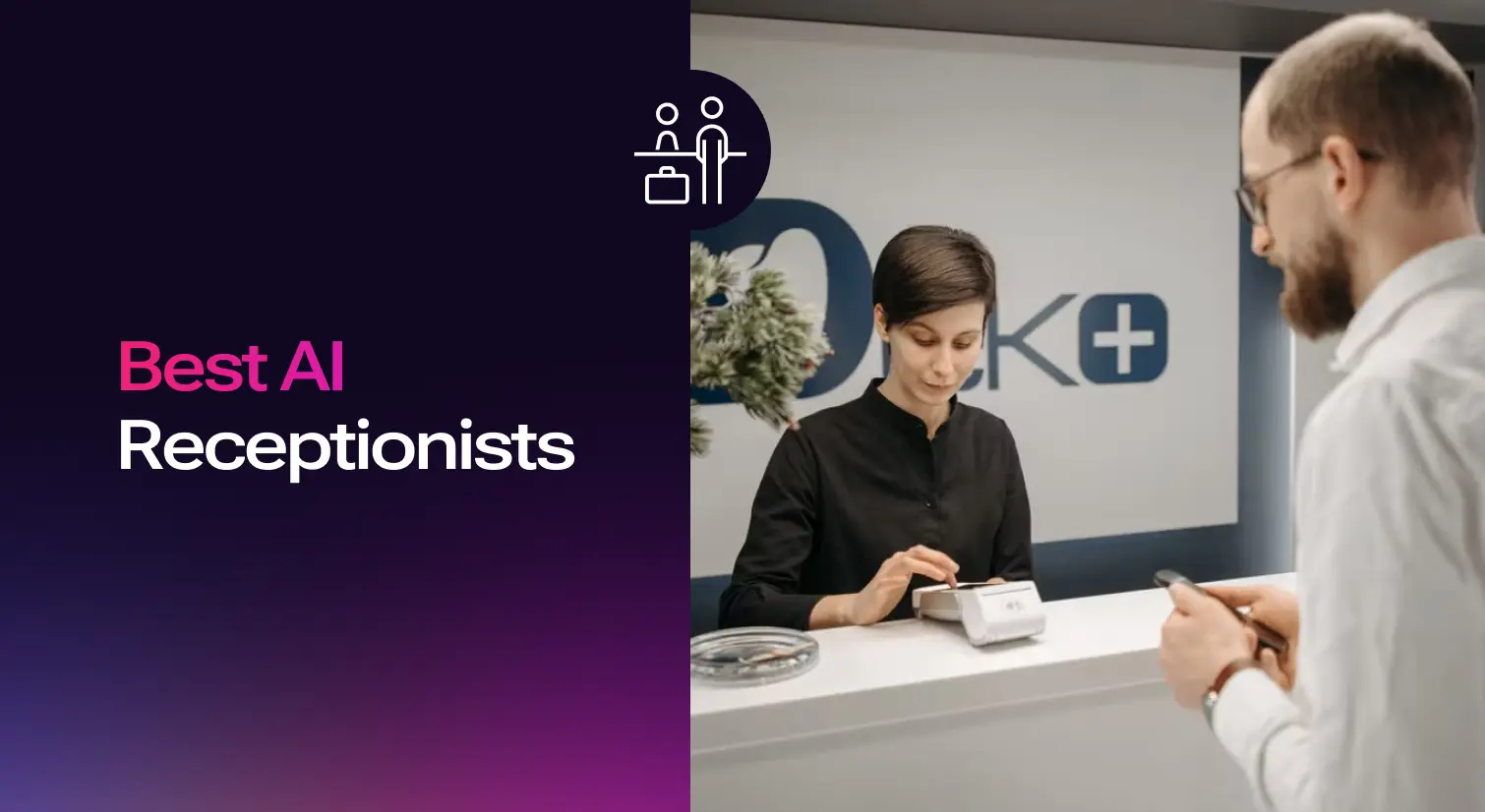

Your phone rings at 9 PM. An HVAC prospect needs someone out tomorrow. An AI phone answering service answers, gathers the details, then transfers the call and the person who picks up says, “How can I help you?” The caller repeats everything. That handoff broke the experience.
That's the live call transfer problem. It's one of the most overlooked factors when businesses evaluate the best AI receptionist platforms and virtual receptionist services. Most comparison guides focus on pricing and setup speed. Almost none evaluate how effectively a platform can transfer calls, preserve conversation context, and maintain customer experience. This guide does.
There are two categories here: voice AI platforms (the technology layer for building your own receptionist) and end-to-end virtual receptionist solutions (subscribe, configure, and go). Murf belongs to the first category, providing the AI voice technology behind some of the most natural-sounding agents in production. The other tools are ranked honestly. If a competitor offers better functionality for a specific use case, we say so.
What makes a good live call transfer
Before comparing platforms, you need to know what to measure. Most buyers never ask these questions, then wonder why their AI answering service feels clunky.
Warm transfer vs cold transfer
A cold transfer drops the caller onto a new line with zero context. A warm transfer alerts the receiving person before connecting, ensuring the right person already knows the caller's name, intent, and urgency. For sales conversations, legal intake, and medical practices, warm transfer calls are essential. The best live transfer options for virtual reception AI support both warm and cold transfers depending on your workflow.
Whisper summary
The best platforms provide call summaries before the connection goes through. Whisper/Announce Transfers are a main category of effective live transfer options. A receiving employee or phone agent may see something like:
"Caller: James Park. Intent: new patient intake. Urgency: appointment this week. Has insurance."
This helps live agents handle calls efficiently without asking customers to repeat information. Platforms that don't provide summaries create friction and reduce customer satisfaction.
Escalation triggers
What causes the AI to decide a transfer is necessary?
Rule-based systems transfer when callers explicitly ask for a human. More advanced systems use artificial intelligence to analyze intent, urgency, and sentiment. They recognize when a nuanced conversation, complex calls, or sensitive customer issues require human assistance.
Platforms with intelligent escalation ensure live virtual receptionists or staff members only receive calls that truly need intervention, allowing teams to focus on higher value work.
Voice continuity
When the AI hands off the call, does the audio quality change?
Poor-quality systems make callers feel like they've been bounced between tools. The strongest AI receptionist answer experiences maintain natural voice quality from start to finish. Platforms powered by advanced AI voice technology preserve voice consistency even during transfers, helping businesses maintain professionalism and improve customer satisfaction.
Quick comparison
Voice AI platforms for building your own receptionist
If you're a developer, agency, or technical team building a custom virtual receptionist solution, you start with a voice AI platform. These platforms provide the components needed to manage incoming calls, including speech recognition, language models, telephony, and AI-powered call routing capabilities.
Murf Agents
Murf powers AI agents with neural TTS optimized for phone-quality speech. The key difference from generic TTS systems is that voice fidelity remains strong under real-world calling conditions, including interruptions and background noise. Businesses can deploy a ready-made receptionist or build customized workflows using APIs and specific call flows.
Transfer support includes warm and cold transfers, configurable escalation triggers, CRM synchronization, and intelligent call forwarding based on caller intent. Businesses can route calls according to department, urgency, or customer profile while maintaining voice continuity throughout the interaction.
The platform also supports lead qualification, appointment booking workflows, and the collection of important caller details before escalation. This enables teams to spend less time on routine tasks and more time on higher value work.
Best for: Businesses that want the most natural-sounding voice layer and are comfortable integrating with their own telephony setup.
Retell AI
Retell operates at roughly 600ms end-to-end latency, helping conversations feel natural and responsive. Designed for production deployments with high call volume, it includes integrations with scheduling tools and supports advanced intent-based escalation.
Warm transfers with whisper summaries work out of the box, allowing human agents to receive detailed call summaries and maintain full conversation context before speaking with the customer.
The platform is particularly effective for businesses handling complex calls, healthcare intake, and legal consultations where preserving customer information and urgency is critical.
Pricing: $0.07/min, no platform fee. HIPAA-compatible with a self-service BAA.
Best for: Teams needing a production-ready platform with developer control, especially for healthcare, legal intake, and service-based businesses.
Vapi
Vapi combines transcription, LLMs, and text-to-speech services in a unified interface. At $0.05/min, it is among the most affordable developer-focused solutions.
Businesses can create custom workflows to route callers, manage customer inquiries, and connect multiple phone lines through a single system. Voice quality varies depending on the TTS provider selected, and warm transfers typically require additional configuration.
For organizations with highly customized business needs, Vapi offers flexibility, though implementing sophisticated transfer experiences may require additional development work.
Best for: Technical teams seeking component-level cost control and extensive customization.
Bland AI
Bland AI performs particularly well in outbound automation environments. For inbound receptionist use cases, it supports basic transfer and routing functionality, though transfer triggers generally require manual configuration rather than advanced intent detection.
Businesses can use Bland to automate lead qualification, answer common questions, collect business information, and handle repetitive customer interactions. However, handling nuanced conversations often requires careful workflow design.
Organizations looking to automate repetitive communication while keeping costs manageable may find value in Bland, particularly if they already have technical resources available.
Best for: Developer-led deployments with significant outbound and inbound call volume.
Synthflow
Synthflow's visual builder allows businesses to launch AI receptionists quickly. Many teams can configure a functioning receptionist in less than 20 minutes, making it one of the strongest platforms for rapid setup speed.
The platform can help businesses schedule appointments, answer FAQs, manage appointment availability, and provide basic after hours coverage without requiring technical expertise.
The tradeoff is that handling sophisticated transfers, preserving detailed context, and managing off-script conversations can be more limited compared to platforms like Murf or Retell. Some advanced transfer capabilities and call summaries are reserved for higher-tier plans.
Best for: Non-technical teams that need fast deployment and simple appointment-booking workflows.
End-to-end AI receptionist services
These are managed virtual receptionist services. You configure the AI receptionist, define transfer rules, connect calendars and phone systems, and start handling incoming calls without building custom infrastructure.
AIRA
AIRA starts at $24.95/month for 30 calls and includes built-in English-Spanish detection, appointment booking through Google Calendar and Calendly, CRM integrations, and warm transfers with whisper summaries.
One of its strongest advantages is multilingual support, allowing businesses to serve customers in multiple languages without additional staffing. The platform can book appointments, verify appointment availability, answer common customer inquiries, and provide reliable after hours coverage when staff members are unavailable.
Its unique caller pricing model is based on calls rather than minutes, making costs more predictable for businesses that handle longer conversations.
There is no human backup layer. If the AI cannot resolve an issue, it collects caller details, records a message, and schedules a callback.
Best for: SMBs, contractors, law firms, salons, and service businesses seeking affordable virtual receptionist services with bilingual capabilities.
NextPhone
NextPhone charges a flat $199/month for unlimited inbound calls. Across more than 1.4 million production calls, the platform reportedly resolves most inquiries without requiring escalation.
The system automatically routes callers based on urgency and intent. Emergency situations are prioritized and immediately transferred to the right person instead of being placed into standard queues.
Businesses can use NextPhone to answer calls during and outside business hours, collect customer information, manage call forwarding, and handle high call volumes across multiple phone lines.
Its unlimited model makes it particularly attractive for organizations that receive unpredictable call volume and need dependable customer service coverage.
Best for: Home services companies that require unlimited call handling, emergency escalation, and reliable transfer workflows.
Smith.ai
Smith.ai combines AI automation with more than 500 human operators, creating a hybrid experience that blends automation with live virtual receptionists.
When the AI encounters complex calls or conversations that require human judgment, the interaction is seamlessly escalated to live agents. Because the human operator receives full transcripts, summaries, and context, customers avoid repeating information.
The platform supports CRM integrations, outbound calling, lead qualification, appointment scheduling, and intake workflows. This makes it particularly valuable for legal firms handling legal intake, consulting organizations, and professional service providers.
Businesses that want the efficiency of AI alongside traditional human receptionist plans often view Smith.ai as a strong middle ground.
Pricing starts from $95/month (~60 calls/month).
Best for: Law firms and professional service businesses seeking AI efficiency with human backup available when needed.
Rosie AI
Rosie's Scale plan includes 1,000 minutes per month and offers competitive economics for businesses handling significant call volume.
The platform can answer common customer inquiries, schedule appointments, manage transfers, and support customer-facing operations without requiring large staffing investments. Warm transfers are included, while advanced summary capabilities are typically reserved for higher-tier subscriptions.
Rosie can be useful for organizations that receive repetitive inquiries and want to automate routine tasks while allowing staff to focus on higher value work.
Best for: Salons, clinics, and service businesses with high call volume where operating costs are a primary consideration.
Goodcall
Goodcall starts at $59/month and includes unlimited AI-answered calls. It is designed for businesses that need simple call handling rather than sophisticated customer engagement workflows.
The platform supports basic call routing, FAQ responses, and transfer functionality. However, it relies largely on cold transfers and lacks many of the advanced key features found in higher-end solutions, including detailed call summaries, CRM-based context sharing, and advanced escalation logic.
For businesses with straightforward requirements - such as routing all non-FAQ calls to a manager or owner - it can be a cost-effective option. Organizations with multiple departments, complex workflows, or detailed intake requirements may need a more advanced virtual receptionist solution.
Best for: Budget-conscious small businesses with simple call patterns and limited transfer requirements.
Five questions to ask any vendor
1. What type of transfer do you support - warm, cold, or configurable?
A vendor that cannot clearly explain its transfer process is unlikely to provide one of the best live transfer options for virtual reception AI. Understanding how transfers work is critical for customer experience.
2. Does the receiving person get a context summary before the call connects?
Without summaries, customers must repeat information. Effective platforms pass caller details, intent, urgency, and other relevant information before connecting the call.
3. What triggers a transfer - rules or intent detection?
Rule-based systems work for straightforward workflows. Advanced systems use artificial intelligence to evaluate customer intent, frustration, urgency, and conversation complexity before deciding to transfer.
4. What's the actual cost at my call volume?
Some providers charge per minute while others use a paid plan based on call count or flat monthly pricing. Understanding total ownership costs is more important than comparing entry-level pricing.
5. Can I hear a real production call?
Listening to actual conversations helps evaluate the quality of the AI phone answering service, voice naturalness, transfer process, and customer experience before making a purchasing decision.
When AI isn't the right choice
AI receptionists are highly effective for handling routine tasks such as appointment scheduling, FAQ responses, lead qualification, and call routing. However, there are situations where even the best AI receptionist should play a supporting role rather than lead the conversation.
Therapy and counseling intake
These conversations require empathy, emotional intelligence, and human judgment. While an AI answering service can collect basic information and direct callers, sensitive emotional discussions should be handled by trained professionals.
Highly consultative B2B sales
When the first conversation is effectively the sales process, businesses should use AI to greet callers, collect basic business information, and quickly connect them to the right person. In these scenarios, AI works best as a front desk rather than a salesperson.
Grief and bereavement services
Human connection is a core part of the service being offered. While AI can provide after hours coverage, schedule callbacks, and answer basic questions, these interactions are better suited for people than technology.
Businesses with highly unpredictable conversations
Some organizations deal with entirely unique customer situations on nearly every call. These conversations often require extensive context, judgment, and flexibility. Even advanced systems powered by artificial intelligence may struggle with this level of variability.
Premium and luxury experiences
For brands offering concierge-style experiences or luxury services, customers often expect a highly personalized interaction from the first call. AI can assist with scheduling and information gathering, but many businesses still prefer live virtual receptionists or hybrid models for premium customer experiences.
For these use cases traditional live virtual receptionist service providers may be a better fit than a fully automated solution.

Frequently Asked Questions
What is live call transfer in an AI receptionist?
.svg)
Live call transfer occurs when an AI receptionist connects an active caller to a human representative. The best platforms preserve conversation context, share caller details, and ensure the receiving person can continue the interaction without requiring the customer to repeat information.
What's the difference between warm transfer and cold transfer?
A warm transfer provides context before the caller is connected. The receiving person receives summaries, intent information, and urgency indicators. A cold transfer simply connects the call to another line with no additional information.
How much does an AI virtual receptionist cost in 2026?
Pricing varies significantly depending on features and deployment models. Basic virtual receptionist services start around $25 per month, while enterprise-grade solutions and hybrid human receptionist plans can cost substantially more. Developer-focused platforms are often priced per minute, while managed services may use monthly subscriptions or a unique caller pricing model.
Which AI receptionist has the most natural-sounding voice?
Murf and Retell AI are among the strongest options for conversational voice quality. Both use advanced AI voice technology designed to sound natural during real phone conversations, even when handling interruptions or transferring calls.
Can an AI receptionist integrate with my CRM or calendar?
Yes. Most leading providers integrate with CRM platforms and scheduling tools. Depending on the platform, an AI receptionist can book appointments, schedule appointments, update customer records, track appointment availability, and synchronize information across business systems.
Is an AI receptionist HIPAA compliant?
Some providers offer HIPAA-compliant plans and business associate agreements for healthcare organizations. Because compliance requirements change over time, medical practices should verify current certifications and compliance status directly with vendors before deployment.
When should I use an AI receptionist over a live human service?
An AI receptionist is ideal when call volume is high, inquiries are repetitive, and businesses want to automate routine tasks. One major AI answering service benefit is the ability to handle multiple conversations simultaneously without increasing staffing costs. Organizations with highly emotional, complex, or relationship-driven interactions may benefit from a hybrid approach involving both AI and human support.
How long does it take to set up an AI virtual receptionist?
Deployment time depends on the platform. Some no-code providers can be configured in under 30 minutes, while custom solutions may require additional integrations and workflow design. Factors such as specific call flows, CRM integrations, and transfer requirements can influence overall setup speed.
Can AI receptionists handle multiple calls simultaneously?
Yes. Unlike a traditional receptionist, an AI receptionist can manage multiple incoming calls at the same time. Whether handling one call or hundreds concurrently, modern systems can answer, qualify, and route callers without creating wait times.
What happens if the AI doesn't understand a caller?
The best platforms monitor intent, confusion, and conversation quality throughout the interaction. When the system cannot confidently provide an AI receptionist answer, it can escalate the conversation, transfer calls to live agents, or route the customer to the appropriate team member. This ensures customers reach the right virtual receptionist or specialist when automation reaches its limits.
Can AI receptionists answer calls outside business hours?
Yes. One of the most valuable benefits of an AI phone answering service is 24/7 availability. AI can answer calls outside business hours, collect customer information, provide updates, schedule appointments, and ensure no opportunity is missed after staff members have gone home.
How do AI receptionists improve customer satisfaction?
AI receptionists improve customer satisfaction by reducing missed calls, shortening response times, preserving customer context, and ensuring callers reach the correct department quickly. Instead of waiting for callbacks, customers can receive assistance, book appointments, or get answers in a single interaction, often within one call.