The 12 Best AI Scheduling Tools in 2026 (Tested)


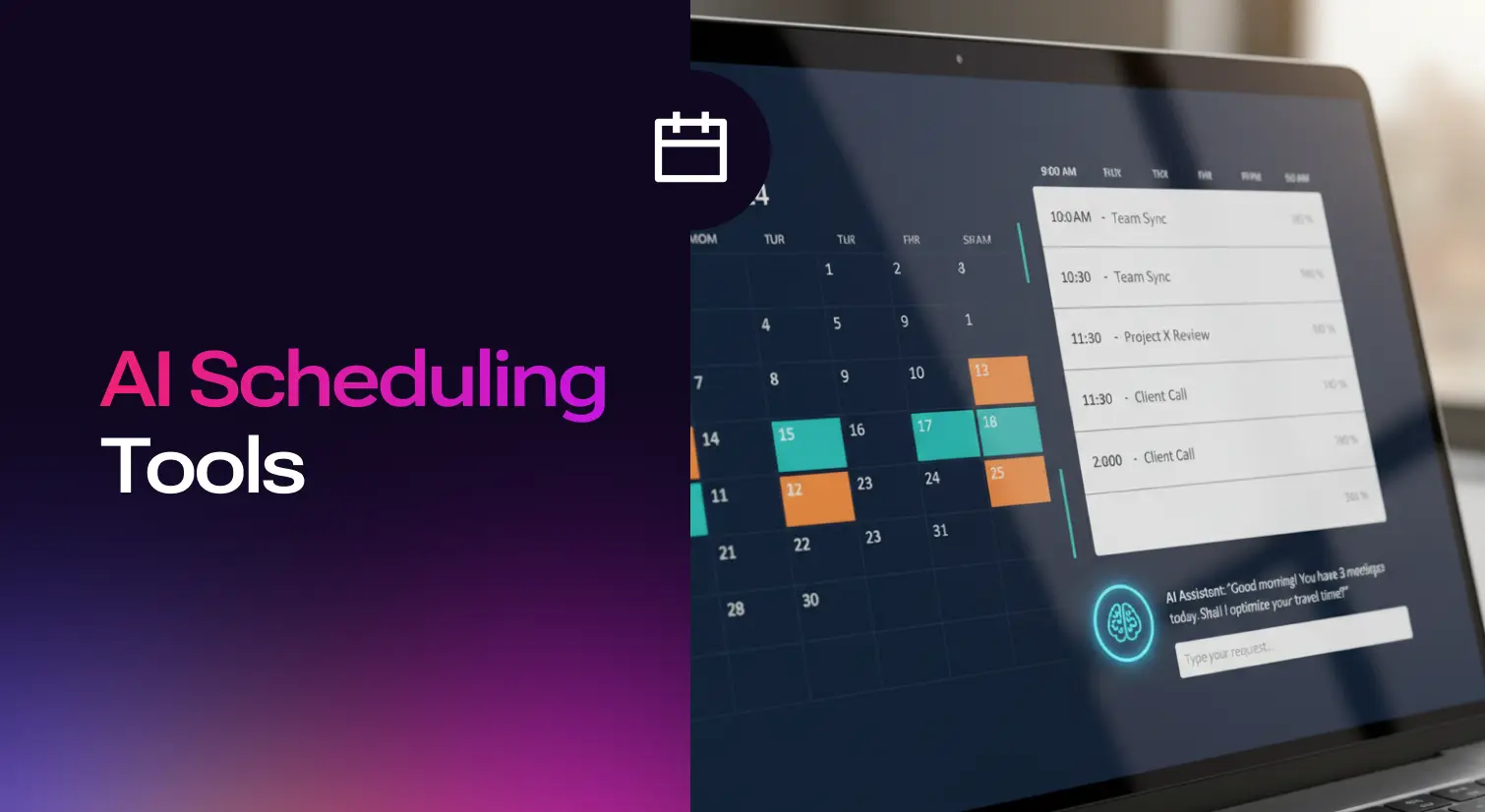

Most calendar problems are not really about calendars; they are about decisions. They are about deciding when to schedule deep work, how to protect a focus block from the meeting that always seems to land on it, and who should respond when a customer calls to book an appointment at 7 PM.
An AI scheduling app makes those small calls for you, then keeps adjusting as the day falls apart and puts itself back together.
We tested the AI scheduling tools people actually search for, ran each against real calendars and real bookings, and grouped them by the job they do best. Some are personal time-blockers. Some coordinate team meetings. One answers your business phone and books the appointment while you are busy.
This guide covers all three, with honest limits and current pricing for every pick - we tested and tried 12 of the best AI scheduling tools available.
How we evaluated these AI scheduling tools
We are not paid for placement, and no vendor bought a spot. We signed up for every scheduling app, connected to a live Google or Outlook calendar, and pushed through the same tasks: schedule a week of work, handle a last-minute reschedule, set up a meeting across two time zones, and take a booking by voice or email where the tool claims to.
We judged each one on five things:
- Real AI, not rules. A lot of "AI scheduling apps" is a rules engine with a new label. We looked for tools that adapt to how you work.
- Calendar and tool sync. Does it read Google Calendar and Outlook, and pull all your tasks from where you already keep them?
- Natural language and voice. Can you tell it what you need in plain words instead of filling in forms?
- Team and customer features. Personal time-blocking is one job. Coordinating a team, or booking a stranger's appointment, is another.
- Honest pricing. A free plan that does nothing is not free. We only note AI scheduling assistants where the useful features start.
One thing up front: the popular calendars apps and planners (Motion, Reclaim) are excellent at organising your day and useless at answering your phone. The reverse is also true. Match the tool to the job, not to the brand.
What to look for in an AI scheduling assistant
A few things separate a tool worth paying for multiple calendars with a chatbot bolted on.
- Does it plan proactively? A weak tool waits for you to drag tasks onto a calendar. A strong AI agent reads your priorities, deadlines, habits, and meetings, builds the schedule, and defends it. When something breaks, it reschedules the rest without asking.
- Integration depth. AI scheduling software is only as good as the calendars and apps it can see. Google Calendar and Outlook are table stakes. The better tools also pull from Todoist, Asana, Slack, and your CRM, so they plan around everything, not just meetings.
- How you give it instructions. Older tools make you configure settings. Newer ones let you type or say "move my dentist appointment to Thursday afternoon and add 30 minutes of travel" and handle it.
- Does it actually get better the more you use it? A good AI assistant should not feel stateless. The more you accept or reject its suggestions, the more it should learn what “good” looks like for you: which meetings are truly movable, how long your tasks really take, what “after-hours” means in your world. Look for tools that give you simple feedback loops.
Last, consider who the tool is for. Personal planners help one person protect focus time, meeting coordinators find slots across multiple calendars, and appointment-booking agents handle customer scheduling. These are three different jobs, and most tools only do one of them well.
Top 12 AI scheduling assistants in 2026
Personal time-blocking and calendar optimisation
These tools organise one person's day. If your problem is "too much to do and no plan for when to do it," start here.
1. Reclaim AI - Best for defending focus time
Reclaim runs on top of your Google or Outlook calendar and schedules your meetings, tasks, habits, and focus blocks around the events you already have. The thing it does best is defend: it carves out focus time and quietly moves it when a meeting lands on top, so deep work does not get eaten.
In testing, the "free vs. busy" system was the useful part. Your focus blocks stay visible to you but bookable by others until the day fills up, which solves the usual problem of blocking eight hours nobody can schedule around. It also books meetings faster than a plain scheduling link and handles recurring one-on-ones well.
Not for you if you want a customer-facing booking tool. Reclaim optimizes your calendar; it does not answer your phone.
Pricing: Free plan. Starter from $10 per seat/month, Business $15, Enterprise $22.
2. Motion - Best all-in-one planner
Motion combines task management and AI scheduling. Enter tasks and deadlines, and it builds a full daily plan, reorders it when priorities shift, and pushes anything you miss into the next open slot. In our test, once the tasks were in, the schedule built itself. No dragging.
That is the appeal and the catch. Motion wants to own your whole workflow, so it shines when you commit and feels heavy if you only want light scheduling.
Not for you if you want something minimal or free. Motion has no free plan.
Pricing: From $19 per seat/month on team plans; about $29/month for an individual.
3. Sunsama - Best for deliberate planning
Sunsama is the calm one. Instead of cramming your day, it walks you through a short morning planning ritual, pulls tasks from your synced productivity apps, and asks you to commit to a realistic amount. Its assistant, "Sunny," can summarise your agenda, adjust durations, add subtasks, and move work to another day when you are overloaded.
It is the best pick if your problem is overcommitting rather than under-planning. The trade-off is that Sunsama expects you to think, by design. There is no Calendly-style booking link, and it is built for personal work, not team coordination. It also pulls tasks from your stack such as Trello, Gmail.
Not for you if you want the tool to plan for you with no input, or you need team features.
Pricing: 14-day trial, then $22 per user/month billed annually (about $25 monthly). Sunsama raised prices in 2026 after five years flat.
4. Akiflow - Best for consolidating scattered tasks
If your work lives in Todoist, Asana, Google Calendar, Slack, and your inbox at once, Akiflow pulls it into one place and time-blocks the day. Its AI auto-labels items as personal, work, or admin, and a command bar lets you capture and move things with keyboard shortcuts without breaking flow.
It is strong at cross-platform sync and daily planning. Less of a "thinking" planner like Sunsama, more a fast cockpit for people who already know what they need to do.
Not for you if you want a free plan or a gentle, low-input experience.
Pricing: No free plan; starts around $14.25/month billed annually.
5. SkedPal - Best for "time maps"
SkedPal asks you to define time maps, the windows where certain kinds of work belong, then fits daily tasks into them automatically. When a new task arrives, an ad-hoc button reschedules the day around it. It also shows critical tasks planned versus actual time on a timeline, so you can see where your hours go.
It rewards setup. Once your time maps are dialled in, it stays realistic even when plans shift.
Not for you if you want zero configuration.
Pricing: Two plans are available namely Core $9.95/month, Pro $14.95/month.
6. Trevor AI - AI workspace with the best free visual planner
Trevor pairs a to-do list with a calendar in one drag-and-drop view, with AI suggesting durations and slots. It is the cleanest entry point for visual time-blocking without a learning curve, and the free plan is genuinely usable for personal planning.
Not for you if you need deep integrations or team features.
Pricing: Free for personal use; Pro $5/month per user.
Meeting scheduling and team coordination
A different job: finding the right slot across several calendars, and letting other people book you.
7. Clockwise - Best for team focus time
Clockwise optimises calendars across a whole team. It moves flexible meetings to open up shared focus time, resolves conflicts, and reports on focus time created and meetings reorganised, so a manager can see the impact. For teams drowning in fragmented calendars, it treats the team's time as the thing to optimise, not just one person's.
Not for you if you are a solo user. Most of the value is in coordinating many calendars.
Pricing: Free plan. Teams from $6.75 per user/month, Business $11.50, Enterprise custom.
8. Calendly - AI scheduling app best for booking links and routing
Calendly is the booking-link standard, and its AI features now help with routing and finding times, not just sharing a link. It is the right tool when you want prospects, candidates, or clients to book you from a page without the back-and-forth. The free plan covers one event type; real flexibility starts on paid.
Not for you if you want proactive daily planning. Calendly schedules meetings others book; it does not organise your tasks.
Pricing: Free plan; Standard from $10/seat/month, Teams $16/seat/month, Enterprise custom.
Voice and natural-language scheduling
A newer category: tell the tool what you want in plain language, or just talk to it.
9. Structured - Best for planning by voice
Structured is a clean, visual day planner with a voice-and-AI tab. Open it, talk your plans, and it turns them into a list of tasks and syncs events you can drop onto the day. It skips the bells and whistles on purpose.
Not for you if you want heavy integrations or team coordination.
Pricing: Free plan for personal use; Pro $19.99/year unlocks Structured AI and customization.
10. Toki - Best visual calendar with voice
Toki offers a colour-coded, canvas-style calendar you can manage with voice, including from an Apple Watch. It is built for people who plan visually and want a fast, good-looking way to check and adjust the day based on your time budgets.
Not for you if you need integrations with a wide app stack; it is more of a self-contained hub.
Pricing: Free plan for basic scheduling; Plus $3.59/month, Super $6.59/month.
11. ChatGPT and Gemini - Best free DIY option with Google calendar
You do not always need a dedicated app. Gemini can create calendar events in Google Calendar from text or a photo of a schedule, and ChatGPT can draft a plan you paste in. This is the answer to the question people keep asking: can ChatGPT just make my schedule? Yes, for one-off planning.
The limit is that general chatbots do not manage your calendar over time. They will not reschedule a missed task, defend focus time, or sync your to-do apps. Great for "build me a study plan," weak for "run my next week type task lists.
Not for you if you want ongoing, automatic schedule management.
Pricing: Free tiers available; paid plans from around $20/month.
AI appointment scheduling and voice booking for businesses
Here is the job none of the tools above do. When a customer calls your business to book, who answers? For a clinic, a salon, a real estate office, or a home-services company, the scheduling problem is not the owner's calendar. It is the missed call at 7PM that becomes a booking for competing with most AI scheduling assistants.
This is where AI appointment scheduling means something different. Instead of optimising your day, an AI voice agent answers the phone, talks to the caller, checks availability, and books the appointment on your calendar, day or night.
12. Murf AI - Best AI agents for appointment booking by phone
Murf builds conversational AI voice agents that answer calls and book appointments in a natural-sounding voice. It is not a calendar app for you. It is an AI receptionist that books appointments for your customers: it picks up, works out what the caller wants, checks open slots, confirms the booking, and hands clean details to your calendar and CRM.
That makes it the pick for customer-facing businesses, not solo planners. The pattern fits healthcare scheduling and real estate, where booking volume is high and a missed call is lost revenue, and it extends into an AI call center setup for higher volumes. You can see the broader AI voice agent range and how voice agents are used across industries.
Be realistic about it: this will not replace your front desk on day one. It covers the calls that otherwise go unanswered.
Not for you if you want a personal time-blocker. Murf does not organize your tasks; it handles the calls and bookings your business would otherwise miss.
Pricing: Usage-Based Pricing
Best free AI assistants
If budget decides it, three picks earn the "free" label honestly. Trevor AI gives you real visual time-blocking on its free plan. Clockwise has a free tier that still optimises focus time. And Gemini or ChatGPT will build and place a schedule for nothing if you do not need ongoing management. Reclaim AI's free plan is also a fair way to test automatic time-blocking before paying.
How to choose the right AI scheduling tool
Start with the buyer you are, not the feature list. Planning actionable tasks with personal calendars? AI scheduling would be better here than other tools with just connected calendars.
If you are a solo professional drowning in tasks, pick a personal planner. Reclaim defends focus time automatically, Motion runs tasks and calendar in one place, and Sunsama helps if your real problem is overcommitting. Want it free? Trevor AI planner or a chatbot will get you going.
If you run a team, the job is shared time. Clockwise optimises everyone's calendars together; Calendly removes the booking back-and-forth with clients and candidates.
If you run a customer-facing business, the calendar app is not your bottleneck, the phone is. An AI voice agent like Murf answers and books appointments so you stop losing after-hours callers. That is the one category the popular planners do not touch.
One more rule: do not buy for features you will not configure. SkedPal and Motion reward setup. If you will not put in the time slot, a simpler tool you actually use beats a powerful one you abandon.

Frequently Asked Questions
What is an AI scheduling tool?
.svg)
An AI scheduling tool uses artificial intelligence to plan, book, and adjust events for you. Depending on the tool, that means time-blocking your tasks, finding meeting time across calendars, or answering calls and booking appointments for a business. Unlike a plain calendar, it makes the scheduling decisions and adapts when plans change.
What's the difference between an AI scheduling assistant and a smart calendar?
A smart calendar shows your events and maybe suggests times. An AI scheduling assistant acts. It builds the plan, defends focus blocks, reschedules missed work, or books appointments without you driving each step. The assistant does the deciding; the calendar just displays it.
Can AI actually create a schedule for me? Can ChatGPT make a schedule?
Yes. ChatGPT and Gemini can both generate a daily or weekly schedule from a prompt, and Gemini can add events straight to Google Calendar from text or a photo. The limit is that general chatbots do not manage your calendar over time. For ongoing, automatic scheduling, a dedicated tool like Reclaim or Motion does more.
What's the best free AI scheduling tool?
Trevor AI is the strongest free personal time-blocker. Clockwise has a useful free tier for teams, and Reclaim's free plan is a good way to test automatic scheduling. For zero-cost one-off planning, Gemini or ChatGPT will build a schedule with no subscription.
Can an AI scheduling tool book appointments with customers over the phone?
Most cannot. Personal planners like Motion and Reclaim optimize your own calendar but do not answer phones. For customer bookings, you need an AI voice agent such as Murf, which answers calls, checks availability, and books the appointment on your calendar in a natural voice, including after hours.
Do AI scheduling tools work with Google Calendar and Outlook?
Almost all of them do. Reclaim, Motion, Clockwise, and most others run directly on Google Calendar or Outlook and schedule around your existing events. Confirm Outlook support specifically, since a few tools support Google first and add Outlook Calendar later.
Is it safe to give an AI scheduling assistant access to my Google calendar and email?
Reputable tools use OAuth, so you grant scoped access without sharing your password, and most offer certifications like SOC 2 on business plans. Risk varies by vendor. Check what data the tool reads and writes, whether it shares data with third-party AI providers, and its data-training policy before connecting work accounts.
How much do AI scheduling tools cost?
Personal planners typically run $5 to $29 per user per month. Trevor AI starts at $5, SkedPal at $9.95, Reclaim at $10 per seat, and Sunsama at $20 per user. Team tools like Clockwise and Calendly start around $7 to $10 per seat. AI agents for appointment booking are priced by usage; check the vendor for current plans.
Can AI handle multi-person meeting coordination reliably?
For straightforward cases, yes. Clockwise and Calendly reliably find slots across calendars and handle flexible time zones. Nuanced coordination, rearranging many constraints at once, is where they still need a human check. Test with your real scheduled meeting patterns before trusting it fully.
Which AI scheduling tool is best for teams versus solo users?
Solo users are best served by personal planners: Reclaim, Motion, Sunsama, or Trevor AI. Teams should look at Clockwise for shared focus time and Calendly for client booking. Customer-facing businesses are a third case, best served by an AI voice agent like Murf for appointment booking.