What is SIP trunking & How does it work? (2026 Guide)



If your business relies on phone calls: whether for customer support, sales, or AI-powered voice automation, you've probably come across the term SIP trunking. It's one of those technologies that works quietly in the background, but plays a critical role in how modern business calls are made, received, and routed.
This blog will explain what a SIP trunking service is, how it works, why it has largely replaced traditional phone lines and how it has become the foundation for modern cloud telephony and AI voice agents.
What is SIP trunk?
Session initiation protocol or SIP trunk is a virtual phone line that allows a business phone system to successfully make and receive incoming calls over the internet. It is the replacement of what traditional phone lines used to use such as analog or ISDN/PSTN lines, and the copper wires that we are aware about.
Think of SIP as the rules that say "ring this number, connect both sides, now hang up." It handles the signalling that starts, manages, and ends a call. The voice itself travels over a separate protocol called Real-time Transport Protocol (RTP), which is a network structure used to send live audio and video over the internet. The word trunking refers to grouping multiple communication channels to the same line.
How does SIP trunk work?
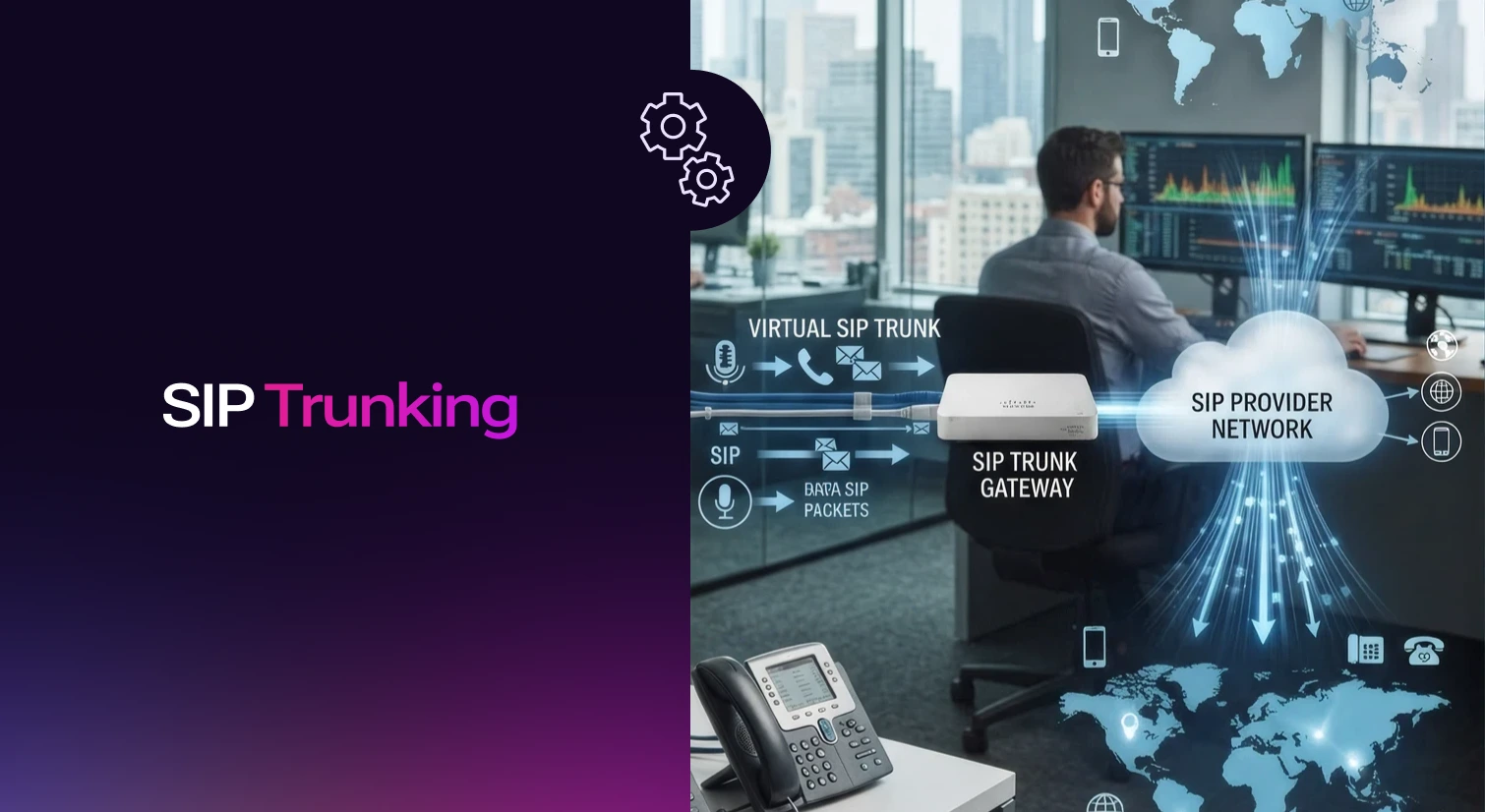
An SIP trunking system acts as a carrier to your calls in a few steps. This is what happens when someone places a call:
- First, an employee dials a number on a desk phone or an app. This call goes to the company's phone system, usually an IP-PBX (a private branch exchange that speaks IP).
- Next, the PBX passes the call to your SIP trunk service provider. A single trunk can hold several SIP channels, and each channel carries one call, so grouping these communication channels together is where the word "trunking" comes from.
- Third, the provider connects to an internet telephony service that hands the call to the public switched telephone network (the PSTN). From which, the call can reach any phone in the world.
Externally, there are also two things that happen underneath this flow.
Underneath this flow, the call splits into two streams. The signalling stream (SIP messages) sets up and ends the call. The media stream (RTP, or Real-time Transport Protocol) carries the actual voice while the call is live. Many businesses also add a session border controller (an SBC) at the edge of their network for security and to smooth out systems that don't quite agree.
That's the whole trip made during inbound and outbound calls: your phone, the PBX, the trunk, the PSTN, and back.
SIP trunk vs VoIP vs PRI
VoIP (Voice over Internet Protocol) is the broad umbrella term used which describes any voice call carried over the internet. A SIP trunk is one specific way to do VoIP, the method that connects a phone system to the PSTN (Public Switched telephone network). A PRI (Primary Rate Interface) is the older technology that a SIP trunk usually replaces.
Here is a comparison table that would help differentiate these key terms and what they do:
The short version: VoIP is the category, a SIP trunk is the connection, and a PRI is the thing you are probably moving away from.
Key benefits of SIP trunking
Here are some of the benefits that a SIP trunking provider brings:
1. Real cost savings
A SIP trunk runs over the internet you already pay for, so there's no separate phone line to rent and none of the per-line fees a PRI charges. Because calls travel over IP for most of the trip, long-distance and international rates drop too. And where a PRI forces you to buy all 23 channels whether you use them or not, a SIP trunk only bills you for the channels you actually need. Vendors commonly report savings of up to 50% on monthly phone costs after the switch.
2. Scales on demand
Adding or removing a channel is a settings change that your provider makes, not a technician visit and a new circuit. Therefore, a retailer whose support volume doubles every holiday season, can turn up extra channels for December and drop them again in January. A PRI doesn't work like this - you would have to buy the whole circuit or nothing at all.
3. Local numbers anywhere
A SIP trunk can carry local phone numbers (DIDs - direct inward dialling) for cities or countries where you have no office. Therefore, a customer in a different region can dial your number, that looks local and reach you directly. This matters as people are more likely to answer, and to trust, a local number than a toll-free or foreign one.
4. Built-in resilience
Since the trunk is a software, not a physical line - your provider can reroute incoming calls to a backup site, if and when a location goes down, instead of leaving callers ringing a dead line. Your numbers keep working through an outage that would have taken an old copper line offline. Many providers also offer number failover - if one route fails, calls automatically jump to a backup, so you stay reachable even at high call volumes.
Why are SIP channels important in 2026?
For years, moving to a SIP trunking provider was a smart cost decision, one businesses could take or leave. In 2026 that changed, because the old network underneath the alternative is being switched off.
In the United States, the copper telephone network is being retired. The number of copper phone lines fell from about 171 million in 2005 to 11.7 million in 2024, and carriers have stopped maintaining what's left. AT&T stopped taking new copper line orders on October 15, 2025 across 18 states, and it spends roughly $6 billion a year keeping the old network running. In March 2026 the FCC rewrote its rules to let carriers retire copper faster, with less paperwork and shorter notice, and by June 2026 AT&T had begun physically shutting down copper in about 500 wire centers, roughly 10% of its footprint.
For a business still on a traditional phone system, that's a countdown. Once your carrier files to shut copper down in your area, a business account gets a minimum of 180 days to switch before the line goes dead, and shorter windows now apply in some cases. The UK has gone further with one hard date: its old network switches off in January 2027, and since 2023 you haven't been able to order a new copper line at all.
A SIP connection is the most direct replacement. It keeps your existing PBX and your existing phone numbers and swaps the dying copper circuit for a connection over broadband. For most businesses the question is no longer whether to move, but when.
It's not just about replacing the line
Once your calls run over SIP instead of copper - you are now using a software, which is something a voice agent can plug into. A copper line could only ever carry a human voice to another human. A SIP channel can hand that same call to an AI voice agent that answers instantly, at any hour, on every line at once.
What does a SIP trunk mean for building AI voice agents?
This is where SIP trunking stops being a legacy-telephony topic and becomes something that makes an AI phone agent possible.
An AI voice agent has three parts. Speech-to-text (STT) is its ears, turning the caller's words into text. A language model, or LLM, makes sense of the words and decides what to say. Text-to-speech (TTS) is its voice, turning the reply back into audio. That stack can hold a conversation in a browser tab, but on its own it can't answer a phone, because it has no link to the phone network.
A session initiation protocol is the missing fourth piece. It carries the call between the phone network and your AI, so a real person can dial a real number and reach the agent.
On an inbound call, the caller dials your number, the call reaches the PSTN, your SIP trunk hands it to your application, the agent's STT transcribes it, the language model decides on a reply, the TTS speaks it, and that audio travels back out through the same trunk. This is commonly known as elastic SIP trunking, and most AI voice platforms connect to it with standard SIP support.
That voice layer is where Murf fits. Murf is not a SIP trunk provider; the trunk carries the audio, and Murf provides the voice that is traveling through it. Falcon 2, Murf's streaming voice model for real-time agents, delivers time-to-first-audio under 100 milliseconds and outputs telephony-ready formats, so the voice drops into a SIP-based call flow without extra transcoding - making it easier to conduct multiple calls with high call quality.
Essentially, you bring the trunk and the brain; the text-to-speech API handles a voice that holds up on the line. Murf AI gives your AI agent SIP-trunking-compatible voice output, so once the trunk connects the call, what the caller hears is a natural human-like voice.
How to choose a SIP service provider?
To get started, it would be useful to have an estimate on how many concurrent calls are held with your business and then understanding the channels you require. Apart from this, here is what you can consider:
- Call quality and reliability: clear audio and a network that stays up.
- Transparent pricing: clear per-channel rates with no long lock-in contracts.
- Number porting: the ability to bring your existing phone numbers with you.
- Setup support: real help during the switch, not just a knowledge base.
- AI platform support (if you are building a voice agent): confirm the provider handles the codecs and SIP features your platform needs.
Most SIP trunk providers connect to a modern PBX or an AI platform within a few days.

Frequently Asked Questions
What is a Session Initiation Protocol (SIP) trunk?
.svg)
A SIP trunk is a virtual phone line that carries calls over the internet instead of over copper wires. It connects your phone system to the public telephone network, so you can make and receive normal calls using the internet connection you already have. They convert voice to data packets ready for transmission.
What is the difference between SIP trunking and VoIP?
VoIP is the broad term for any voice call sent over the internet. SIP trunking is one specific type of VoIP: the connection that links a business phone system to the public phone network. So all SIP trunking is VoIP, but plenty of VoIP (like a consumer calling app) has nothing to do with a SIP trunk.
What is a SIP trunk in a PBX?
A PBX is the phone system that routes calls inside a business. On its own it can only connect internal extensions. The SIP trunk is what links that PBX to the outside world, so calls can reach real phone numbers. In short, the PBX handles calls within the company, and the SIP trunk carries them in and out. Without a SIP trunk (or an older line doing the same job), the PBX cannot reach outside numbers at all.
How much does a SIP trunk cost?
Most providers charge per channel plus usage, and it usually costs less than an old PRI line because there is no separate line rental and no physical circuit to maintain. Your final bill depends on how many channels you need, your call volume, and where you call. Compare providers on clear per-channel pricing rather than headline rates.
How are SIP trunks delivered?
A SIP trunk is delivered as a service over your internet connection, not as physical hardware. A provider sets up the SIP trunk on their network and connects it to your PBX or app using SIP settings, usually just credentials and an address you enter once. Nothing gets installed in the ground; the whole thing is software plus your existing broadband.
Why do I need a SIP trunk for incoming?
If your business makes or takes phone calls and you want to move off old copper lines, a SIP trunk is how you do it. A SIP trunk cuts call costs, lets you add or remove capacity easily, and keeps your existing numbers.it also monitors calls for unusual behaviour, helping you understand call behaviour better.
Is SIP trunking secure with an internet connection?
Yes, when it is set up properly. Voice traffic can be encrypted, and a session border controller (SBC) at the edge of your network adds sign-in checks, fraud protection, and traffic control. Security comes down to the setup, so pick a provider with strong encryption and clear security practices.
Can a SIP trunk connect to an AI voice agent?
Yes, and it is one of the fastest-growing uses. The SIP trunk carries the call between the phone network and your AI, while the agent handles listening (speech-to-text), thinking (the language model), and speaking (text-to-speech). Most AI voice platforms connect over standard SIP, often sold as elastic SIP trunking.