Deep Learning in Conversational AI: How AI Learns to Understand and Respond



Key Takeaways
- Deep learning conversational AI enables systems to understand intent, context, and urgency, not just process user input
- Modern conversational AI systems use neural networks and large language models (LLMs) to move beyond scripted responses and handle real conversations
- The shift from rule based systems to deep learning allows AI to complete tasks such as blocking cards, processing requests, and triggering workflows
- Context handling across multi turn conversations is a major differentiator, making interactions more natural and consistent
- Real world deployments across banking, telecom, healthcare, and SaaS show measurable impact in cost reduction, efficiency, and customer experience
A banking customer calls customer support and says, "I lost my card while traveling. Can you block it and issue a new one to my hotel address?"
Traditional support systems would typically struggle to provide a quick resolution. They would ask the user to repeat information, navigate menus, or transfer the call to another department after blocking the card. Modern conversational AI handles this in one flow. It understands the request, extracts key details, confirms intent, and completes the action.
That shift comes from deep learning conversational AI. Deep learning allows conversational AI systems to move beyond scripted responses and rigid decision trees. It enables machines to understand human language, detect patterns in user behavior, and generate responses that feel real, natural, and relevant.
What Is Deep Learning in Conversational AI?
Deep learning in conversational AI refers to the use of neural networks to process, understand, and generate human language across chatbots, voice assistants, and other conversational interfaces.
Traditional systems relied on rules and decision trees, which worked for predictable inputs but failed in front of unstructured language. Deep learning changed this. Instead of mapping inputs to predefined responses, models are trained on large volumes of real world language data. This includes customer interactions, support conversations, and general language usage.
These models learn how language is structured, how meaning changes with context, and how intent is expressed differently across users. This is where natural language processing conversational AI connects with deep learning. NLP structures the input. Deep learning models interpret and act on it.
Modern conversational AI systems use this combination to:
- Understand user queries beyond keywords
- Handle incomplete or ambiguous inputs
- Maintain context across conversations
- Generate responses that match intent
This is what allows conversational AI to move from answering questions to completing tasks.
How Deep Learning Powers Conversational AI
Deep learning conversational AI works through a structured pipeline. Each stage contributes to how the system understands and responds. Here is how deep learning powers Conversational AI systems:
Input Processing and Data Representation
The process starts with user input. This can be text or voice. In voice systems, automatic speech recognition converts spoken language into text. Accuracy in production systems typically ranges between 90% and 95%, depending on conditions.
Once converted, NLP techniques process the input:
- Removing noise
- Normalizing text
- Breaking sentences into tokens
Deep learning models then convert this input into embeddings. These are numerical representations of words and phrases.
Embeddings capture relationships between words. For example, "cancel," "stop," and "end" are treated as related actions.
Neural Network Models for Language Understanding
Once input is structured, neural networks analyze it to understand the meaning.
Earlier models like Recurrent Neural Networks (RNNs) and Long Short-Term Memory networks (LSTMs) processed text sequentially. They helped systems understand sentence structure, but struggled with long-range context.
Modern systems use transformer models. Transformers process entire sentences at once and use attention mechanisms to identify important words and relationships.
For example:
“I want to cancel the order I placed last Friday.”
The system identifies:
- Action: Cancel
- Object: Order
- Context: Last Friday
Context Handling and Dialogue Management
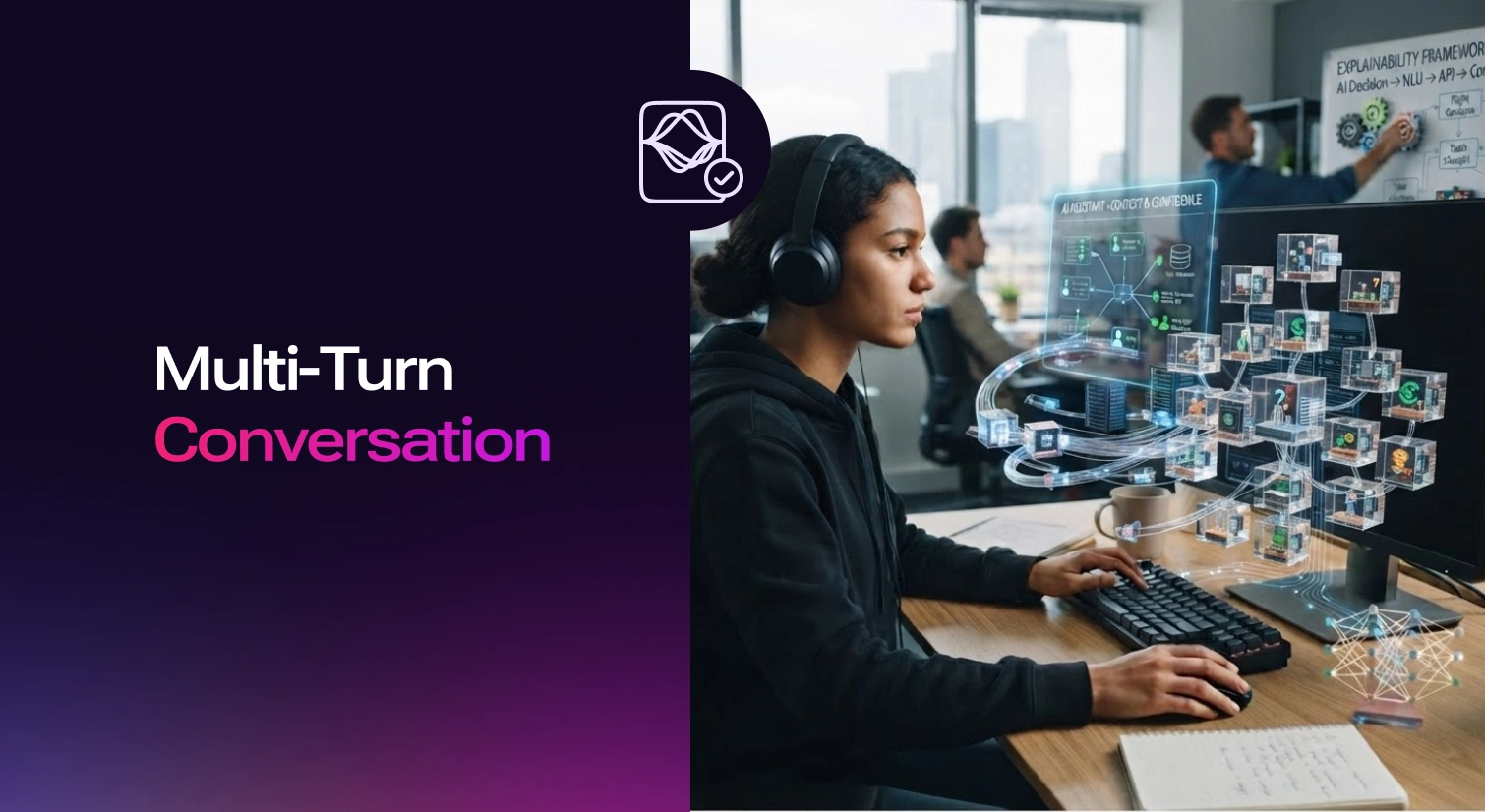
Most user interactions are not single step queries. They are conversations.
For example, when a user says, "Book a cab to the airport," "Make it for 6 AM," and "Add one more stop,” the system must connect all inputs.
Deep learning models track conversation history and maintain context across turns. Dialogue management systems store this context and combine it with new input.
This allows conversational AI systems to:
- Handle follow-up queries
- Maintain conversation flow
- Provide consistent responses
Response Generation Using Deep Learning Models
After understanding the input, the system generates a response. Modern systems rely on conversational LLMs trained on large datasets. These models generate responses based on patterns learned from real conversations.
Response generation includes producing natural language replies, fetching relevant data, and triggering workflows.
For example, in banking:
- Block a card
- Check balance
- Update account details
The response is not just text. It is often tied to an action. This is what separates conversational AI systems from traditional chatbots.
Key Deep Learning Models Used in Conversational AI
Deep learning conversational AI systems rely on a set of core models, each designed to handle different aspects of language understanding and response generation. Understanding these models helps explain how conversational AI systems process input, maintain context, and generate accurate, human like responses.
Recurrent Neural Networks (RNNs) and LSTMs
RNNs were among the first deep learning models used for language tasks. They process sequences of text and were useful for early conversational AI systems.
LSTMs improved on RNNs by handling longer dependencies. However, both struggled with complex conversations and large datasets.
Transformer Models and Attention Mechanisms
Transformers introduced a new approach. They process entire sentences simultaneously and use attention mechanisms to focus on relevant parts of the input.
This improves:
- Context understanding
- Processing speed
- Accuracy
Transformers form the backbone of modern conversational AI systems.
Generative Pre-trained Transformers (GPT Models)
GPT models are designed for generating text. They are trained on large datasets and can handle a wide range of tasks, including:
- Chat
- Question answering
- Content generation
These models power many conversational AI tools along with generative AI platforms and enable systems to handle open ended queries.
BERT and Contextual Understanding Models
BERT focuses on understanding context. It analyzes words in relation to the entire sentence, improving intent recognition.
BERT is widely used in:
- Search systems
- Chatbots
- Language understanding tasks
It improves how conversational AI systems interpret user queries.
Benefits of Using Deep Learning in Conversational AI
Deep learning has significantly improved how conversational AI systems understand, respond, and scale across real world interactions. The benefits go beyond basic automation and directly impact accuracy, efficiency, and user experience.
Improved Language Understanding
Deep learning models can interpret variations in human language, including slang, typos, and incomplete queries.
This reduces dependency on exact phrasing and allows systems to understand user intent more accurately, even when inputs are unstructured or ambiguous.
Better Context Handling
Deep learning enables conversational AI systems to maintain context across multiple turns in a conversation.
This ensures that follow up queries are understood correctly, making interactions more coherent and closer to real human conversations.
Higher Response Quality
Responses generated using deep learning models are more natural and aligned with user intent.
This improves user experience by making conversations feel less scripted and more relevant, especially in complex or open-ended interactions.
Scalability
Deep learning powered systems can handle thousands of interactions simultaneously across multiple channels.
This allows businesses to manage high volumes of customer interactions without increasing operational costs or compromising response consistency.
Continuous Learning
Deep learning models improve over time as they process more data and interactions.
This allows conversational AI systems to adapt to changing user behavior, refine responses, and improve accuracy without requiring constant manual updates.
Use Cases of Deep Learning in Conversational AI
Deep learning conversational AI is applied across core business functions. Here are the key use cases of Deep Learning in Conversational AI:
Customer Support Automation
Deep learning models process unstructured customer queries, identify intent, and extract key details such as order IDs, issue types, or service locations. Based on this, systems trigger actions like retrieving order status, initiating refunds, or logging complaints directly within backend systems.
For example, Vodafone’s TOBi chatbot handles millions of customer interactions across markets, resolving a significant portion of queries without human intervention.
Sales and Lead Qualification
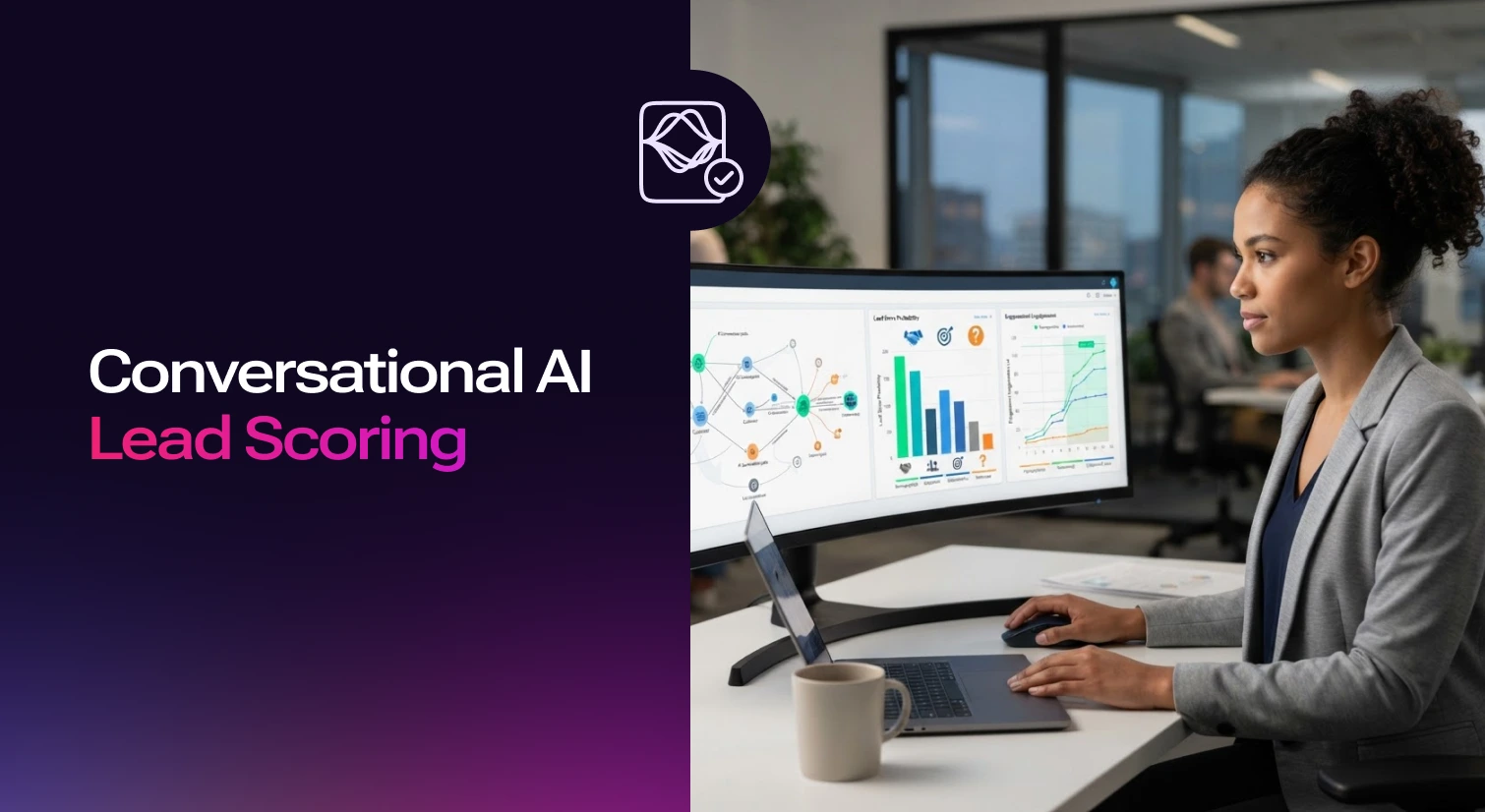
Deep learning models analyze user queries in real time. These systems classify leads and route high intent prospects to the appropriate sales teams. In SaaS and B2B environments, early stage conversations often determine whether a lead is qualified or not.
For instance, companies using conversational AI tools like Drift and Intercom have reported higher conversion rates and faster lead response times by engaging users instantly on websites. Instead of static forms, conversational systems guide users, ask qualifying questions, and pass structured data directly to sales teams.
Voice Assistants and Virtual Agents
Deep learning models convert spoken input into text, interpret intent, and generate responses that align with user requests. These systems are widely used as part of voice assistants and virtual agents in customer support, virtual shopping assistants, banking, and telecom.
For example, Google Assistant and Amazon Alexa answer user queries for millions of their users, relying on deep learning. Similarly, solutions like Murf’s conversational AI voice agents extend this capability to business use cases such as:
- Handling customer queries
- Supporting sales conversations
- Executing actions through voice commands
Healthcare and Patient Interaction
Healthcare interactions often involve unstructured input, where patients describe symptoms or request services in their own words.
Deep learning models process these inputs, identify intent, and extract relevant details such as symptoms, duration, or severity. A well known example is Babylon Health, which uses AI driven conversational systems to assess symptoms and guide patients toward appropriate care. Hospitals and healthcare providers also use similar systems to manage appointment bookings and patient queries at scale.
Internal Business Automation
Organizations use conversational AI to handle internal requests across HR, IT, and operations.
Deep learning models interpret employee queries submitted through internal systems, identify intent such as leave applications or technical issues, and trigger workflows like updating records or creating support tickets. For example, large enterprises deploy conversational AI to automate IT service requests. In such a scenario, employees can describe issues in natural language, and the system logs tickets, assigns priority, and routes them automatically.
Summing up
Deep learning has changed how conversational AI systems operate. It allows machines to understand human language, maintain context, and generate responses that align with user intent.
Modern conversational AI systems are no longer limited to answering questions. They can complete tasks, manage workflows, and handle complex interactions at scale.
For businesses, the shift is clear. Systems powered by deep learning deliver better accuracy, faster responses, and more consistent user experiences across channels.

Frequently Asked Questions
What are examples of deep learning in conversational AI?
.svg)
Conversational artificial intelligence examples include AI chatbots handling customer queries, voice assistants processing commands, and virtual agents managing workflows. These systems use deep learning models to understand language patterns, detect intent, and generate responses in real time with natural language understanding across chat and voice interfaces.
How does deep learning improve conversational AI?
Deep learning improves conversational AI technology by enabling better language understanding, context tracking, and response generation. It allows systems to handle complex queries, interpret variations in human language, and respond in a way that aligns with user intent and conversation context.
What models are used in deep learning conversational AI?
Common models include RNNs, LSTMs, transformer models, GPT models, and BERT. These models help conversational AI systems process language, understand context, and generate responses based on training data and patterns learned from large datasets.
What are the challenges of deep learning in conversational AI?
Challenges include the need for large training datasets, potential bias in artificial intelligence models, difficulty handling ambiguity in language, and maintaining accuracy across multiple languages and contexts. These factors require continuous monitoring and improvement for conversational AI agents to achieve customer satisfaction.
How is deep learning different from machine learning in conversational AI?
Machine learning relies on structured data and predefined features, while deep learning uses neural networks to learn patterns directly from large datasets. Deep learning is better suited for handling unstructured language and complex conversational interactions to achieve human-like conversations across functions like chatbots, virtual assistants, and other business processes that require natural language generation.

.webp)
.webp)


