Audiobook vs Reading: Pros, Cons, and Which You Should Choose


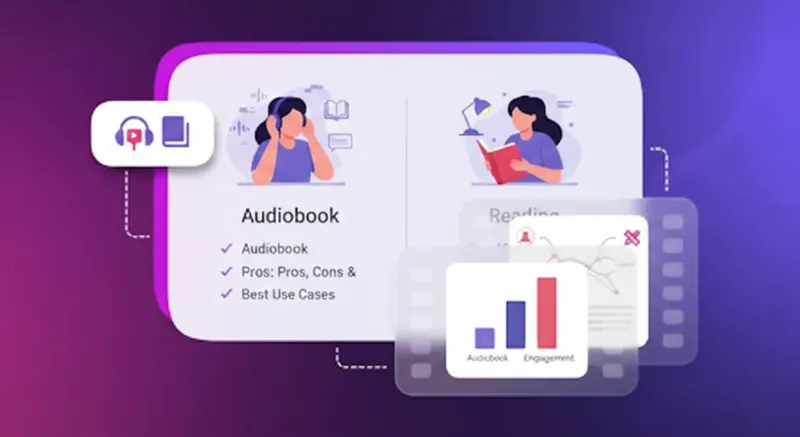

We all want to read more than we actually do. But time gets in the way. So does fatigue. That’s where the audiobooks vs. reading question usually starts.
Do you wait for quiet time that rarely shows up, or do you listen while driving, walking, or doing chores? While both options count, they feel very different in practice. Reading demands focus and stillness, but audiobooks fit into the flow of busy days.
For some, listening makes books accessible again. For others, nothing replaces turning pages and setting the pace yourself. This article looks at both formats without hype.
So, is listening to audiobooks actually the same as reading? Well, let's find out the answer in this read.
What Is an Audiobook?
An audiobook is a spoken version of a written text or book. Instead of reading text on a page or screen, you listen to the content through audio.
In most cases, the narration follows the original text closely and is read aloud by a professional narrator, the author, or sometimes a full cast. An example of this is Sandman by Neil Gaiman, which became a sensation in the audiobook industry over the last few years.
Here are a few key features of audiobooks:
- Audiobooks present the full text through spoken narration, allowing listeners to absorb the content without reading
- Most audiobooks are available in digital formats and can be streamed or downloaded through apps and online platforms
- They allow for hands-free listening, making them easy to use while driving, exercising, or doing household chores
- Many audiobooks are narrated by trained voice actors or authors, which can add tone, emotion, and clarity to the content
- Playback tools such as speed control, bookmarks, and sleep timers help listeners customize their experience
Audiobooks are designed for listening on phones, tablets, computers, or smart speakers. They are commonly used during commutes, workouts, or routine tasks when reading is not practical.
What Is Traditional Reading (Print/Digital)?
Traditional reading involves visually engaging with text, either in a printed book or on a digital screen. The reader processes words through sight, controls the pace, and actively interprets the material.
This format requires focused attention and usually happens in quiet, distraction-free moments. Here are a few key features that make traditional reading unique:
- Reading relies on visual decoding, where the brain processes written words and converts them into meaning
- It encourages active engagement, as readers set their own pace and decide when to pause or continue
- Printed and digital books make it easy to revisit specific passages for better understanding or reflection
- Readers can annotate the text by highlighting, underlining, or adding notes, which supports learning and recall
Reading allows for deeper interaction with the text. You can pause, reread difficult sections, skim ahead, or reflect without losing context. When reading, the reader is in control, whether you read physical books or ebooks.
Listening to Audiobooks vs. Reading Books: Key Differences
Audiobooks and reading deliver the same content, but the experience is different. How you consume a book affects focus, retention, flexibility, and even how much you enjoy it.
These differences matter when you are choosing a format that fits your routine, energy level, and learning style.
Below is a clear breakdown of how listening to audiobooks compares with reading books:
The Case for Listening to Audiobooks: Benefits and Strengths
Audiobooks fit how people live now. Long days, constant screens, and tight schedules leave little room to sit and read the old way. Audio books turn those gaps into usable time.
Commutes, chores, walks, or rest after hours of work become moments to consume the same book without adding more pressure to your day. That’s the biggest difference between the two media.
One asks for stillness, and the other moves with your life. There are trade-offs, but for many, audiobooks remove friction rather than add it.
1. Convenience and Multitasking: Listen On the Go
Reading needs dedicated time. However, listening to audiobooks does not. You can listen to an audiobook even when you are driving, cleaning, traveling, or walking.
You can fit listening to audiobooks into the time that would otherwise be wasted. Many people realized this only after trying an audiobook version of a good book they didn’t have time to finish.
Hence, for those who prefer convenience, audiobooks are the best option.
2. Accessibility and Inclusivity: For Visual Impairments or Reading Challenges
Audiobooks matter for listeners who struggle with vision, focus, or traditional reading. Students, kids, and adults with reading challenges gain access to stories without barriers.
In school, middle school, or a college course, audiobooks can support reading assignments when print becomes a hurdle.
Research, including work by Beth Rogowsky at Bloomsburg University, shows that many students can grasp content just as well through listening.
3. Emotional and Performative Value: Narration, Voice Acting, Tone
A skilled narrator's voice adds emotion that print can’t always convey. Tone, pacing, and pauses shape the narrative, making characters feel more alive.
For fiction, this can feel closer to a movie than old-fashioned reading. We know that stories were spoken long before they were written. That context is absolutely relevant today.
People who love audio immersion while reading find audiobooks vital for the full reading experience.
4. Eye-Friendly: Reduce Screen or Page Strain
After a full day staring at screens, opening an e-reader is not always appealing. Audiobooks give your eyes a break, especially as screen fatigue increases at every age. You don’t miss out on the idea of reading just because your eyes need rest.
5. Flexibility and Time Efficiency: Fit Into Busy Schedules
People are always busy today. And audiobooks work around modern schedules, book club goals, and daily demands.
Whether you have spent years trying to read more or want to stay connected to the world of books, audiobooks make it interesting and practical.
For how people learn today, that flexibility is hard to ignore.
The Case for Traditional Reading: Why Many Prefer Text or Printed Books
For readers who want depth and control, text still wins. Across the two media, traditional reading offers fewer trade-offs when focus, retention, and close analysis matter, especially when time constraints aren’t the main pressure.
Here are a few benefits that make traditional reading still popular among readers:
1. Better Comprehension and Memory For Some Reading Contexts
Reading text matter often leads to stronger recall for complex material. Students can understand dense nonfiction better when they engage in visual reading and see what they read, says Sunah Chung from the University of Northern Iowa, USA.
With the same book, readers can slow down and absorb the author's words more carefully, unlike with audiobooks.
2. Focus Deep Engagement: Lower Distractions, More Attention
Unlike listening, where a narrator's voice competes with other things, reading demands attention. That active focus reduces drift and helps readers stay grounded in the material, even during longer sessions.
This is especially true in reading academic books, where grasping content is more important than immersion or emotional resonance.
3. Active Interaction with Text: Note-Taking, Highlighting, Reflection
Printed books and an e-reader allow highlighting, margin notes, and easy cross-referencing. This interaction supports reflection, especially for learning-heavy stories or analysis-driven reading.
You may not need this ability while reading books as a hobby. However, when you read books for academic purposes, all this becomes vital. You can take notes, mark pages, and come back to it later, which is not true of audiobooks.
4. Control Over Reading Speed and Pace: Tailor to Your Mood and Understanding
Everyone has their own rhythm and pace for reading books. Some read faster while others take time. And you can adjust your pace based on what you want.
Text lets you skim, pause, or reread instantly. That level of control doesn’t exist in audio, even with changes to playback speed.
Whether you have physical books or ebooks, you are always in control of your reading.
5. Tactile and Psychological Satisfaction: The Experience of “Holding A Book”
Many still value old-fashioned reading. They love the physical act of holding a book. For kids and adults alike, it reinforces attention and reading habits in a way audio doesn’t.
Many young readers, despite growing up in a tech-driven world, love the idea of holding books to read.
The physical experience of being one with the book and its proximity is something audiobooks can never replicate.
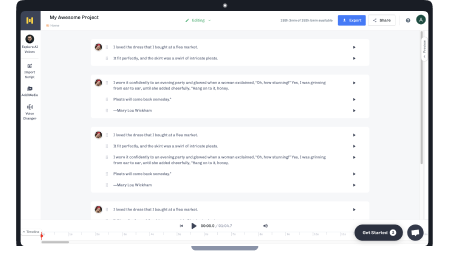
Expanding Audiobooks with Murf AI Translation
Audiobooks are no doubt among the best ways to reach a wider, younger audience that wants to consume books and literary works. While translating and printing regular books have been the go-to option for many publishers and authors to reach new audiences from different parts of the world, audiobooks make it even easier with AI translation platforms.
For example, Murf AI offers a reliable, advanced platform for translating your audiobooks into diverse languages and reaching new audiences. And the best part is that it is easier and more affordable to do than translating and printing books.
Apart from AI-enabled translation, Murf AI offers a variety of benefits to businesses, such as:
- Text-to-speech: Convert text, ePubs, scripts, books, documents, and articles into human-like speech online without losing quality
- AI video and audio dubbing: Voice Dub your video and audio files instantly using Murf AI into 40+ languages for any projects
- AI voice cloning: Clone your voice for your audiobook projects to use your own voice in multiple languages when translating audiobooks
- Voice changer: Change your voice when translating your audiobooks or content, instead of using your own voice, to protect your identity
- Voice APIs: Use APIs to integrate Murf AI into your workflows or internal IT ecosystems, like Adobe Audio or Canva, to translate and turn text to speech quickly
- Audio & Video Translator: Translate video and audio files into 40+ languages with accurate voice output, preserving tone, timing, and context for global audiences.
Try Murf AI for free and explore the platform to see if it meets your expectations and takes you one step closer to audiobook translation and localization.

Frequently Asked Questions
Are audiobooks as good as reading physical books?
.svg)
Yes, audiobooks are as good as reading physical books. While the experience may differ, the outcome of reading physical or e-books and listening to audiobooks remains the same. At the same time, there are readers with individual preferences for audiobooks over physical books and vice versa.
Does listening to an audiobook count as reading books?
Yes, in a sense, it does. The knowledge that one may get from reading a book and listening to an audiobook remains the same. The differences are due to individual preferences and not the books or audiobooks.
Which is better for learning—reading books or listening to an audiobook?
While both reading books and listening to audiobooks can help learning, it really depends on what the reader wants personally. If the reader is busy and travels a lot, audiobooks are the best way to learn because they can listen to them while commuting without being disturbed. On the other hand, if the reader wants to highlight sections and want to take notes, physical books are better.
Can audiobooks improve vocabulary, comprehension, or writing skills?
Yes, audiobooks can help improve vocabulary, comprehension, and writing skills. In fact, if the reader wants to improve their English-speaking skills, audiobooks are a great way to become familiar with how words and sentences are spoken correctly.