Text to Speech for Animator: How to make Mickey Talk?



Key Takeaways
- Mickey AI voice brings charm to kid-focused content, making audiobooks, videos, and games feel fun, friendly, and relatable for young viewers.
- Animations without audio make viewers work too hard whereas a good voiceover lets them sit back and actually absorb the story.
- TTS in animation is exploding, with AI in the animation industry expected to hit $17.7 billion by 2032.
- Speed matters: TTS lets animators create polished narration in minutes instead of hunting down studios and voice actors for weeks.
- Flexibility is a big win. You can assign unique voices, tones, and emotions to every character without blowing the budget.
- Localization is no longer a luxury; TTS makes it simple to create versions in various languages so global viewers aren’t left out.
- Murf gives creators production-ready voiceovers and direct timeline syncing in the same tool, keeping workflows tight and creative.
- With Murf Falcon, voiceovers scale even further with real-time performance, massive concurrency, and the freedom to build interactive voice experiences.
According to a report by Enterprise Apps Today, the use of generative AI in the animation market, which includes text to speech technology, is projected to reach an impressive USD 17.7 billion by 2032.
But why use this technology in animated videos?
Because an animated video can look stunning, packed with smooth motion, expressive characters, and educational text on screen.
But when viewers have to read every detail to follow the story, their attention gets split. The images and videos lose impact, and the message doesn’t land as strongly as it should.
Add a voiceover, however, and everything changes.
Clear, expressive narration guides the viewer, highlights key moments, and builds emotion. Instead of processing text, the audience can stay immersed in the animation and absorb information naturally. This is where text to speech animation steps up.
More creators now use AI-powered text to speech technology to produce voiceovers quickly, in multiple languages and many voices. It’s efficient, scalable, and helps animated content feel more professional. After all, these voiceovers help bring animation to life, making it more engaging and immersive.
In this article, we’ll explore how voiceovers produced using text to speech AI can elevate animations and how Murf plays a helpful role in this.
Why Use Text to Speech in Animation
By seamlessly converting scripts into lifelike sounds, TTS for animators opens doors to a multitude of creative possibilities, from enriching character depth to expediting production timelines.
Saving Time and Effort
Recording voiceovers the old-school way means scheduling voice actors, fixing retakes, waiting on audio engineers, and hoping nobody catches a cold halfway through production. It’s slow. TTS lets animators convert text into clean voiceover in minutes, keeping the focus on creativity instead of logistics.
Variety and Flexibility
Need a bold hero, a nervous sidekick, and a bored narrator who sounds done with everyone’s nonsense? AI has your back. TTS tools offer a huge range of tones, styles, and accents. You can experiment freely, give characters distinct personalities, and fine-tune delivery without a single recording session.
Localization for Global Reach
Animated content travels. With text to speech technology, you can instantly generate narration in various languages and share the same message across different social media platforms. Just swap the language and keep the animation rolling.
Consistent, Studio-Quality Output
Every line sounds clean, clear, and consistent. No background echo, no mic issues, no dog barking in the middle of a crucial scene. High-quality sound helps keep viewers engaged from the first frame to the final video.
Better Accessibility
Voiceovers help visually-impaired users enjoy animations fully and make learning materials more inclusive. These tools are part of creating for a world where everyone belongs.
How Mickey AI Voice Influences Content
Mickey’s voice has that playful, friendly vibe that kids instantly warm up to. That’s why creators love using it for anything meant to teach, entertain, or just make little humans giggle while they learn.
Here are a few areas where Mickey’s voice can make a real difference:
- Children’s Audiobooks: Keeps kids listening instead of wandering off halfway through the story.
- Educational Videos: Makes learning feel like a game, not homework.
- Advertisements: Makes kid-friendly ads sound fun instead of pushy.
- Children’s Games: Explains the rules without making kids rage-quit.
- Kids’ Podcasts: Chats about topics pre-teens actually care about, in a voice they trust.
- Voice Assistants for Kids: Helps out with chores or questions without sounding like a robot overlord.
- Interactive Toys: Turns toys into little buddies that talk back and guide playtime.
- Story Apps: Adds imagination to storytime when parents need a tiny break.
- YouTube Kids Channels: Reads stories, shares facts, and keeps young viewers glued to the screen.
All in all, the goal is to keep young minds excited, this voice doesn’t just narrate, but connects. And that exactly what distinguishes a mediocre voiceover in animation from a great one!
Murf Text to Speech for Animator: A Game Changing TTS Tool

Animators move fast. And deadlines move faster. That’s where Murf steps in.
Murf’s voice library comes with range. Need a calm, reassuring guide for an e-learning video? Voices like Iris or Theo fit the vibe. Creating something goofy or high-energy? Julie or Ken can dial up the fun without missing a beat. Working on a serious documentary? Miles, Ruby, or Terrell bring the kind of authority that makes viewers lean in.
And when your narration is ready, syncing it with your animation doesn’t require a whole separate workflow. Upload the video, adjust timing right on the timeline, and you’re done. No extra tools, no technical gymnastics. Just a smoother pipeline that keeps you focused on storytelling instead of troubleshooting.
Murf also makes it easy to take your animation global. With support for 35 languages, you can localize content for wider audiences without hunting down multilingual talent or booking more sessions.
For projects that go beyond simple videos, like voice agents, interactive experiences, or scalable multi-user voice delivery, Murf Falcon is a serious game-changer.
- Delivers AI voice in about 130 ms to first audio, with model latency around 55 ms
- Handles up to 10,000 concurrent calls while keeping latency stable, at a rate roughly 1 cent per minute of audio
- Offers over 200 voice options across 35+ languages, with smooth switching between languages even mid-sentence
- Creates conversational prosody with clear pronunciations (99.38% accuracy)
- REST APIs, SDKs for major languages, and compatibility with platforms like Twilio, Discord, or custom agents
So whether you’re producing a polished animated short, an interactive storytelling app, or a multilingual voice agent, Murf gives you creative control, speed, scalability, and quality all in one. Try Murf today!
Creating Voiceovers with Murf: A Step-by-Step Guide
Generating voice overs for your animated videos doesn’t have to be a daunting task. With Murf, you can seamlessly convert text into speech for any type of animation:
Step 1: Upload Your Script
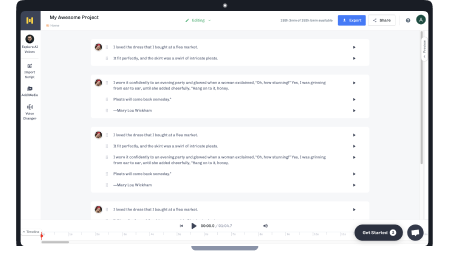
Prepare a script that effectively communicates your core message or tells the story. Enter or copy-paste the script to Murf’s text editor. You can also upload the script and divide it by sentence or paragraph

Step 2: Choose the Right Voice
Choose the AI voice. For instance, if it is an anime, you can opt for a calm, narrative voice, like Gabriel. At the same time, a DIY craft tutorial could benefit from a playful, young adult tone, such as Iris.

Step 3: Customize the Voice
Want to emphasize a crucial point in your explainer video? Add emphasis to specific words. Creating a dramatic scene in an animation? Insert a pause for added effect. With Murf, the possibilities are vast and versatile.

Step 4: Add your Animated Video
Add images or upload your existing animated videos and synchronize it with the voiceover. Once aligned, simply click the play button to render your voiceover-enhanced video.

Step 5: Review and Edit
As the next step, review your voiceover and make any necessary edits. With Murf, you can easily tweak your voiceover until it’s right.

Step 6: Export and Download
Once satisfied with your outcome, you can export and download the final video in the format of your choice!

Still not sure of the steps: Take a look at the following video in the AI Voice of our very own Ruby
Conclusion
In animation, the visuals might grab attention first, but it’s the voiceover that gives the story its heartbeat. And that’s exactly where Murf fits in. Instead of stale, robotic narration, Murf gives animators access to expressive AI voices that feel like real characters.
Its advanced technology helps you shape personality, emotion, and timing all the little things that make an animated scene actually connect with the audience.
With this free text to speech tool to start off, and you’ll be amazed at how much it can elevate your animation projects. Your audience will thank you, and your creativity will soar. Start your free trial now!
Frequently Asked Questions
Can text to speech software provide diverse and realistic voice options for animated characters?
.svg)
Absolutely! Free text to speech software like Murf offers a wide range of AI voices, allowing animators to give each character a unique voice that resonates with the audience.
How can text to speech software ensure audio consistency and quality in animations?
Text to speech software can maintain the same tone, pitch, and pace throughout the voiceover, ensuring audio consistency. As for quality, these software can produce clear, crisp audio without any unwanted background noise, enhancing the viewer’s experience.
Is it possible to create unique character voices using text to speech software?
Yes, it is. Text to speech software like Murf allows animators to customize the voice to suit a character’s personality and the scene’s context. You can adjust the pitch, tone, and speed and add pauses or emphasis. This level of customization enables the creation of unique character, different voices that can bring your animations to life.